
Root weevil
Barypeithes
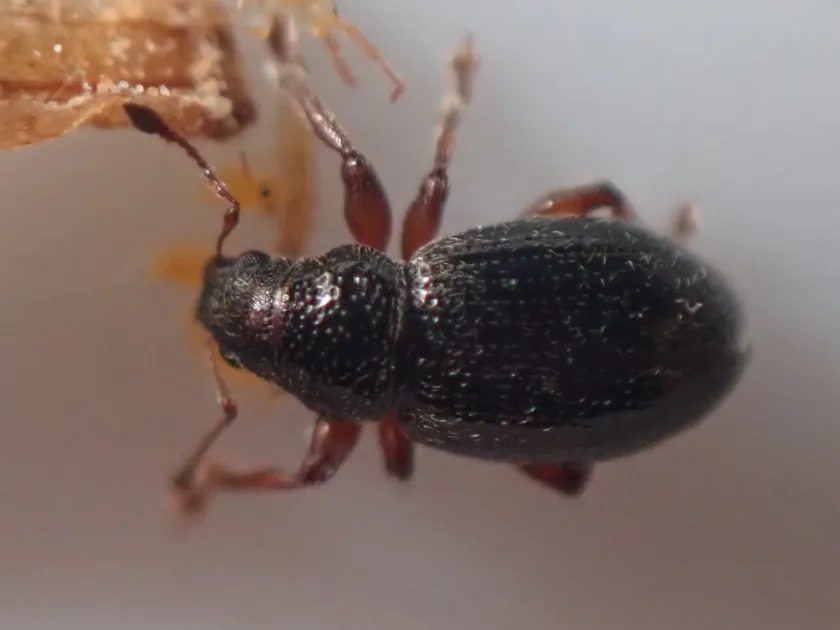
Description
How to identify
The genus Barypeithes belongs to the family Curculionidae, commonly known as root weevils. These are small beetles, typically ranging from 3 to 5 mm in length, characterized by a distinct snout-like rostrum.
Their coloration is usually dark brown or black, sometimes featuring a slight metallic sheen or fine hairs on the elytra. The larvae are typical of the weevil family: legless, C-shaped, and creamy-white in color with a distinctive brown head capsule.
Adult weevils are strictly nocturnal, which makes them very difficult to observe during daylight hours. They spend their days hidden in the soil, under plant debris, or at the base of the stem.
The life cycle includes complete metamorphosis: egg, larva, pupa, and adult. Depending on the species, they may overwinter as adults or larvae in the soil, emerging when temperatures become favorable in spring.
Accurate identification is crucial for effective management. Field scouts should use nocturnal monitoring, such as light traps or cloth beating, to detect the presence of adults in the canopy.
What it damages
Root weevils of the genus Barypeithes are polyphagous pests, feeding on a wide range of agricultural crops and wild vegetation. Both adults and larvae cause significant damage.
The most economically significant damage occurs in berry crops like strawberries, as well as in young vineyards and fruit tree nurseries, where the root systems are particularly vulnerable.
Larvae develop in the soil, feeding on roots and root hairs. This feeding reduces the plant's capacity to absorb nutrients and water, often leading to stunted growth, leaf chlorosis, and eventual plant death.
Adult beetles feed on leaves, creating characteristic notches or "ragging" along the leaf margins. While rarely fatal on their own, heavy defoliation can significantly weaken young plants and reduce yields.
In high-pressure infestations, larvae can consume the entire root cortex of young seedlings, leading to total crop failure and the need for immediate replanting.
When it appears
Adult activity typically begins in the spring as soil temperatures rise, prompting the emergence of beetles from their overwintering sites in the soil.
The primary feeding period for adults occurs from late spring through mid-summer. This period coincides with the most active vegetative growth phase of many target crops.
Females deposit eggs in the soil near the base of host plants. The larvae hatch and immediately burrow into the soil to begin feeding on roots throughout the summer months.
As autumn approaches, larvae tend to move deeper into the soil profile to find suitable conditions for overwintering, though some species may complete their development into adults before the first frost.
Environmental factors such as high soil moisture and moderate temperatures are ideal for larval development, often leading to population surges that require early intervention.
Signs of infestation
The most recognizable sign of an infestation is the presence of serrated or notched leaf margins, caused by adult feeding. These notches are distinct from the circular holes made by other leaf-feeding insects.
Sudden wilting of plants in hot weather, despite adequate irrigation, is a strong indicator of root damage caused by larvae. Affected plants may show uneven development and poor vigor.
Nocturnal visual inspections are the most reliable method for detecting adult weevils. Using a flashlight after dark allows for the direct observation of beetles feeding on foliage.
Soil examination around the base of affected plants can reveal larvae. Digging a small pit (up to 15 cm deep) near the root zone often exposes the white, C-shaped larvae.
The emergence of bare patches in fields or orchards, accompanied by the gradual decline of previously healthy plants, serves as a warning sign that the root system is under siege.
Control measures
Managing Barypeithes requires an integrated approach that combines cultural, biological, and chemical control strategies to keep populations below the economic threshold.
- Implement crop rotation to disrupt the life cycle of the pest.
- Perform mechanical soil cultivation to expose and kill larvae and pupae.
- Use certified, pest-free plant material in nurseries.
- Apply contact or systemic insecticides during the peak nocturnal activity of adults.
- Use entomopathogenic nematodes (such as Heterorhabditis spp.) as a biological control for soil-dwelling larvae.
When using chemical insecticides, treatments must be applied during the evening to coincide with the beetles' nocturnal feeding habits, ensuring maximal exposure to the product.
Biological control using beneficial nematodes is highly effective, provided soil moisture is maintained, making it an excellent choice for integrated pest management programs in sensitive berry crops.
Taxonomy
- Latin name
- Barypeithes
- Order
- Coleoptera (beetles)
- Family
- Curculionidae
- EPPO code
- BARPSP
Discussion
No discussions yet — be the first.