
Barynotus obscurus
Barynotus obscurus
Description
How to identify
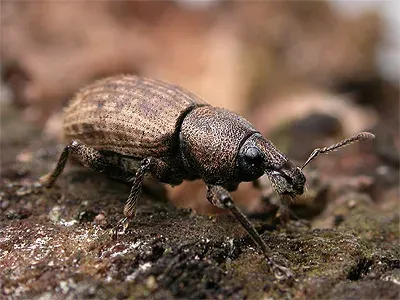
Barynotus obscurus is a species of weevil belonging to the family Curculionidae. These beetles typically measure between 6 and 8 mm in length, possessing a dark brown to black body covered in fine, dense scales that give them a matt appearance.
A key identifying feature of this species is that the adults are flightless, as their elytra are fused together. This physical limitation means they do not disperse rapidly through flight but often spread through the movement of infested soil or nursery stock.
The larvae are typical of the weevil family: they are legless, C-shaped, and creamy-white in color with a distinctive brown head. They live exclusively within the soil profile, where they spend their entire development feeding on plant roots.
The lifecycle of this beetle is heavily influenced by soil moisture levels. They are most commonly found in habitats with moist, heavy soils, which provide the ideal microclimate for the development of both the larvae and the adults.
Taxonomically, this beetle is classified under the order Coleoptera, family Curculionidae, and genus Barynotus. It is recognized as a polyphagous pest, meaning it can feed on a wide variety of plant species, causing economic damage.
What it damages
The damage caused by Barynotus obscurus occurs in two distinct stages: adult feeding on foliage and larval feeding on roots. Adults create characteristic irregular, scalloped notches along the leaf margins, which is a classic symptom of weevil activity.
The larval stage is significantly more destructive. By feeding on and tunneling through the roots and rhizomes, they disrupt the plant's ability to take up water and nutrients, eventually leading to stunted growth, yellowing, and plant death.
Primary host plants include strawberries, raspberries, and a range of perennial ornamental plants. When population densities are high, the larvae can virtually destroy the entire root system of a crop, making the infestation particularly devastating.
Root damage also predisposes plants to secondary infections by soil-borne pathogens, including various species of fungi and bacteria. These infections often finish off the plants that were already weakened by the insect's feeding activity.
In strawberry production, large infestations often appear as circular dead patches in the field. These patches expand over time, necessitating the complete removal of the plants and intensive soil treatment before replanting can occur.
When it appears
Adult activity begins in the spring, typically when soil temperatures rise to support insect metabolism. By May, adults emerge and begin their nocturnal feeding and mating cycles.
During the summer months, the beetles are nocturnal, hiding during the daylight hours in the soil or under debris. This behavior makes it difficult to detect them during routine field inspections conducted during the day.
Larval development occurs throughout the growing season. Depending on the soil conditions and temperature, larvae can be active from late spring through to autumn, continuously feeding on the root zone of susceptible plants.
Both adults and larvae can overwinter in the soil at various depths. This adaptation allows the population to persist from one year to the next, even in temperate climates with cold winter seasons.
The peak risk period for agricultural crops occurs during the late spring and early summer when larval activity coincides with the plant's peak vegetative and reproductive growth phases.
Signs of infestation
The most visible sign of an adult Barynotus obscurus presence is the characteristic scalloped feeding damage on leaf edges. The leaves appear to have been bitten by small scissors, while the main leaf veins are often left intact.
Wilting of plants during the hottest part of the day, even with sufficient irrigation, is a strong indicator of larval root damage. If such a plant can be easily pulled from the ground with little resistance, the root system has likely been destroyed.
Adult beetles can be detected by using a flashlight during night-time inspections. They move relatively slowly on the leaves and are easily captured by hand once they have been spotted.
The presence of larvae can be confirmed by digging around the root zone of wilted plants to a depth of 5–15 cm. The C-shaped, creamy-white larvae are usually found near the root crown.
Proximity to unmanaged fields or weed-heavy areas containing Rosaceae or Fabaceae plants often increases the risk of colonization, as these plants serve as alternative hosts for the weevil.
Control measures
Cultural control, such as crop rotation, is essential. Avoiding planting susceptible crops on the same site for at least 4-5 years helps to break the lifecycle of the pest and reduces the population of larvae in the soil.
Good field hygiene, including regular weeding and the removal of plant debris, is highly effective in reducing the number of hiding spots available to the adults during the day.
Manual collection of adults at night can significantly reduce the potential for egg-laying. This is a practical and effective method for small garden plots or organic production systems where chemical control is restricted.
Chemical control involving soil insecticides may be necessary in cases of severe infestation. These treatments must be applied according to local regulations, often as a soil drench or incorporated into the soil during planting.
Biological control using entomopathogenic nematodes (such as Heterorhabditis spp.) is highly effective. When applied to moist soil, these nematodes actively seek out and infect the larvae, providing an eco-friendly alternative to traditional chemicals.
Taxonomy
- Latin name
- Barynotus obscurus
- Order
- Coleoptera (beetles)
- Family
- Curculionidae
- EPPO code
- BARYOB
Discussion
No discussions yet — be the first.