
Barynotus
Barynotus
Description
How to identify
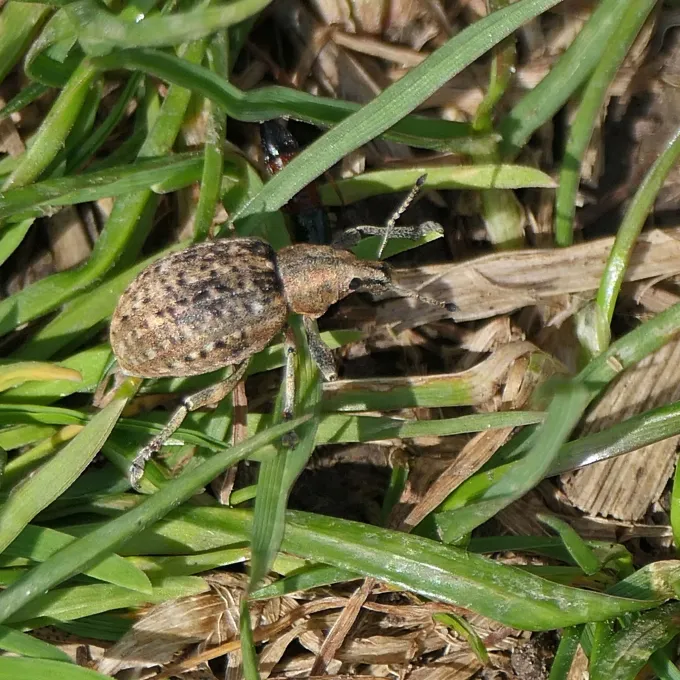
Barynotus is a genus of broad-nosed weevils within the Curculionidae family. These beetles are generally medium-sized, measuring between 5 to 10 mm in length with a robust, elongated body.
Their bodies are typically covered in dense scales, which give them earthy tones—ranging from brown to grey—providing excellent camouflage in soil or dense vegetation.
A key biological characteristic of this genus is that most species are flightless, meaning they rely on walking for dispersal, which limits their rapid migration across agricultural landscapes.
The larvae are typical of the weevil family: legless, cream-colored, and curved in a C-shape, with a distinctive brown or black head capsule adapted for feeding on roots.
Common species such as Barynotus obscurus are recognized in European agronomy as notable pests of perennial crops and certain vegetables.
What it damages
Adult Barynotus weevils are generalist feeders that cause significant damage by grazing on the leaves of a variety of agricultural and horticultural plants.
The adults are known for feeding on leaf margins, leaving characteristic notches that reduce the photosynthetic capacity of the plant, which is critical during the seedling stage.
The larvae are the most destructive stage, living underground where they feed on the roots, often causing the plant to wither, lose vigor, and eventually die due to nutrient transport disruption.
Perennial forage crops like clover or alfalfa are particularly susceptible, as established larval populations can destroy the root systems over multiple seasons.
Root damage also leaves plants susceptible to secondary soil-borne pathogens, as the lesions created by larval feeding provide entry points for bacteria and fungi.
When it appears
Adult activity generally commences in early spring as temperatures rise, signaling the emergence of overwintering populations from the soil.
Throughout the late spring and summer, adults are most active, focusing on feeding and egg-laying in the soil near the root zones of host plants.
The larval stage is prolonged, spanning through the summer and autumn months as they feed aggressively on root tissues below the soil surface.
Overwintering typically occurs as either larvae in the soil or adults in sheltered areas, depending on the specific species and local climate conditions.
Environmental factors such as high soil moisture and mild winter temperatures tend to favor the survival and subsequent development of the larvae.
Signs of infestation
The most visible sign of an adult Barynotus infestation is the presence of irregular, semi-circular notches along the edges of leaves, known as "notching."
If you suspect an infestation, you can often find the beetles by inspecting the base of plants or the soil surface during dusk or dawn, as they are nocturnal or crepuscular.
Evidence of larval presence often manifests as patches of stunted or wilting plants that fail to thrive compared to the rest of the field.
When pulling an affected plant, you may notice that the root system is truncated, malformed, or entirely missing due to the larval feeding process.
- Characteristic leaf edge notching
- Patchy, stunted plant growth
- Presence of C-shaped larvae near roots
- General plant decline and wilting
Control measures
Crop rotation is one of the most effective cultural control methods, as it breaks the life cycle of the weevils by denying them consistent access to host plants.
Deep autumn cultivation helps expose larvae and pupae to surface conditions, drastically increasing mortality rates through desiccation or predation.
In cases of economic threshold violation, foliar insecticide applications targeted at adults during their peak activity period can reduce the population for the next season.
Soil-applied systemic insecticides at the time of planting can provide a protective barrier for young roots, preventing early-stage larval damage.
Biological alternatives, including the use of entomopathogenic nematodes or fungi, have shown promise in controlling soil-dwelling larvae without the need for synthetic chemicals.
Taxonomy
- Latin name
- Barynotus
- Order
- Coleoptera (beetles)
- Family
- Curculionidae
- EPPO code
- BARYSP
Discussion
No discussions yet — be the first.