
Mint weevil
Baris menthae
Description
How to identify
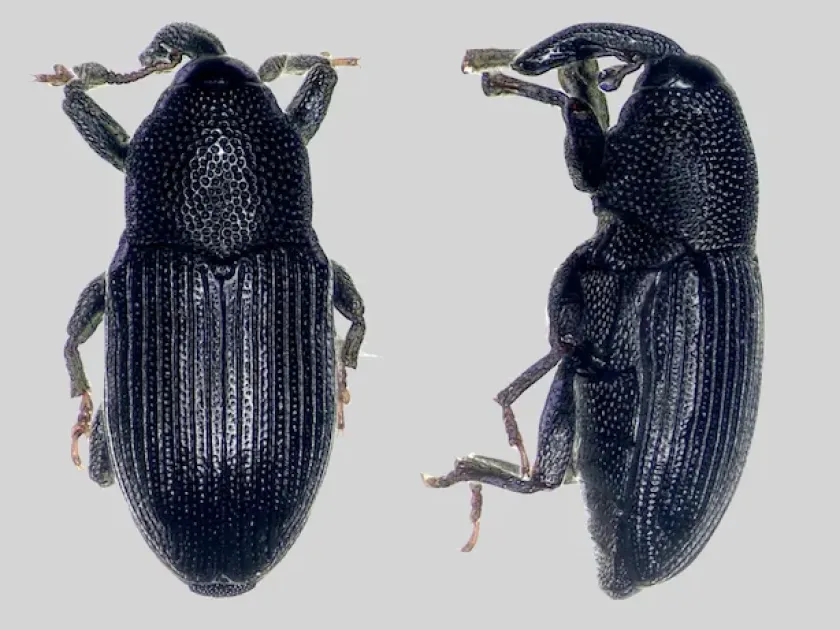
The mint weevil (Baris menthae) belongs to the order Coleoptera and the family Curculionidae. These are small beetles, typically measuring between 3 and 4 mm in length.
The adult insect has a shiny black body with a dense, punctured appearance. Like other weevils, it features a distinct snout or rostrum used for feeding and laying eggs.
The larvae are legless, white to cream-colored, and curved in a C-shape, which is characteristic of the weevil family and adapted for living inside plant tissues.
This species is highly specialized for mint cultivation, meaning its life cycle is synchronized with the growth phases of the plant, making it a persistent pest.
Identification is often based on the observation of adults on leaves in the spring, as the larvae remain hidden inside the plant stems throughout their development.
What it damages
The primary hosts for this weevil are plants within the Mentha genus. Both adults and larvae contribute to the overall damage of the crops.
Adult beetles feed on the leaves and young shoots, causing visible holes and minor tissue destruction, which reduces the plant's overall vitality and photosynthetic capacity.
Larvae are significantly more destructive because they bore into the stems and rhizomes, feeding on internal tissues and causing systemic damage to the plant structure.
Infected plants show signs of stunted growth and, in severe cases, the stems may wither and collapse due to the destruction of internal transport tissues.
Economic damage is substantial, as the pest reduces both the total green biomass yield and the concentration of essential oils in the harvested mint crop.
When it appears
Adult weevils emerge from hibernation in late spring, appearing on mint fields as temperatures rise and the plants start their initial vegetative growth phase.
Following emergence, the mating period occurs, and females deposit eggs into the tissue of young stems, initiating the next generation of the pest.
The larval stage develops internally over several weeks throughout the summer, making them well-protected from environmental factors and surface-applied treatments.
Pupation typically takes place within the soil, where the larvae move after completing their internal feeding stage, remaining there until transformation.
By autumn, the new generation of adult beetles moves into the soil or under plant debris to enter diapause, overwintering to restart the cycle in spring.
Signs of infestation
Early symptoms include small, regular holes in the foliage, which are created by adult weevils feeding during the early spring growth period.
Darkened spots or slight scarring on the stem surface often indicate the precise locations where eggs were laid or where larvae entered the tissue.
Patches of chlorotic or stunted plants within an otherwise healthy field are often a sign of deep internal damage to the root system or main stem.
Premature wilting of individual stems, despite adequate soil moisture, suggests that the larvae have severely compromised the plant's vascular integrity.
Visible boreholes or tunnels filled with brownish larval waste inside the stems of declining plants provide confirmation of a Baris menthae infestation.
Control measures
The most effective strategy is a robust crop rotation plan, ensuring that mint is not grown on the same plot for more than three consecutive years.
Deep plowing in autumn helps destroy overwintering populations by exposing them to harsh weather conditions and mechanical damage from soil tillage.
- Proper sanitation through the removal and disposal of all crop residues after harvest.
- Selection of clean, pest-free planting stock for new fields.
- Regular field scouting in spring to detect the first sign of adult activity.
- Use of biological controls or specialized microbial products to target developing stages.
- Judicious use of insecticides, adhering to safety intervals for medicinal and essential oil crops.
Integrated Pest Management (IPM) is recommended, combining cultural practices with precision monitoring to minimize the need for heavy chemical applications.
Taxonomy
- Latin name
- Baris menthae
- Order
- Coleoptera (beetles)
- Family
- Curculionidae
- EPPO code
- BARIME
Discussion
No discussions yet — be the first.