
Spruce cone moth
Barbara osmana
Description
How to identify
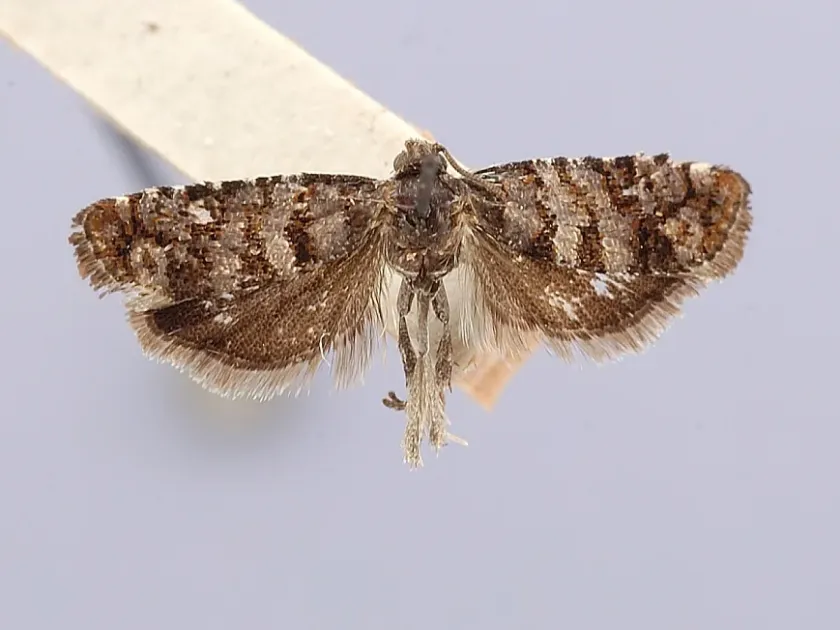
The spruce cone moth (Barbara osmana) is a member of the Tortricidae family within the Lepidoptera order. The adult moth has a wingspan of approximately 12–15 mm and features brownish-gray patterned wings, providing effective camouflage against spruce bark.
The larva is the primary destructive stage of this pest. Fully grown larvae reach 10–12 mm in length and are distinguished by a pale yellowish to reddish body with a conspicuous dark head capsule, which helps in field identification.
Systematically, Barbara osmana is closely linked to the reproductive cycle of the Norway spruce (Picea abies). The insect undergoes complete metamorphosis, including egg, larva, pupa, and adult stages, each adapted to the phenology of its host tree.
Understanding the life strategy of this moth is crucial for forest managers. The species is highly specialized, concentrating its life cycle entirely around the development of spruce cones, making it a significant challenge for seed production areas.
Adults are nocturnal and typically elusive. Their presence is often identified not by sightings of the moths themselves, but by the secondary effects of their larval activity on the host tree's cone crop.
What it damages
The spruce cone moth is a major pest for Norway spruce plantations. The larvae feed exclusively on the reproductive structures of the tree, focusing on the developing seeds inside the cones.
By boring into the central axis and the cone scales, larvae destroy the seed supply. This feeding activity disrupts the flow of nutrients to the cone, causing it to stop growing, deform, or wither prematurely.
In outbreak years, this pest can cause severe economic losses, sometimes destroying the majority of the cone harvest in a given stand. This significantly reduces the availability of high-quality seeds for forest regeneration.
Besides direct consumption of seeds, the damaged cones are often rendered unviable for seed extraction. The physical damage caused by the larvae weakens the structural integrity of the cone.
Furthermore, the galleries created by the larvae provide easy entry points for fungal pathogens, which can exacerbate the degradation of the cones and further reduce the seed yield and germination rate.
When it appears
The flight period for adult moths occurs in late spring, generally between May and June, coinciding with the flowering phase of spruce trees when young cones are actively forming.
Females lay eggs singly or in small clusters on the surfaces of young cones. The timing of egg-laying is critical for the survival of the offspring, as larvae need fresh cone tissue immediately upon hatching.
Larval development takes place throughout the summer. The larvae remain inside the cone for most of their development, consuming the seeds and inner tissue while being protected from environmental factors.
By late summer or early autumn, the larvae reach maturity and exit the cones to pupate. They typically seek shelter in the bark crevices of the tree or within the forest litter layer for overwintering.
The species has a univoltine life cycle, meaning it completes one generation per year. The overwintering pupal stage is a period of dormancy, with adults emerging only when the spring temperatures trigger the next cycle.
Signs of infestation
The most reliable sign of an infestation is the presence of resin flow on the exterior of the cone. This is the tree's natural defense reaction to the mechanical injury caused by the larvae.
- Presence of small circular exit or entry holes on the cone surface.
- Accumulation of brownish, sawdust-like frass (boring dust) around the cone or on nearby branches.
- Premature yellowing or browning of young cones.
- Visible deformation or stunted, asymmetric growth of the cone.
- Early drop of infested cones from the tree branches.
Control measures
Effective control measures rely on integrated pest management (IPM) strategies. Chemical insecticides are most effective when applied during the peak moth flight or early larval hatching period.
Cultural control includes the collection and destruction of infested fallen cones to reduce the pest population density for the following season.
Pheromone traps are extensively used for monitoring purposes to determine the precise timing for intervention and to assess the scale of the population density in seed orchards.
Biological control, including the application of Bacillus thuringiensis, offers an environmentally friendly alternative to chemical pesticides, particularly in managed forest stands.
Long-term silvicultural practices, such as maintaining healthy tree vigor and strategic stand management, remain the best defense against major outbreaks of Barbara osmana.
Taxonomy
- Latin name
- Barbara osmana
- Order
- Lepidoptera (butterflies)
- Family
- Tortricidae
- EPPO code
- BARBOS
Discussion
No discussions yet — be the first.