
Fir cone moth
Barbara herrichiana
Description
How to identify
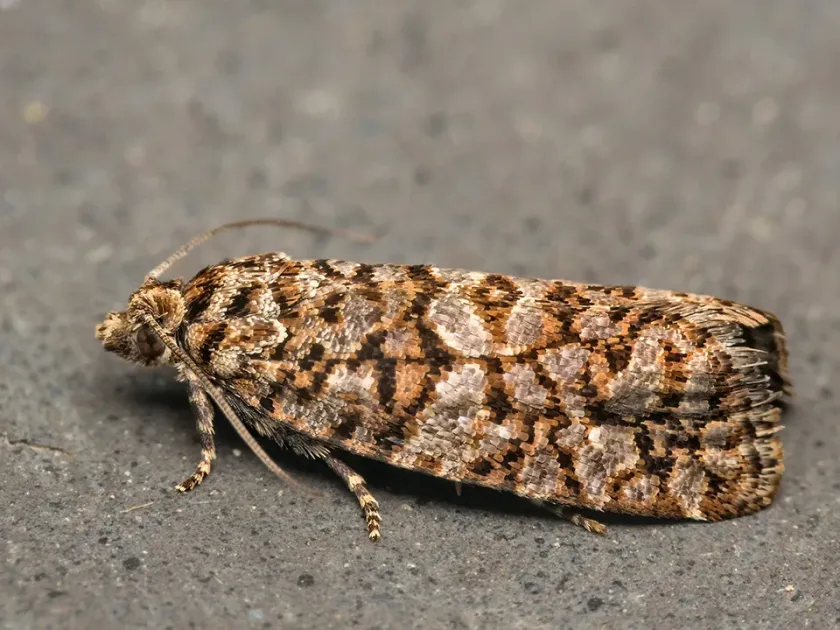
The Fir cone moth (Barbara herrichiana) is a species of moth belonging to the family Tortricidae. Adults are small, cryptic insects with a wingspan ranging between 12 and 16 mm, featuring a complex pattern of brownish-grey scales that blends perfectly with the bark of fir trees.
The larvae, which are the main destructive stage, have a yellowish or pinkish body with a sclerotized head. They develop exclusively within the cones of fir (Abies), where they remain protected from environmental factors and most predators throughout their larval stage.
What it damages
This pest is a significant threat to fir seed production, as the larvae feed specifically on the developing seeds inside the cones. This damage results in severe losses for nurseries and forestry, often leading to a total failure in seed harvest for affected trees.
The feeding activity also causes structural damage to the cone axis and scales. This deformation prevents the proper ripening of the cones and often leads to premature dropping, which forces the larvae to relocate or seek pupation sites before completing their full development.
When it appears
Adult moths emerge in late spring to early summer, coinciding with the flowering period of host trees. During this time, they mate and lay eggs directly onto the surface of young, developing cones, ensuring the larvae have an immediate food source upon hatching.
Development is relatively slow; the larvae grow throughout the summer months. By early autumn, they typically enter a period of diapause. They either pupate inside the remains of the cones or drop to the ground, overwintering in the soil litter or bark crevices until the following spring.
Signs of infestation
Visible signs of infestation include piles of "frass" (larval excrement and boring dust) on the exterior of the cone. The presence of resin exuding from small boreholes is another classic indicator that a larva has tunneled into the cone interior.
Infested cones usually exhibit stunted growth, asymmetry, and premature browning or decay. If many cones are found prematurely on the ground, it is a strong indication of a high-density infestation requiring immediate intervention or monitoring.
Control measures
Integrated Pest Management (IPM) is the most sustainable approach. The primary strategy involves the early collection and removal of infested cones before the larvae emerge, which significantly helps in reducing the population density for the next season.
Chemical control is rarely used in forest stands but can be applied in seed orchards during peak moth flight. Monitoring populations via synthetic pheromone traps is essential for timing these interventions correctly and minimizing the ecological impact of pesticide application.
Taxonomy
- Latin name
- Barbara herrichiana
- Order
- Lepidoptera (butterflies)
- Family
- Tortricidae
- EPPO code
- BARBHE
Discussion
No discussions yet — be the first.