
Lesser bandicoot rat
Bandicota indica
Description
How to identify
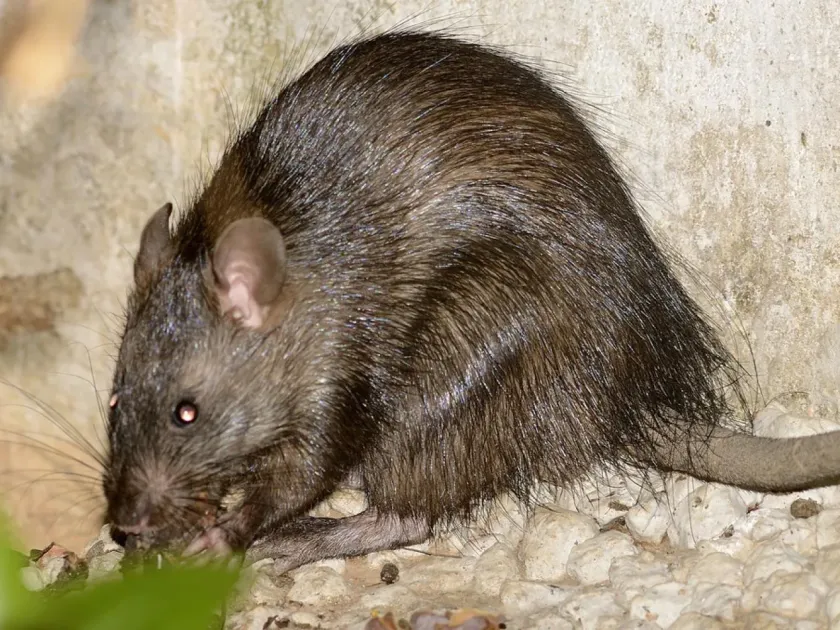
The Lesser bandicoot rat (Bandicota indica) belongs to the order Rodentia and the family Muridae. It is a large, robust rodent with a body length often exceeding 30 to 40 centimeters.
It possesses coarse, dark-brown or greyish hair and a thick tail. Their most distinctive features are their powerful, chisel-like incisors designed for gnawing through tough materials.
These rodents are primarily nocturnal and highly territorial, living in complex burrow systems. Their burrows can be quite deep, featuring multiple entry points and specialized chambers for storing food.
They are prolific breeders, capable of producing several litters per year under favorable conditions. This high reproductive rate allows them to rapidly colonize agricultural areas.
Due to their size and aggressive nature, they are recognized as a serious threat to food security in many regions, particularly in rice-growing countries.
What it damages
Bandicoot rats cause extensive damage to a wide range of crops, including rice, wheat, maize, sugarcane, and various garden vegetables. They are major agricultural pests.
They damage crops at almost every growth stage, from digging up seeds after sowing to cutting down mature stems to access the grain heads.
A notable characteristic is their hoarding behavior. They transport significant quantities of grain to their underground burrows, which often leads to losses far exceeding what they consume.
In paddy fields, their tunneling activity severely undermines irrigation systems, causing leaks in dams and embankments, which disrupts water management for the entire crop area.
In farm buildings, they are notorious for chewing through plastic, wood, and electrical cables, which often results in structural damage and fire hazards.
When it appears
Bandicoot rats remain active year-round, but their level of infestation and perceived damage fluctuate with agricultural cycles and environmental conditions.
During flooding or heavy monsoon seasons, they often migrate to higher ground, frequently moving into storage areas or residential structures to escape waterlogged soil.
Breeding activity is strongly linked to food availability. During peak harvest times, the population of these rodents tends to explode due to the abundant food supply.
In arid conditions, they concentrate near irrigation canals and water sources where the soil remains moist enough for tunneling and maintains a consistent food supply.
Young rats reach sexual maturity in just a few months, making it difficult for farmers to keep populations under control without continuous management efforts.
Signs of infestation
The most common sign of a Bandicoot rat presence is the existence of large burrow entrances, usually 10 to 15 centimeters wide, surrounded by heaps of freshly excavated soil.
Farmers often notice cut stalks of rice or corn lying in neat piles near the burrow entrances, as the rodents frequently cut the plants to carry them into their nests.
Distinct, well-worn runways or tracks in the vegetation indicate where the rats consistently travel between their nests and their preferred feeding grounds.
Visible damage to irrigation dikes, such as holes or water leaks through embankments, is a clear indicator that a burrow system has been established underneath.
Large, elongated droppings found along their movement paths are another reliable indicator of a colony's presence in a specific area.
Control measures
An effective management program for the Lesser bandicoot rat requires an integrated approach that combines chemical, mechanical, and cultural control methods.
The use of second-generation anticoagulant baits is often the primary method for large-scale infestations, though it requires strict safety protocols to protect non-target species.
Deep plowing of fields immediately after harvest is a vital cultural practice that destroys burrow systems and exposes the rodents to natural predators.
Keeping the perimeters of fields clean and removing dense weeds around the site reduces the availability of hiding spots and nesting sites for the pests.
- Installing live or lethal traps near known burrow entrances.
- Flooding burrows to force rodents out for immediate disposal.
- Reinforcing dike structures with stone or concrete mesh to prevent burrowing.
Taxonomy
- Latin name
- Bandicota indica
- Order
- Rodents
- Family
- Muridae
- EPPO code
- BANDIN
Discussion
No discussions yet — be the first.