
Shoebill
Balaeniceps rex
Description
How to identify
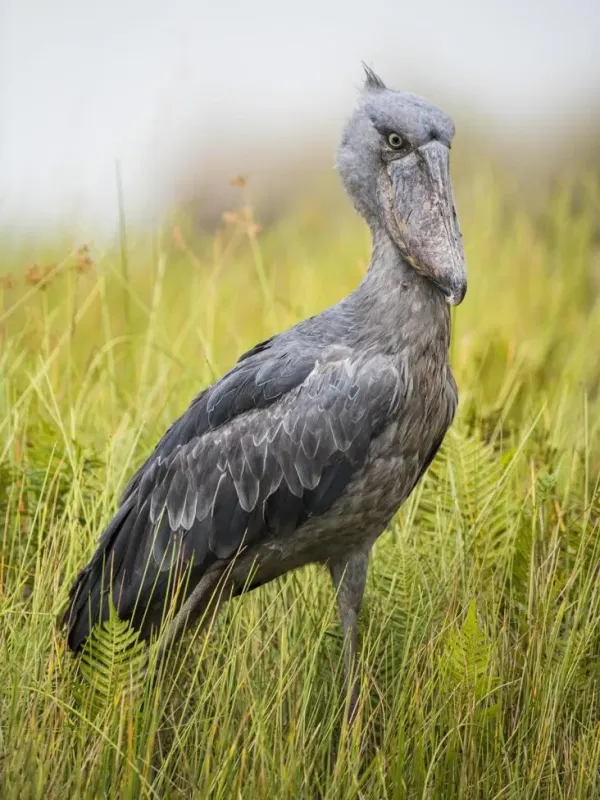
The Shoebill (Balaeniceps rex), also known as the whalehead, belongs to the order Pelecaniformes. It is a large, stork-like bird easily identified by its massive, shoe-shaped bill, which is uniquely adapted for capturing prey in wetland environments.
Adult birds are primarily slate-grey in color and can grow up to 150 centimeters in height. They are famous for their "statue-like" hunting technique, where they remain motionless for long periods, waiting for an opportunity to strike.
Taxonomically, the Shoebill is a solitary predator. Its evolutionary biology is strictly linked to aquatic habitats in tropical Africa, far removed from modern intensive agricultural systems.
The species is considered extremely rare and is listed as vulnerable by conservation organizations. Its presence in any area is an indicator of a healthy, undisturbed wetland ecosystem.
Classifying the Shoebill as a pest is biologically inaccurate, as the bird does not interact with cultivated crops in any form or manner.
What it damages
The Shoebill is a carnivorous bird that feeds exclusively on aquatic prey such as lungfish, catfish, and snakes. It possesses no physiological capacity or behavioral drive to feed on agricultural crops.
There is no evidence of the Shoebill damaging grains, vegetables, or fruits. Its foraging habits do not involve trampling crops or destroying soil structure, as its habitat preference is distinct from arable land.
The bird does not serve as a vector for plant diseases or weeds. Therefore, it causes zero economic damage to agricultural production and is not a factor in crop loss analysis.
Agricultural operations do not need to account for this species when planning pest control strategies, as it remains entirely neutral regarding plant pathology and cultivation.
The perception of the Shoebill as a potential pest is an error based on a misunderstanding of its ecological requirements and dietary specialization.
Control measures
No control measures are needed for the Shoebill. As a non-pest species, it should not be targeted by any pest management protocols, including chemical or physical deterrents.
Conservation efforts are the appropriate way to manage human interaction with the Shoebill. If farmers operate near the bird's natural habitat, the recommended practice is to avoid disturbance and maintain local water quality.
Agro-ecological balance is better achieved by protecting biodiversity rather than eliminating rare species that do not threaten crop output. The Shoebill is an essential part of its local ecosystem.
Farmers are encouraged to prioritize scientific pest identification to distinguish between actual pests and protected wildlife, ensuring that resources are focused on real threats to agriculture.
There is no need for protective equipment or intervention strategies regarding the Shoebill, as it is a protected species of immense ecological value and zero agricultural impact.
Taxonomy
- Latin name
- Balaeniceps rex
- Family
- Balaenicipitidae
- EPPO code
- BLNCRE
Discussion
No discussions yet — be the first.