
Australothrips
Australothrips
Description
How to identify
Australothrips is a genus of insects belonging to the order Thysanoptera and the family Pangaeothripidae. These tiny insects are widely recognized in entomological studies for their distinct morphological features and specialized feeding habits.
Adult Australothrips typically possess slender, elongated bodies, often dark brown or black in coloration. Measuring between 1 to 2 mm in length, they are highly mobile and often evade detection by hiding within leaf crevices.
The larval stages are characterized by a paler, yellowish appearance and soft cuticles. These immature insects are active feeders, similar to the adults, and are often found in clusters on the undersides of leaves.
The insect features a highly specialized piercing-sucking mouthpart. This apparatus allows the thrips to penetrate the epidermis of plants and extract cell contents, which serves as their primary source of nutrition.
Species identification within this genus often requires careful examination of microscopic features, such as the arrangement of setae and the specific structure of the antennae, as described by taxonomic experts.
What it damages
Australothrips is known as a polyphagous pest, meaning it feeds on a variety of plant hosts. It is particularly problematic in greenhouses and indoor plant collections, where it can cause widespread damage.
The feeding process results in the destruction of plant cells, leading to characteristic silvering or bronzing of the leaves. Over time, these areas may become necrotic, significantly affecting the plant's aesthetic quality.
Severe infestations lead to stunted growth, leaf deformation, and, in extreme cases, premature defoliation. Plants subjected to high pressure from these pests often show signs of overall physiological stress.
Beyond direct damage, Australothrips may act as a vector for various plant pathogens. The lesions left by their feeding provide easy access for fungi and bacteria, which can cause secondary infections.
In ornamental crops, even moderate damage is unacceptable due to the decline in marketability and the overall health of the plant specimen.
When it appears
The life cycle of Australothrips is heavily influenced by ambient temperature and humidity. In greenhouse environments, where conditions are kept stable, the pest can reproduce continuously throughout the year.
The developmental stages include the egg, two larval stages, prepupa, pupa, and adult. The duration of this cycle is temperature-dependent, with warmer conditions significantly accelerating the maturation process.
Females insert their eggs into the leaf tissues. This behavior provides the eggs with protection from environmental fluctuations and many types of chemical pesticides applied to the surface.
Dispersal primarily occurs through the movement of infested plant material, though adult thrips are capable of short-distance flight. Greenhouse air currents can also assist in their rapid spread.
Without intervention, populations can explode in a short amount of time, as multiple overlapping generations can be present on a single plant simultaneously.
Signs of infestation
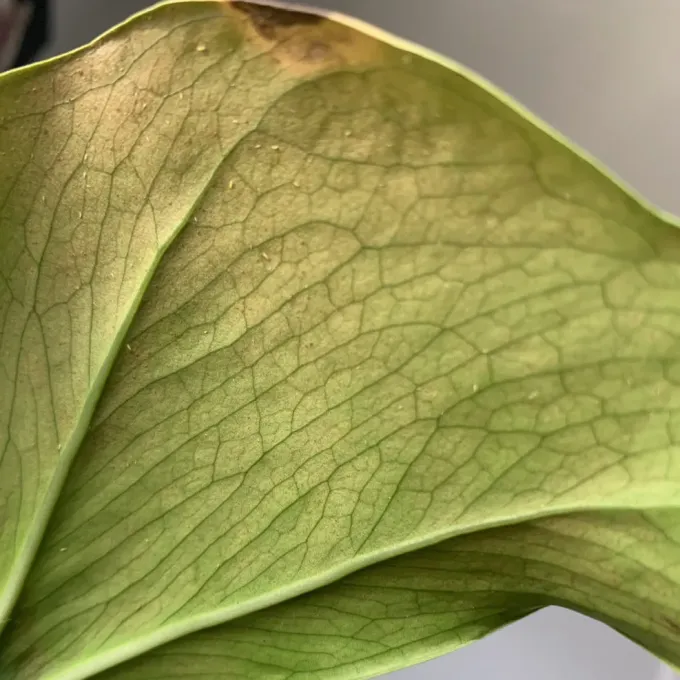
Visual identification of an infestation starts with the appearance of irregular silvery or mottled patches on the leaf surface. These patches are a result of cell collapse following the extraction of sap.
Small, dark, excrement spots are frequently observed on the lower surfaces of infested leaves. These residues are key indicators of ongoing thrips activity and population density.
Leaf twisting, curling, and abnormal development of new shoots are common symptoms that indicate a high population load affecting the plant's growth pattern.
During inspections, shaking the foliage over a white piece of paper can often reveal the presence of adult insects and larvae as they become dislodged from the plant tissue.
Sticky traps, typically yellow or blue, are essential tools for early detection. Monitoring these traps regularly helps growers gauge the need for control measures before visible damage occurs.
Control measures
Managing Australothrips requires an integrated pest management (IPM) approach. Prevention is the first line of defense, involving strict screening of all new plant material entering the facility.
Cultural control methods include removing weeds and disposing of severely infested plant parts to reduce the available reservoir for the pest. Maintaining proper humidity levels can also create less favorable conditions for thrips.
Biological control agents, such as predatory mites (e.g., Amblyseius species) and minute pirate bugs (Orius), have proven highly effective in reducing thrips numbers in controlled environments.
Chemical control should be used judiciously, with a rotation of different insecticide modes of action to prevent the development of resistance within the thrips population.
- Deployment of sticky traps for monitoring and mass trapping.
- Regular inspection of plant undersides for signs of larvae.
- Application of entomopathogenic fungi as a biological suppressant.
- Quarantine procedures for all new plant acquisitions.
Taxonomy
- Latin name
- Australothrips
- Order
- Thrips
- Family
- Thripidae
- EPPO code
- AUSASP
Discussion
No discussions yet — be the first.