
Austrian bug
Asproparthenis
Description
How to identify
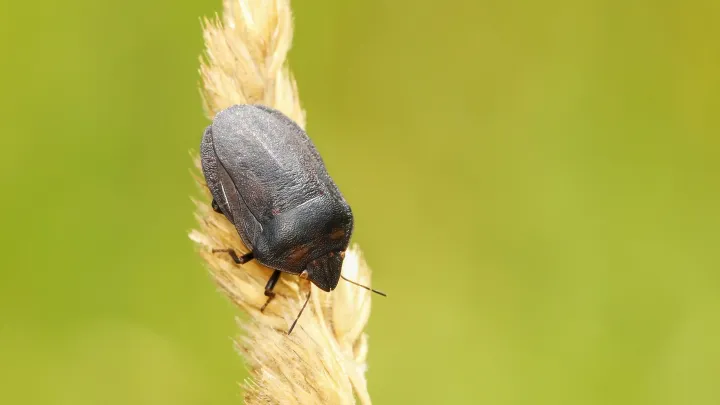
The Austrian bug (Asproparthenis punctum) is a significant pest belonging to the shield bug family (Pentatomidae). It has a shield-like body shape measuring 10–13 mm in length, with a coloration ranging from light brown to dark gray.
The insect possesses a piercing-sucking mouthpart designed specifically for feeding on plant juices. It bears a strong visual resemblance to the Sunn pest, making precise field identification crucial for effective management.
The life cycle consists of egg, five larval stages (instars), and the adult stage. Larvae undergo gradual development throughout the season, gaining size and morphological features at each molting stage.
Adults overwinter in wooded areas, leaf litter, or dense crop residues, which provide protection against extreme winter temperatures. In spring, as temperatures rise, they emerge and migrate to cereal fields to feed and reproduce.
These insects are highly adaptive, surviving in various ecological conditions, which makes them a constant threat to cereal production across their range.
What it damages
The primary hosts of the Austrian bug are cereal crops, including wheat, barley, and rye. The pest causes damage throughout the entire growing season, starting from the tillering stage to grain filling.
Adults migrating in spring damage the stems by sucking juices, leading to wilting and the necrosis of the central leaf. This can significantly stunt plant growth and reduce the overall density of the stand.
The most severe damage occurs during the grain-filling stage. When feeding, both larvae and adults inject saliva containing enzymes into the grain, which degrade gluten and proteins, severely affecting bread-making quality.
Damaged grain becomes shriveled, light, and stained. This reduction in quality often forces producers to sell the yield as low-grade animal feed rather than high-quality milling wheat.
High infestations can lead to substantial yield losses, often exceeding 20%, depending on the timing and density of the bug population during the reproductive phase of the crop.
When it appears
The activity begins in early spring when air temperatures reach 12–14 degrees Celsius. During this time, overwintered adults move from hibernation sites to actively growing cereal fields.
Egg-laying occurs shortly after arrival. Females deposit eggs on the undersides of cereal leaves or weeds. Development from egg to larva typically takes about two weeks under favorable weather conditions.
Summer is marked by the intense feeding activity of nymphs. The older instars are particularly aggressive feeders, causing the most significant harm to the developing grain heads.
Adults of the new generation emerge during the final stages of crop ripening. After the harvest, they remain on the stubble briefly before migrating to shelters for winter diapause.
Monitoring is most critical from the late tillering stage until the dough stage of the grain. Keeping track of adult presence in spring is a primary indicator of potential larval infestation density.
Signs of infestation
Early symptoms include the yellowing and wilting of the central leaf on young plants. Upon closer inspection, you may find small puncture marks surrounded by discolored plant tissue.
The presence of egg clusters on the undersides of leaves is a clear sign of an active infestation. These clusters are usually organized in neat rows, making them detectable through careful scouting.
On the grain head, you can observe small dark spots where the bugs have pierced the kernels. Affected grain kernels often appear flat, white-spotted, or generally unhealthy.
A phenomenon known as "whitehead" can occur if the bug damages the stem directly below the ear, causing the entire head to die and lose its color due to the lack of nutrient supply.
Presence of adult bugs in the field, detectable via sweep-net sampling, remains the most reliable field sign for assessing the need for intervention.
Control measures
Cultural control is the first line of defense. Deep autumn plowing buries crop residues and destroys overwintering sites, significantly reducing the survival rate of the population.
Chemical control via systemic or contact insecticides is recommended when larval counts surpass the economic injury threshold. Strategic timing ensures the protection of the grain-filling period.
Crop rotation and the destruction of weeds along field margins help break the pest's cycle and eliminate alternative food sources for nymphs.
Integrated Pest Management (IPM) practices, including the use of entomopathogenic fungi, are becoming increasingly popular for sustainable bug population control.
- Use resistant or early-maturing wheat varieties.
- Maintain optimal field sanitation to reduce hibernation opportunities.
- Perform regular scouting to avoid late-stage infestations.
- Harvest crops promptly to limit the window of damage to the grain.
Taxonomy
- Latin name
- Asproparthenis
- Order
- Coleoptera (beetles)
- Family
- Curculionidae
- EPPO code
- ASPOSS
Discussion
No discussions yet — be the first.