
Nile grass rat
Arvicanthis niloticus
Description
How to identify
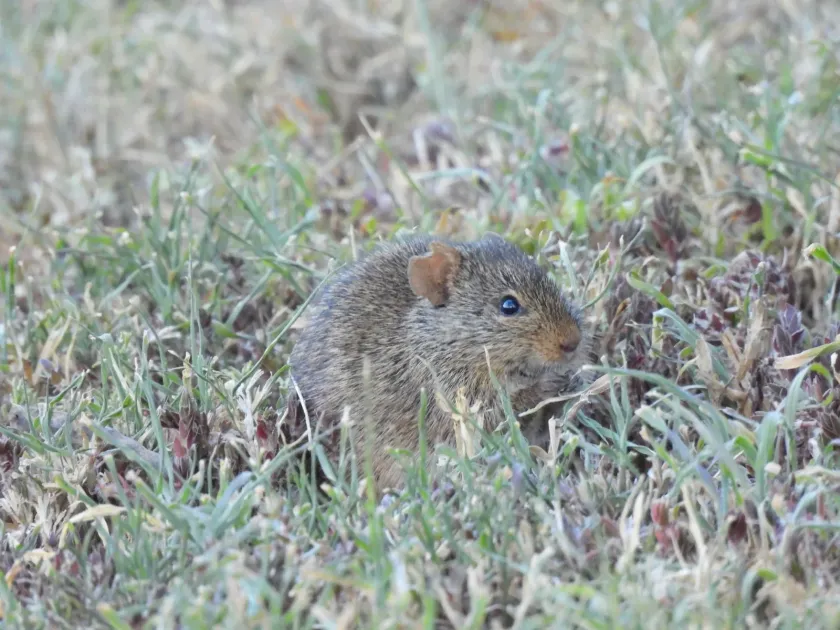
The Nile grass rat (Arvicanthis niloticus) is a member of the Muridae family, recognized as a significant agricultural pest in various regions. These rodents are relatively large, typically measuring 10–20 cm in body length, with a tail roughly equal to their body size.
They are characterized by a coarse, brownish-grey coat with distinct dark stripes along the back, providing camouflage in tall grasses. Their feet are robust, enabling agile movement across varied terrain.
Unlike most nocturnal rodents, the Nile grass rat is largely diurnal, which makes them visible during daylight hours. They are highly social, living in complex burrow systems or dense vegetation mats.
These rats possess high reproductive rates, often producing multiple litters annually. This biological trait allows populations to explode in size rapidly when food sources are abundant.
They are highly adaptable creatures, capable of thriving in both natural grasslands and human-modified agricultural landscapes, where irrigation provides year-round moisture.
What it damages
Nile grass rats pose a severe threat to cereal crops, including wheat, maize, sorghum, and rice. They feed on seeds during development and consume young seedlings, causing significant crop stand loss.
They also cause damage to commercial crops like cotton, legumes, carrots, and potatoes. By gnawing through stems and roots, they weaken the plants and facilitate the entry of pathogens.
In infested fields, these rodents often cut down tall stalks, leading to widespread lodging that makes mechanical harvesting impossible and results in total yield loss.
Beyond direct feeding, their burrowing activities can disrupt soil structure and irrigation systems, leading to water wastage and uneven field maturation.
Contamination of grain stores with feces and urine poses a food safety risk, as these materials can harbor pathogens and promote the growth of storage molds.
When it appears
The activity of these pests is closely linked to the crop calendar. They are most active during the grain ripening stage, which provides a high-energy food source.
In irrigated farming areas, populations can remain active and reproductive throughout the year, taking advantage of consistent water and cover availability.
The onset of the harvest season often triggers migrations as rodents move from freshly harvested fields to nearby areas with standing crops or storage facilities.
Extreme temperatures do not significantly deter them, as their deep, burrow-based lifestyle provides a stable microclimate regardless of surface weather conditions.
Spring and early summer are critical periods for farmers, as the emerging crops are particularly vulnerable to the feeding behavior of these rodents.
Signs of infestation
One of the most obvious signs is the appearance of distinct, well-worn pathways or "runs" through the field, used by the rats to commute between nesting areas and foraging sites.
Mounds of displaced soil and excavated debris near the entrance of burrows are clear indicators of a large-scale nest structure located underground.
Visual inspection of the crop often reveals gnawed stems with clean, angled cuts at the base, which is characteristic of rodent feeding patterns rather than insect damage.
The presence of droppings and food remnants in field edges, along irrigation canals, and inside storage barns confirms the presence of a sustained population.
Daytime sightings of the rodents crossing field edges or near irrigation equipment are strong evidence of an infestation that requires immediate control action.
Control measures
Managing the Nile grass rat requires an integrated pest management approach that combines habitat modification with effective population control methods.
Deep plowing of the fields immediately after harvest is one of the most effective mechanical methods to destroy burrow systems and expose the rodents to predation.
Maintaining clean field borders by clearing tall weeds and debris removes essential nesting cover, making the area less attractive for colonization by the rats.
The application of rodenticides, when necessary, should be carried out using tamper-resistant bait stations to target the pests while ensuring safety for non-target wildlife.
- Implement strict crop rotation patterns.
- Use natural predator attraction (e.g., raptor perches).
- Install physical barriers around high-value vegetable plots.
Taxonomy
- Latin name
- Arvicanthis niloticus
- Order
- Rodents
- Family
- Muridae
- EPPO code
- ARVINI
Discussion
No discussions yet — be the first.