
Arixyleborus granifer
Arixyleborus granifer
Description
How to identify
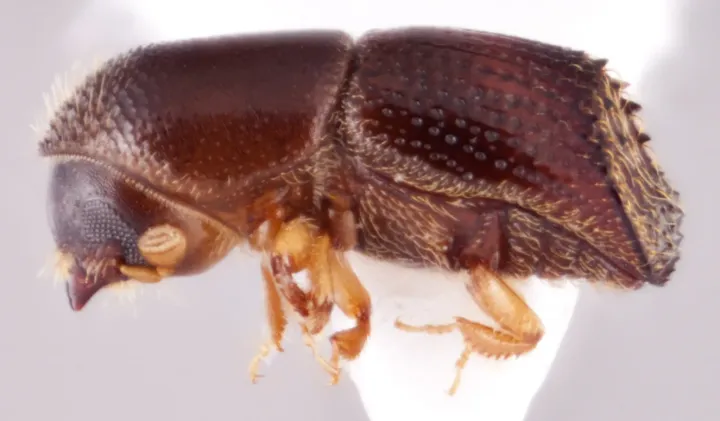
Arixyleborus granifer is a species of bark beetle belonging to the Curculionidae family and the Scolytinae subfamily. It is a small wood-boring insect that spends most of its life cycle within the host wood.
The adult beetle has a cylindrical, dark brown or black body, typically covered in fine scales. Due to its very small size, it often goes unnoticed until the damage to the tree becomes significant.
The life cycle of this beetle is intrinsically linked to ambrosia fungi. Adults create tunnels in the tree's xylem, where they cultivate fungal gardens that serve as the primary food source for their larvae.
This species demonstrates significant environmental plasticity, allowing it to colonize a wide range of tree species across various tropical and subtropical forest ecosystems.
Accurate identification of this beetle requires microscopic examination of key morphological features, such as the structure of the pronotum and elytra, as it resembles other members of the Xyleborini tribe.
What it damages
This pest affects a broad spectrum of tree species, ranging from native forest trees to economically important agricultural crops like rubber trees (Hevea brasiliensis).
While the beetle typically attacks weakened, stressed, or fallen trees, healthy trees can also be heavily infested if the beetle population reaches high enough levels in an area.
The galleries excavated by the beetles disrupt the tree's vascular system, directly interfering with the movement of water and essential nutrients from the roots to the canopy.
A major component of the damage is the introduction of pathogenic fungi and bacteria into the tree, which can lead to rapid decay, branch dieback, or the total death of the host plant.
Economic impacts are severe, leading to the devaluation of timber, reduced yields in plantations, and the loss of young nursery stock due to intense tunneling activity.
Signs of infestation
The most visible sign of infestation is the presence of small entry holes on the bark, often accompanied by "frass" (fine sawdust) accumulating on the bark surface or at the base of the tree.
Trees often respond to the beetle's entry by exuding sap or gum at the site of the attack, which can be a visible indicator of the tree's struggle to fend off the invaders.
Upon cutting into the wood, one can see characteristic intricate tunnel networks, which are often stained dark by the fungal growth maintained by the beetles within their galleries.
Crown symptoms such as yellowing foliage, wilting, or premature leaf fall are typical manifestations of systemic damage to the tree's internal transport system caused by the beetle infestation.
During a thorough inspection, one may find all life stages of the beetle—adults, larvae, and pupae—residing within these tunnels deep inside the tree stem.
Control measures
Effective management begins with rigorous forest hygiene, which includes the immediate removal and proper disposal of infested trees to prevent the spread of the beetle to nearby hosts.
Fever-based monitoring and pheromone traps are essential tools for tracking beetle flight periods and assessing population density, allowing for timely intervention strategies.
Chemical control involving systemic or contact insecticides may be applied to tree trunks during the beetle's flight season to protect healthy trees from initial colonization.
Maintaining tree vigor through proper irrigation, fertilization, and avoiding physical trunk damage helps enhance the tree's natural resistance against such wood-boring threats.
- Sanitary clearing of infested wood and residues.
- Deployment of pheromone traps for early detection.
- Application of insecticides as a preventive measure.
- Implementing strict quarantine protocols for wood movement.
Taxonomy
- Latin name
- Arixyleborus granifer
- Order
- Coleoptera (beetles)
- Family
- Curculionidae
- EPPO code
- ARXYGR
Discussion
No discussions yet — be the first.