
Red-banded leafroller
Argyrotaenia velutinana
Description
How to identify
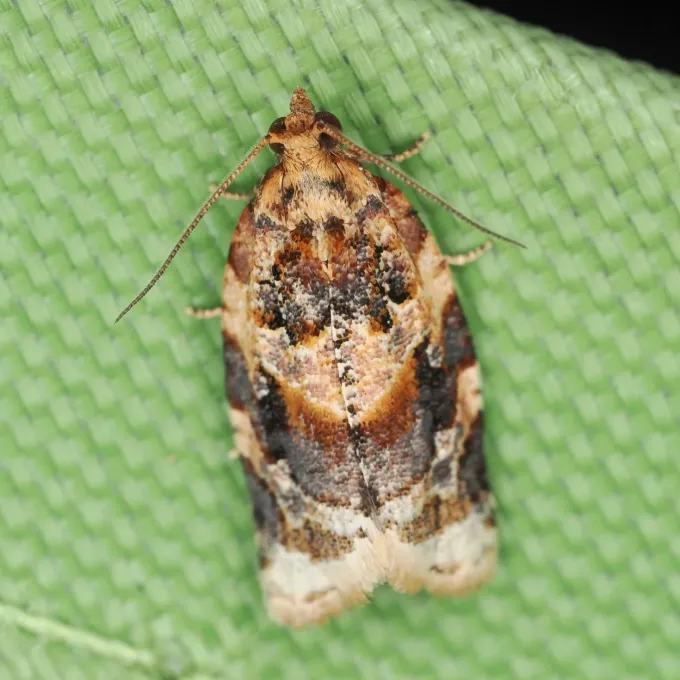
The red-banded leafroller (Argyrotaenia velutinana) is a member of the Tortricidae family and a significant pest in agricultural settings. The adult moth features a distinctive reddish-brown band across its brownish-grey wings, which gives the species its common name.
The larvae are active caterpillars that reach approximately 15 mm in length. Their appearance ranges from light yellowish-green to a deeper olive-green, always possessing a darker head capsule. They are known for their quick, wiggling movement when disturbed.
What it damages
This species is a highly polyphagous pest that affects a wide variety of fruit trees, including apples, pears, cherries, and plums. It can also be found on various ornamental plants and shrubs, which serve as alternative hosts for the population.
Larvae cause direct damage by feeding on leaves, buds, and fruit. By web-spinning leaves together, they create protective shelters that make it difficult for natural predators or contact-based control methods to reach them, leading to significant yield losses.
When it appears
Depending on the latitude, the insect completes two to three generations annually. Overwintering occurs in the pupal stage, typically within silk-lined cocoons located in leaf litter or crevices on the bark of host trees.
Emergence usually begins in early spring, synchronized with the bud burst of apple trees. Subsequent generations emerge throughout the summer, often with overlapping cycles, making continuous monitoring essential for successful management programs.
Signs of infestation
The most obvious sign of infestation is the presence of webbed or rolled leaves, which house the larvae. These structures are often easily spotted during tree inspections and are accompanied by small amounts of frass near the feeding sites.
Fruit damage usually appears as irregular, shallow depressions or scarring on the skin. In more severe cases, larvae may tunnel deeper into the fruit, which often results in secondary infections and early fruit drop before harvest.
Control measures
Integrated Pest Management (IPM) is the standard approach for controlling this leafroller. The use of pheromone traps is critical for timing the application of insecticides to target the most vulnerable larval stages of the pest.
Cultural practices, such as clearing orchard floor debris and sanitation, play a vital role in reducing the overwintering population. Biological control agents, including parasitic wasps and Bacillus thuringiensis, are also effective tools in sustainable orchard management.
Taxonomy
- Latin name
- Argyrotaenia velutinana
- Order
- Lepidoptera (butterflies)
- Family
- Tortricidae
- EPPO code
- ARGTVE
Discussion
No discussions yet — be the first.