
Oak leafroller
Argyrotaenia quercifoliana
Description
How to identify
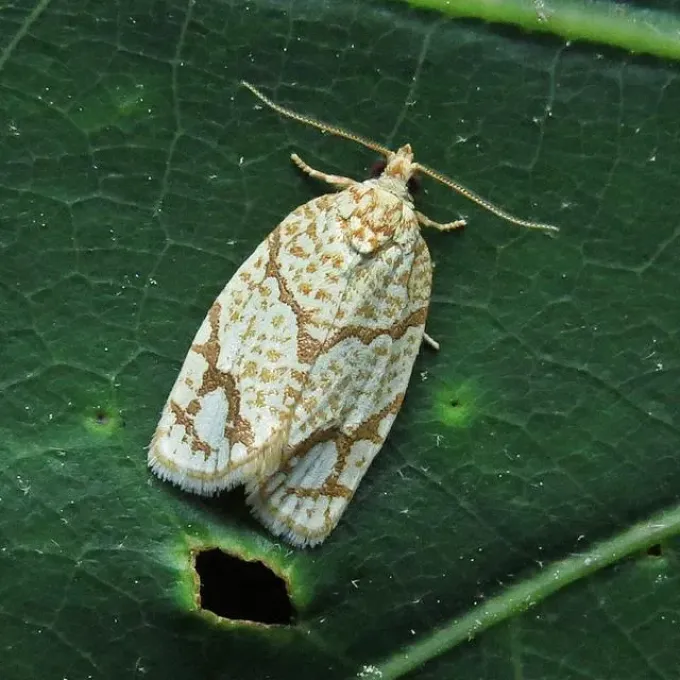
The oak leafroller (Argyrotaenia quercifoliana) belongs to the order Lepidoptera and the family Tortricidae. It is a moth species recognized for its distinct wing patterns.
The adult moth has a wingspan of approximately 18–22 mm. The forewings display a mottled appearance with brownish, ochre, and dark bands, providing excellent camouflage against tree bark.
The larvae, or caterpillars, are light green with a darker head capsule. They are highly active and demonstrate a characteristic behavior of dropping on a silk thread when disturbed.
Eggs are typically deposited in clusters on the smooth bark of branches or on the upper surface of leaves, often covered with a protective secretion by the female.
Pupae are dark brown and are formed within shelter structures created by the larvae, specifically using leaves rolled up and secured with silk webbing.
What it damages
This pest primarily infests oak species (Quercus). Under high population densities, it may also attack related broad-leaved trees such as maples and beeches.
Young larvae feed on the parenchyma of leaves, creating small holes, while older larvae proceed to skeletonize the leaves, leaving only the primary veins intact.
Significant infestations can cause premature defoliation of the tree canopy, which severely weakens the plant and reduces its overall growth and vigor.
Repeated annual damage results in stunted growth and makes trees more susceptible to opportunistic secondary pests, such as wood-boring beetles and pathogens.
In urban forestry and park settings, the presence of these pests reduces the aesthetic and health value of the trees, necessitating management interventions.
When it appears
The oak leafroller completes one generation per year. The species overwinters in the egg stage, which remains dormant on the bark until the following spring.
Larval emergence coincides precisely with the bud-burst phase of the host oak trees, ensuring that the larvae have immediate access to fresh, tender foliage.
The active feeding period for the caterpillars occurs throughout May and June, which is the most critical time for monitoring and intervention in forest stands.
Pupation takes place throughout June, with the larvae transforming into pupae inside their rolled-leaf shelters. This stage is followed by the adult emergence.
Adult moths are active during mid-summer, specifically in June and July. Following mating, the females lay the eggs that will remain on the trees until the next season.
Signs of infestation
The most prominent sign of an infestation is the presence of curled or rolled leaves tightly bound together by silk threads, which form visible shelter tubes.
Leaf surfaces show irregular-shaped feeding holes, and in severe cases, entire leaves appear skeletonized, turning brown and brittle due to the loss of tissue.
The presence of larval frass, appearing as tiny dark granular pellets trapped within the rolled leaves, is a strong indicator of an active caterpillar population.
Disturbed caterpillars may be observed hanging from branches by silk threads, a behavior that allows them to escape predators and move between parts of the canopy.
The remnants of pupal casings, which often stick out of the edges of the rolled leaves, confirm that the life cycle of the leafroller is nearing its completion.
Control measures
Biological control using formulations based on Bacillus thuringiensis is highly effective and recommended for minimizing environmental impact in forests.
Chemical insecticides, such as pyrethroids or organophosphates, may be applied if infestation levels reach economic thresholds, specifically targeting early larval stages.
Integrated Pest Management (IPM) strategies, including the use of pheromone traps, are essential for monitoring population levels and timing control measures accurately.
Encouraging natural predators, such as insectivorous birds and parasitic wasps, provides long-term suppression of leafroller populations in natural ecosystems.
Mechanical removal of infested leaf clusters is a practical and effective solution for protecting individual ornamental trees or young saplings in nursery settings.
Taxonomy
- Latin name
- Argyrotaenia quercifoliana
- Order
- Lepidoptera (butterflies)
- Family
- Tortricidae
- EPPO code
- ARGTQE
Discussion
No discussions yet — be the first.