
Fruit leafroller
Argyrotaenia pomililiana
Description
How to identify
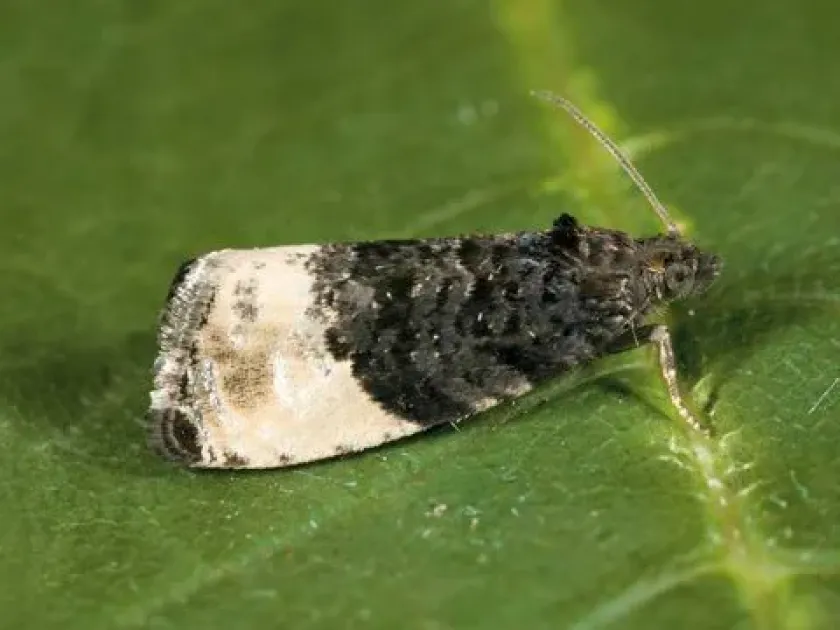
The fruit leafroller (Argyrotaenia ljungiana) is a moth belonging to the family Tortricidae. Adults are small moths with a wingspan of approximately 12–16 mm, characterized by a brownish to reddish-brown coloration.
The forewings feature a distinctive oblique dark band. The hindwings are usually grayish-brown, often with a fringe along the edges, helping the moth blend into the bark of host trees during the day.
Larvae (caterpillars) progress through several instars. They are typically olive-green to brownish with a dark head capsule. They are highly active and drop on a silken thread when disturbed.
Pupae are formed within tightly rolled leaves or silk webs. The species typically overwinters as a larva in a protected hibernaculum within bark crevices or organic debris.
The number of generations per year is highly dependent on local climate conditions, with warmer regions supporting multiple overlapping broods, making the pest persistent throughout the season.
What it damages
This pest is highly polyphagous, attacking a wide variety of fruit trees including apple, pear, plum, and cherry. It can also cause significant damage to berry bushes and grapevines.
Larvae feed on buds, flowers, and developing fruit. Early-season feeding on buds and blossoms results in immediate loss of yield potential and structural damage to the branch tips.
The characteristic leafrolling behavior, where the larva spins leaves together with silk, creates a sheltered environment that protects the pest from both predators and chemical sprays.
Fruit damage is the most economically significant aspect. Larvae feed on the surface of the fruit, creating shallow, irregular cavities. These wounds often lead to secondary fungal infections and rot.
In addition to physical damage, the presence of these larvae reduces the aesthetic quality of fruit, rendering them unsuitable for sale or long-term storage.
When it appears
Overwintered larvae emerge in early spring, coinciding with bud break on fruit trees. This usually occurs as soon as temperatures consistently rise above the threshold of 10°C.
The flowering period often overlaps with the active feeding stage of the first generation of larvae. This is a critical time for monitoring and intervention in many commercial orchards.
Adult moths emerge in late spring to early summer to mate and lay eggs. These eggs are usually deposited in masses on the upper surface of leaves or smooth fruit skins.
A second generation typically develops during mid-summer. This generation is often larger and more destructive to the maturing fruit as they seek high-sugar food sources.
As autumn approaches and temperatures drop, mature larvae move to protected locations to construct hibernacula, where they enter diapause for the duration of the winter.
Signs of infestation
The most visible sign of infestation is the presence of rolled or folded leaves fastened with silk webs. These nests are often found at the tips of new, tender shoots.
Damage to blossoms is common, where larvae web buds together. These damaged buds fail to open properly and eventually dry out, leading to sparse fruit set.
Fruit surface scarring is a hallmark sign. You may find small, irregular tracks or holes on the skin, often accompanied by silk strands or larval frass (excrement).
Larvae may also stitch a leaf to the fruit surface to feed in secrecy. Removing the leaf often reveals a discolored, damaged patch of skin beneath.
- Tightly rolled or webbed leaves.
- Webbed and dried-up flower clusters.
- Superficial scarring and feeding holes on fruit.
- Presence of larval frass near feeding sites.
Control measures
Cultural control practices include removing and destroying infested leaves and fruit. Winter pruning and the removal of loose bark help reduce overwintering sites for the larvae.
Biological control methods, such as the use of Bacillus thuringiensis sprays, are highly effective against young larvae while preserving the populations of beneficial predatory insects.
Pheromone traps are essential for monitoring adult moth populations. They provide data on flight peaks, allowing growers to time chemical applications for maximum effectiveness.
Chemical control should be targeted at the larval stage before they roll the leaves. Use of specific insecticides must follow local regulations to ensure safety for pollinators.
Promoting a healthy orchard ecosystem by encouraging natural enemies, including parasitic wasps (such as Trichogramma) and lacewings, can significantly suppress leafroller populations.
Taxonomy
- Latin name
- Argyrotaenia pomililiana
- Order
- Lepidoptera (butterflies)
- Family
- Tortricidae
- EPPO code
- ARGTPO
Discussion
No discussions yet — be the first.