
Fruit tree tortrix
Argyrotaenia ljungiana
Description
How to identify
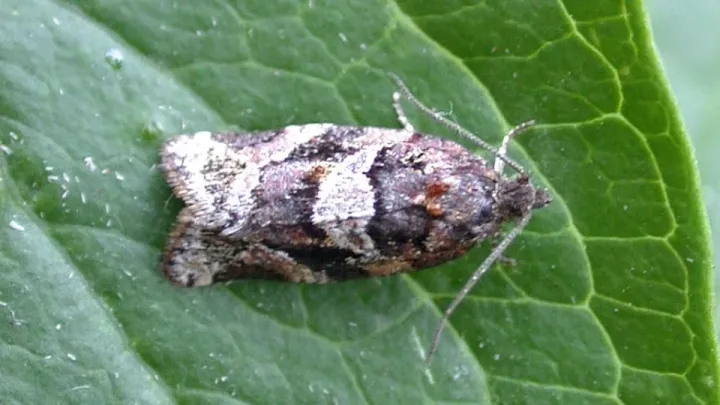
The fruit tree tortrix (Argyrotaenia ljungiana) is a species of moth belonging to the family Tortricidae. The adult moth has a wingspan of 12–16 mm, with forewings typically featuring a distinct, dark diagonal band across the middle.
The larvae progress through several instars. Mature larvae typically measure 10–12 mm in length, possessing a light green or brownish-green body with a dark, polished head capsule.
Females deposit their eggs on the upper surface of leaves in overlapping, scale-like clusters. These egg masses are initially pale, turning darker as the larvae develop inside the eggs prior to hatching.
Pupae are approximately 7–9 mm long and dark brown in color. They are usually found protected inside folded leaves or silk-lined nests, which the larvae create during their final developmental stages.
This species is a highly adaptable polyphagous insect. Its ability to feed on a wide variety of hosts allows it to thrive in diverse agricultural environments, including both traditional orchards and vineyards.
What it damages
As a polyphagous pest, the fruit tree tortrix targets a broad range of agricultural crops. It causes significant damage to vineyards, as well as apple, pear, and plum orchards across temperate regions.
In addition to fruit trees, the pest infests various small fruit bushes, including strawberries, raspberries, currants, and blueberries, which often results in reduced vigor and commercial yield losses.
The primary damage is caused by the larvae, which feed on buds, foliage, fruitlets, and ripening fruit. They construct silk nests by folding leaves, which provides them with shelter and a consistent food supply.
Severe infestations can lead to significant defoliation of the host plant. This loss of photosynthetic surface area weakens the trees and can negatively impact the development of fruit buds for the following season.
Fruit damage manifests as surface feeding, which ruins the appearance and quality of the harvest. On grapes, the larvae often damage the rachis, creating entry points for secondary fungal pathogens like Botrytis cinerea.
When it appears
The fruit tree tortrix typically completes 2 to 3 generations per year depending on local climatic conditions. It overwinters as a larva in a protected stage, often hiding in bark crevices or plant debris.
In the spring, as temperatures rise above 10°C, overwintering larvae emerge and begin feeding on developing buds and young shoots, often causing terminal growth dieback.
The first adult flight usually occurs in late May or early June. Following mating, females lay eggs, and the next generation of larvae hatches within approximately two weeks to begin the summer feeding cycle.
Subsequent generations develop throughout July and August. During this period, the pest population can increase rapidly, often leading to overlapping generations that require careful monitoring throughout the summer.
As autumn approaches, the final generation of larvae seeks hibernation sites. They become dormant to survive the winter, waiting for the return of favorable temperatures to continue their life cycle in the following year.
Signs of infestation
The most characteristic sign of infestation is the presence of webbed or folded leaves, which are tied together with silk threads. These structures often serve as hiding spots for the larvae.
- Leaves rolled into tubes or tied with silk webbing.
- Silk nests between leaves or attached to fruit surfaces.
- Larval excrement (frass) accumulated inside the silk structures.
- Superficial feeding scars on the skin of young fruits.
- Premature wilting or shedding of damaged leaves and fruitlets.
Egg masses can be identified on the upper leaf surface as slightly raised, pale patches. They are arranged in a pattern resembling shingles, which is a key diagnostic feature for visual scouting.
Injured fruit often shows irregular feeding patterns. If feeding occurs early, the fruit may become stunted or deformed, creating deep depressions that are susceptible to opportunistic rot infections.
In high-pressure orchards, the impact is visible through general tree decline and significant crop drop. Early detection is crucial to preventing the larvae from boring into deeper tissues of the plant.
Control measures
Cultural control is a foundational strategy. Regular pruning to remove infested shoots and foliage during the dormant season helps reduce the overwintering population density effectively.
Pheromone traps are essential for monitoring the flight activity of adult moths. These traps allow growers to accurately time their interventions and ensure that control measures hit the most susceptible larval stages.
Biological control, such as the use of Bacillus thuringiensis (Bt), is effective against young larvae and minimizes the impact on beneficial insects and predatory mites in the orchard ecosystem.
Chemical control should be applied during periods of peak larval hatching. It is important to rotate insecticide classes to prevent the development of resistance and to strictly adhere to pre-harvest intervals.
Integrated Pest Management (IPM) programs rely on balancing natural predators and timely targeted applications to keep the population of the fruit tree tortrix below the economic damage threshold.
Taxonomy
- Latin name
- Argyrotaenia ljungiana
- Order
- Lepidoptera (butterflies)
- Family
- Tortricidae
- EPPO code
- ARGTPU
Discussion
No discussions yet — be the first.