
Water spider
Argyroneta
Description
How to identify
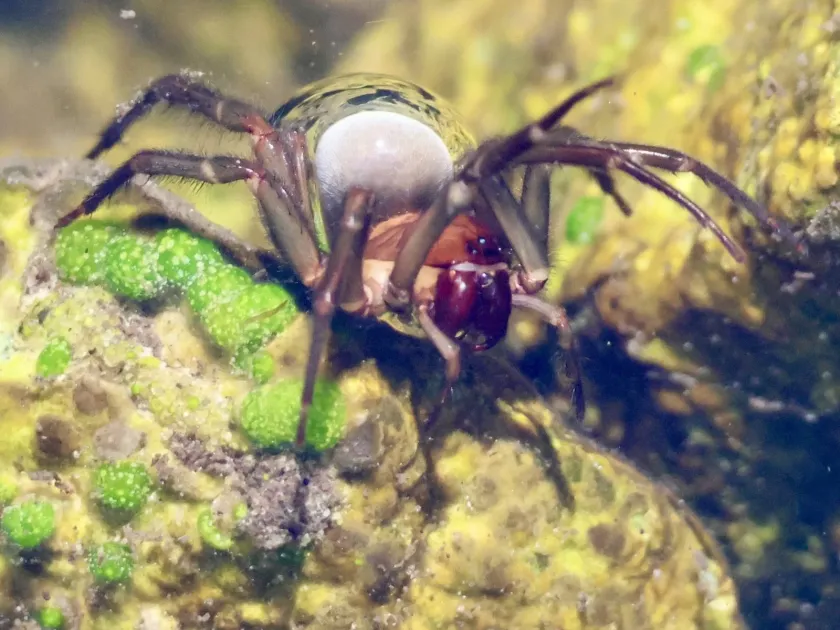
The water spider (Argyroneta aquatica) is the only species of spider in the world that spends almost its entire life cycle underwater. It belongs to the Cybaeidae family and typically measures between 10 and 20 mm in length.
The spider's body is covered in hydrophobic hairs that trap a layer of air around its abdomen. This creates a distinct silver appearance when submerged, which is the origin of its common name.
Unlike other spiders, it constructs complex underwater bell-shaped nests made of silk. These webs are anchored to aquatic plants and filled with air that the spider collects from the surface.
The spider relies on atmospheric oxygen and must periodically swim to the surface to replenish the air bubble trapped against its abdomen. This behavior is essential for its survival in aquatic environments.
They are primarily found in still or slow-moving water bodies, such as ponds, canals, and ditches, that are rich in vegetation and free from heavy pollutants.
What it damages
In an agricultural context, the water spider is not considered a pest of crops. It is a strictly carnivorous animal that feeds on small aquatic invertebrates, mosquito larvae, and tiny crustaceans.
It does not consume plant matter or damage crops, as it has no interest in agricultural produce. Therefore, it causes no economic damage to field or greenhouse farming.
However, in aquaculture or fish-farming operations, they can be viewed as minor pests if they compete for food with fish fry or occasionally prey on very small fingerlings.
Their presence is generally viewed as a sign of good water quality and ecological health. They are sensitive to pesticides and heavy water pollution, making them natural bio-indicators.
There is no need for large-scale eradication programs, as these spiders do not represent a threat to food security or agricultural infrastructure in most environments.
When it appears
The water spider is active throughout the year, though its behavior changes with the seasons. Activity levels peak during the warmer spring and summer months when prey is abundant.
During spring, males actively search for mates, and females focus on expanding their air-filled nests to accommodate egg cocoons. This is the period of highest population growth.
As temperatures drop in autumn, spiders become less active but remain submerged. They do not migrate to land for the winter, staying in the water even when the surface freezes.
Winter survival is achieved by remaining in deeper water or utilizing empty mollusk shells and stable underwater nests where they maintain an air supply under the ice.
The life cycle involves multiple stages of development, all occurring within the water. The eggs are deposited inside the silk bell-shaped nests, where the spiderlings emerge and eventually disperse.
Signs of infestation
The most visible sign of a water spider's presence is the shimmer of silver air bubbles attached to submerged aquatic plants.
An observer can identify their nests by looking for transparent, dome-shaped silk structures attached to stems or submerged debris, often containing a visible bubble of air.
Watching for the spider surfacing to grab air is a common way to confirm their presence in shallow, still water during the summer months.
Presence of fine, tangled silk webbing on water pumps, irrigation filters, or debris in canals can indicate an established population of water spiders.
In cases of pond cleaning or water sampling, the spider can be identified by its characteristic movement and the presence of the air film on its abdomen.
Control measures
Control of the water spider is rarely necessary in agricultural settings. Because they do not damage crops, they are generally left alone to fulfill their ecological role as predators of aquatic insect larvae.
If management is required in fish-farming environments, the most effective approach is physical habitat modification, such as removing excess vegetation from the edges of ponds.
Keeping irrigation canals free of debris and dense weeds reduces the surface area available for the spiders to anchor their nests, which naturally limits their density.
Installing fine-mesh filters on irrigation intakes prevents the migration of spiders and other aquatic organisms into specialized tanks or sensitive water systems.
The use of chemical pesticides in water bodies is strictly discouraged, as it can cause long-term environmental damage and harm non-target aquatic organisms.
Taxonomy
- Latin name
- Argyroneta
- Family
- Cybaeidae
- EPPO code
- ARGRSP
Discussion
No discussions yet — be the first.