
Carp louse
Argulus foliaceus
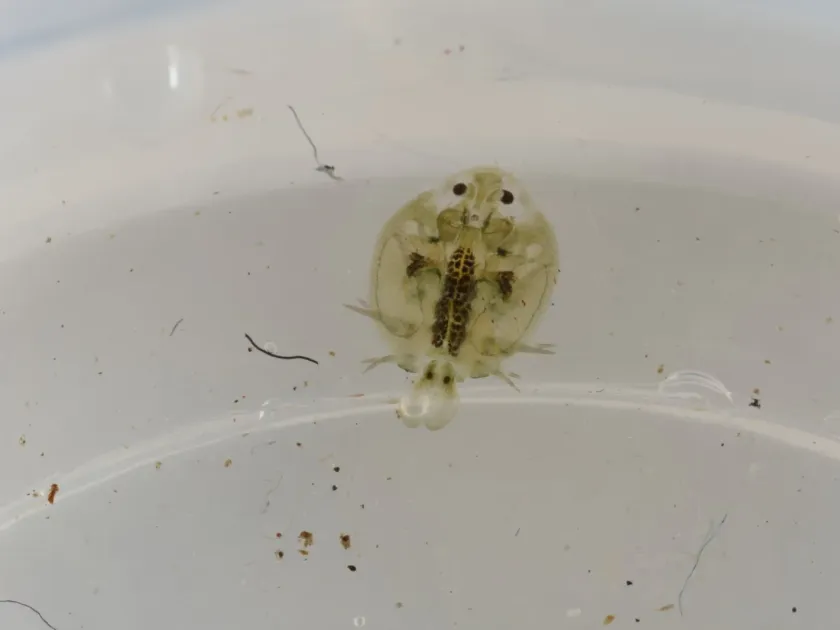
Description
How to identify
Argulus foliaceus, commonly known as the carp louse, is a crustacean ectoparasite belonging to the order Branchiura and the family Argulidae. It is a highly mobile parasite that lives on the surface of freshwater fish.
The body is dorso-ventrally flattened and protected by a transparent shield, making the parasite difficult to spot against the fish scales. It possesses two large compound eyes which are highly sensitive to movement.
A distinctive anatomical feature is the pair of prominent suckers, derived from modified maxillules. These organs allow the parasite to attach firmly to the host's body while moving or feeding.
The carp louse feeds by piercing the skin of the fish with a specialized proboscis (stylet). It injects digestive enzymes and toxins that liquefy tissues, allowing it to ingest the nutrient-rich fluids.
Adult specimens typically reach 5–10 mm in length. Their coloration ranges from translucent green to brown, providing effective camouflage while the parasite resides on the fish's skin.
What it damages
This pest primarily affects freshwater fish species, including carp, koi, trout, and various ornamental fish. It is a major concern in commercial aquaculture and pond keeping due to the direct impact on fish health.
The damage stems from the mechanical puncture of the skin and the injection of toxic secretions, which induce localized inflammation, swelling, and ulceration at the site of attachment.
Infested areas are prone to secondary infections, often allowing bacteria, viruses, or fungi (such as Saprolegnia) to invade the host, which significantly increases fish mortality rates.
Young fish (fry and fingerlings) are particularly vulnerable. Infestation leads to stunted growth, metabolic disruption, and severe stress, which can quickly turn fatal in high-density stocking environments.
Outbreaks can cause significant economic losses in the fishing industry. A large population of carp lice can drastically reduce the commercial value and vitality of the entire fish population in a pond.
When it appears
The activity and lifecycle of the carp louse are heavily influenced by water temperature. Peak infestation periods usually occur during spring and summer months when temperatures exceed 15°C.
Females lay eggs in clusters on various hard surfaces, including rocks, aquatic vegetation, concrete pond walls, and even submerged equipment. Multiple clutches are deposited throughout the warm season.
The incubation period for eggs is temperature-dependent. During the heat of summer, the developmental cycle from egg to mature parasite is accelerated, enabling rapid population spikes.
As water temperatures drop in the autumn, the metabolic rate of the parasites slows down. Adults eventually die off as the cooler environment halts their reproductive activity.
Eggs are highly resilient and serve as the overwintering stage. They remain dormant in the pond substrate until the following spring, ensuring the continuation of the infestation cycle.
Signs of infestation
The first indicator of a carp louse infestation is abnormal fish behavior, such as "flashing" (darting quickly), rubbing against pond sides, or jumping out of the water to dislodge the parasite.
Visible physical signs include small red lesions, bruising, or open ulcers on the skin. Secondary fungal growth, appearing as fuzzy white patches, often covers these injured areas.
If examined closely, the parasites themselves may be seen as small, flattened, oval-shaped discs moving across the fish's skin, often clustering near the fins or gill covers.
Heavily infested fish may gasp for air at the water surface due to gill irritation and physical trauma, which impairs their respiratory function and leads to oxygen deficiency.
General signs of distress include loss of appetite, lethargy, and a drastic decline in the fish's overall condition, making them appear dull or emaciated over time.
Control measures
Effective control starts with sanitation. Draining and thoroughly drying out ponds between production cycles is a proven method for eliminating overwintering eggs.
Quarantine protocols are essential for biosecurity. All new fish must be kept in isolation and inspected carefully before being introduced into established ponds to prevent introducing the pest.
Chemical treatments, such as specialized immersion baths or water additives, can be utilized in controlled environments. However, extreme caution is required to ensure the dosage does not harm the fish.
In decorative or small-scale ponds, mechanical removal using fine-mesh nets or tweezers can provide temporary relief, though this is not a viable strategy for large-scale aquaculture.
Maintaining optimal water quality and providing a balanced diet helps improve the fish's immune response, making them more resilient to parasite stress and reducing the severity of infestations.
Taxonomy
- Latin name
- Argulus foliaceus
- Family
- Argulidae
- EPPO code
- ARGUFO
Discussion
No discussions yet — be the first.