
Carp louse
Argulus
Description
How to identify
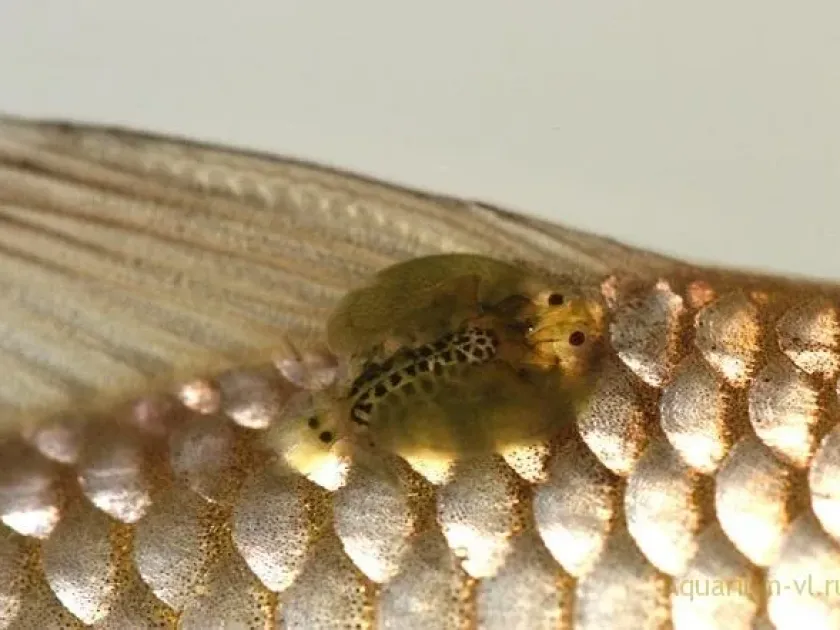
The carp louse (Argulus) is a small crustacean parasite belonging to the class Branchiura. These parasites are disc-shaped, translucent, and highly mobile, which allows them to move quickly over the fish's body.
They possess compound eyes and specialized suction cups used to firmly attach themselves to the host. These structures enable them to maintain their position even when the fish moves through the water.
Their mouthparts are adapted to pierce the fish's skin and suck blood and tissue fluids. During feeding, they inject an irritating secretion that causes inflammation and tissue damage at the site of attachment.
The life cycle involves egg-laying on solid surfaces, such as stones or aquatic vegetation. Larvae emerge and must find a host within a few days, otherwise, they will not survive the transition to adulthood.
As a highly specialized ectoparasite, Argulus has evolved to thrive in various freshwater environments, presenting a significant management challenge for commercial and ornamental fish farmers.
What it damages
The carp louse primarily targets cyprinid fish, including carp, goldfish, and minnows. High stocking density in aquaculture facilities creates ideal conditions for rapid spread of the parasite throughout the population.
The main damage is caused by the mechanical perforation of the skin. These multiple wounds lead to secondary infections, often involving bacteria or fungi, which can significantly increase mortality rates.
Young fish (fry and fingerlings) are particularly vulnerable to infestation. Persistent feeding by lice leads to anemia, growth retardation, and a weakened immune system, which reduces the overall productivity.
Commercial value is severely impacted as fish displaying open sores, ulcers, or visible parasites are rejected by markets. This leads to substantial financial losses for producers.
While larger fish can withstand a small number of lice, chronic infestation stresses them, making them more susceptible to other stressors or environmental changes within the pond.
When it appears
The activity and reproduction of the carp louse are strongly temperature-dependent. Infestations are most severe during the warmer months when water temperatures rise above 15–20 degrees Celsius.
In spring, as water temperatures increase, overwintering adults begin the breeding cycle. Early detection during this period is critical to prevent the population from exploding in the summer.
Summer months provide optimal conditions for the life cycle of Argulus, with multiple generations emerging in a single season. This rapid turnover makes containment difficult without ongoing management.
Autumn cooling triggers a slowdown in biological activity. Most adults die off, but the parasite can overwinter in the egg stage in the sediment of the pond, awaiting the return of favorable conditions.
Pond managers must remain vigilant throughout the entire growing season, as even small fluctuations in water temperature can trigger a cycle of rapid re-infestation if the population is not kept in check.
Signs of infestation
The most common sign of infestation is abnormal behavior, such as "flashing" or rubbing against the sides of the pond or bottom substrates. This is a clear indicator that the fish are irritated.
Visual inspection often reveals the parasites themselves, appearing as small, flat, greenish-gray discs. They are typically found on the flanks, at the base of fins, or near the gill covers.
The attachment sites are marked by red, inflamed areas that may develop into open ulcers or necrotic patches. In severe cases, the affected areas may bleed or show signs of missing scales.
Affected fish often exhibit signs of systemic stress, including lethargy, loss of appetite, and hanging near the water surface. They appear sickly and show little interest in feeding activity.
An indirect sign of the presence of carp lice is the observation of egg masses on submerged structures. Monitoring these surfaces can provide early warning of an impending parasite outbreak.
Control measures
The primary control strategy is the implementation of strict quarantine procedures for all new fish entering the facility. This prevents the introduction of the parasite into clean environments.
Chemical treatments are available for pond management, but they must be applied with extreme caution. Dosages must be calculated correctly to kill the parasite without harming the fish or water quality.
Emptying and drying the pond bottom after the harvest is an effective mechanical method. Exposing the bottom to air and applying lime destroys the overwintering eggs present in the mud.
Biological control, such as stocking predator species that consume carp lice, can be a sustainable option in integrated systems. This reduces the reliance on chemical interventions.
Ongoing monitoring and the manual removal of parasites from infested fish (if the scale allows) can help maintain the louse population below an economic injury level throughout the season.
Taxonomy
- Latin name
- Argulus
- Family
- Argulidae
- EPPO code
- ARGUSP
Discussion
No discussions yet — be the first.