
Lugworm
Arenicola marina
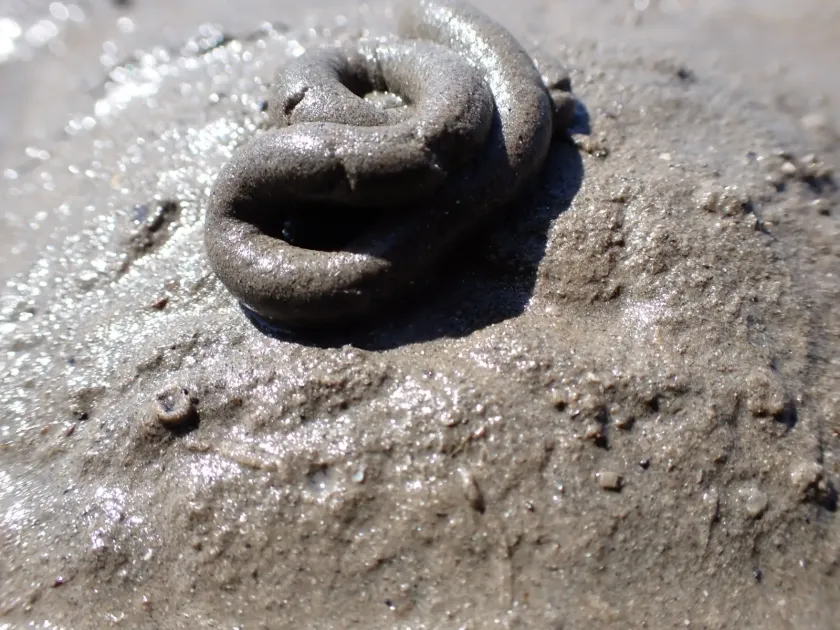
Description
How to identify
The lugworm is a marine polychaete worm belonging to the family Arenicolidae. It typically features a segmented body, reaching lengths of 10 to 20 centimeters, with a color profile ranging from red to dark brown.
The anatomy includes a thicker anterior segment and a slender posterior end. Along the body, there are tufts of bristles that assist the worm in navigating through sandy substrates and stabilizing within its burrow.
These organisms are strictly marine, inhabiting the intertidal zones of coastal regions. They construct U-shaped burrows at depths of up to 30 centimeters in sandy or silty coastal sediments.
Scientifically classified under the class Polychaeta, these worms play a vital role in the marine ecosystem through the process of bioturbation, which involves mixing and oxygenating sediments.
There is no evidence supporting the classification of this worm as a pest for terrestrial plants; it is an exclusively aquatic species that cannot survive in typical farm soil environments.
What it damages
It is important to clarify that the lugworm does not cause any damage to agricultural crops. It lives in salt water and coastal areas, where it has no contact with land-based crops.
Any claims identifying the lugworm as a plant pest are scientifically incorrect. The organism lacks the physiological capacity to feed on terrestrial plant roots or foliage.
The feeding mechanism involves consuming detritus and microorganisms filtered from marine sand. It does not utilize living plant biomass as a source of energy.
The presence of this worm is restricted to saline, intertidal environments. It cannot exist in cultivated soil, nor can it interact with typical garden or field vegetation.
In summary, the lugworm poses zero risk to the agricultural industry, as it remains entirely within the coastal marine ecosystem throughout its life cycle.
Control measures
No protection or control measures are required for the lugworm in an agricultural context. Strategies aimed at controlling pests are not applicable to this marine organism.
If coastal sediments are utilized as a soil conditioner or fertilizer, the incidental presence of lugworms should not be treated as an infestation, as they will perish immediately upon exposure to non-saline conditions.
Farmers should focus their resources on managing genuine agricultural pests such as wireworms or nematodes, which are distinct from marine polychaete species.
No agricultural manuals or pest control guides include the lugworm as a threat, confirming its status as an environmentally neutral organism regarding farming operations.
In conclusion, the lugworm is an important ecological indicator of marine health and does not constitute an economic risk to crop production worldwide.
Taxonomy
- Latin name
- Arenicola marina
- Family
- Arenicolidae
- EPPO code
- ARNCMA
Discussion
No discussions yet — be the first.