
Variegated golden tortrix
Archips xylosteanus
Description
How to identify
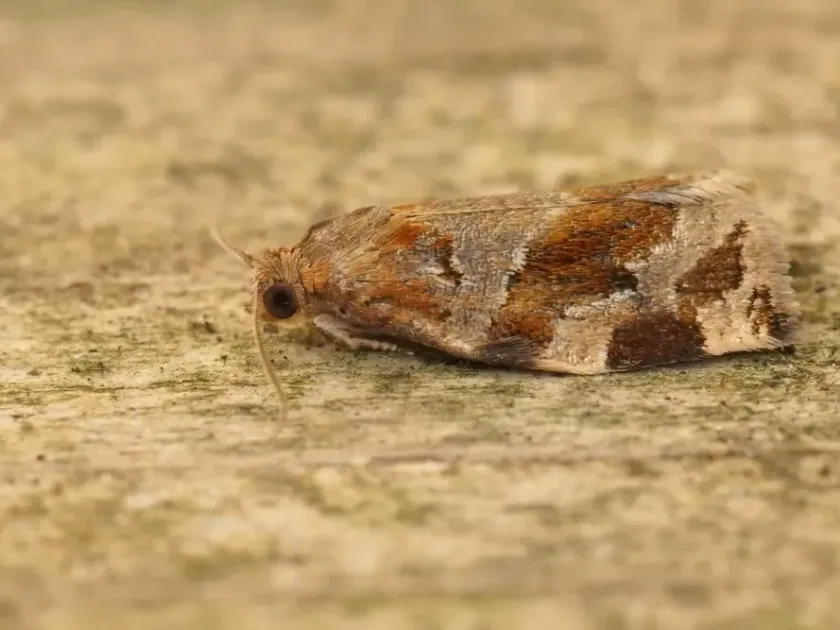
The Variegated golden tortrix (Archips xylosteanus) is a member of the Tortricidae family within the order Lepidoptera. The adult moth features a wingspan of 15-22 mm, with forewings that exhibit a distinct ochre-yellow to golden-brown color patterned with complex dark brown reticulations and bands.
Larvae, commonly known as leafroller caterpillars, grow up to 20 mm in length. They are characterized by a bright green to yellowish-green body, a shiny dark brown head, and distinct black tubercles (warts) on the dorsal segments, which serve as a key diagnostic feature.
The life cycle typically spans one generation per year (monovoltine). It progresses through the stages of egg, larva, pupa, and imago, with development tightly synchronized with the host plant's vegetative cycle.
Overwintering occurs at the egg stage. The females lay eggs in clusters on the bark of host trees, covering them with a secretion that hardens into a protective, bark-colored shield, making them difficult to spot during winter pruning.
As spring temperatures rise, larvae emerge synchronously with the swelling of leaf buds, immediately beginning to feed on the tender green tissue of the host plant.
What it damages
This species is a highly polyphagous pest capable of causing extensive damage to various woody plants. While it thrives on wild deciduous trees, it is a significant economic threat to pome and stone fruit orchards.
Primary host plants include apple, pear, plum, and cherry trees. Additionally, it frequently colonizes common landscape trees such as oak, maple, birch, and linden, which often serve as reservoirs for migration into orchards.
Early-stage larvae tunnel directly into developing buds. This activity often destroys the central growing point of the bud, preventing the formation of healthy leaves and reproductive structures.
As larvae grow, they tie leaves together with silk, forming characteristic rolls or clusters. Inside these shelters, they skeletonize the leaf tissue, significantly reducing the tree's photosynthetic capacity.
Severe infestations lead to stunted growth of new shoots, mass premature fruit drop, and deep scarring on the skin of developing fruits, which renders them unmarketable for fresh consumption.
Signs of infestation
The earliest symptom of infestation is the appearance of damaged, hollowed-out buds in early spring, which fail to open properly or display irregular ragged edges due to larval feeding.
Visible silk webbing pulling leaves into tight, cigar-shaped rolls is the most reliable indicator that the larvae are active within the tree canopy.
Opening these leaf rolls often reveals the green larvae, which typically exhibit a quick, wriggling escape response when disturbed, often dropping on a silk thread.
Damaged fruits exhibit surface feeding marks or irregular, hardened patches that develop as a result of earlier larval grazing on the fruit skin, often occurring where a leaf is webbed against the fruit surface.
During the late summer, one may observe empty pupal exuviae (cast skins) protruding from the edges of dried or skeletonized leaf nests, signaling that the adult moths have emerged.
Control measures
Effective management requires an integrated approach that focuses on reducing overwintering populations and timing insecticide applications to the most vulnerable larval stages.
Cultural control involves thorough pruning and bark inspection, particularly focusing on the removal and destruction of infested twigs and egg-bearing bark segments during the dormant period.
Biological control methods utilize natural enemies, specifically the egg parasitoid Trichogramma, which can significantly reduce the potential number of larvae if released during the egg-laying period.
Chemical control is most effective when targeted at young larvae before they create protective leaf rolls. Once larvae are enclosed in silk, contact insecticide efficacy drops significantly.
- Monitoring flight activity using pheromone traps to time treatments.
- Applying microbial insecticides like Bacillus thuringiensis.
- Using systemic insecticides if thresholds are exceeded.
- Encouraging predatory birds and beneficial insects in the orchard.
Taxonomy
- Latin name
- Archips xylosteanus
- Order
- Lepidoptera (butterflies)
- Family
- Tortricidae
- EPPO code
- CACOXY
Discussion
No discussions yet — be the first.