
Oak leafroller
Archips semiferana
Description
How to identify
The Oak leafroller (Archips semiferana) belongs to the Tortricidae family within the order Lepidoptera. It is a well-known dendrophagous insect that specifically targets various oak species in forestry settings.
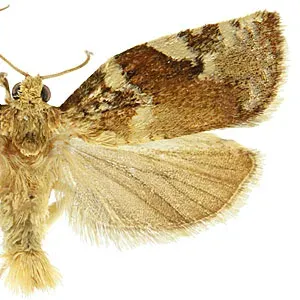
Adult moths have a wingspan typically ranging from 20 to 25 mm. Their forewings feature a mottled pattern of brown, yellowish, and gray scales, providing excellent camouflage against the bark of host trees.
The larvae, or caterpillars, undergo several instar stages, transitioning from light green to an olive or grayish-green color as they mature. The head capsule is usually distinctively darker, often brown or black.
The species follows a complete metamorphosis life cycle. A critical biological aspect is their winter survival strategy, as they overwinter in the egg stage, attached to the bark of branches or trunks.
Adults are primarily nocturnal. Their behavior is highly adapted to the phenology of their host trees, ensuring that the next generation of larvae hatches exactly when the oak buds are beginning to swell.
What it damages
The primary host plant for this species is the Oak (genus Quercus). The larvae are defoliators, meaning they consume the leaf tissue, which can significantly hinder the tree's ability to photosynthesize.
While oaks are the preferred host, this leafroller can also affect other deciduous trees like beech, maple, and hornbeam when they grow in mixed stands, especially during high infestation years.
Early-stage larvae are particularly destructive as they burrow into opening buds, destroying them before the leaves can even emerge, which prevents proper crown development for the season.
Heavy infestations can lead to total defoliation of the canopy. This stress leaves the trees susceptible to secondary pests, such as wood-boring beetles and various fungal pathogens that exploit weakened hosts.
Consistent annual damage results in stunted growth, dieback of the upper crown, and in extreme cases, the mortality of the affected trees, leading to economic losses in timber production.
When it appears
The lifecycle is tightly synchronized with the host tree. Larval emergence coincides with the spring budburst of oak trees, ensuring an immediate food supply for the young caterpillars.
The feeding period occurs throughout late spring, primarily May and early June. Once the larvae reach maturity, they pupate within the protection of curled or webbed leaves.
The flight period of the adult moths typically takes place in June and July. During this time, mating occurs, and females deposit their egg masses on the bark, which will remain there until the following spring.
Climatic factors, such as an early warm spring, can accelerate the development cycle. This synchronicity is essential for the species' survival, as delayed hatching would result in food scarcity.
The remainder of the year, from late summer through winter, the insect remains in the egg stage. This dormancy protects the species from the harsh conditions of winter.
Signs of infestation
One of the most obvious signs of an infestation is the presence of silk webbing among the leaves. The larvae use this silk to tie leaf edges together, creating a protected shelter.
Malformed or skeletonized leaves are common symptoms. The larvae chew through the leaf tissue, often leaving only the main veins, which gives the canopy a sparse, ragged appearance.
The presence of frass (larval excrement) covering the ground beneath the canopy is a clear indicator of a high population density, especially during the peak feeding months.
Bud damage is a critical diagnostic sign. If buds appear to be eaten from the inside or fail to unfold properly in early spring, the presence of the leafroller is highly probable.
Careful inspection of the tree bark during late autumn or winter can reveal egg masses. These look like small, hardened, flattened patches that mimic the color and texture of the surrounding bark.
Control measures
Chemical control involving systemic or contact insecticides is often applied during the early larval stages to prevent severe defoliation. Timing is crucial for maximum efficacy.
Biological control methods, including the application of Bacillus thuringiensis (Bt), are highly effective and environmentally friendly, as they target Lepidopteran larvae without harming beneficial insects.
Promoting a healthy environment for natural predators, such as insectivorous birds and parasitic wasps, is a key component of sustainable forest management against leafrollers.
- Using pheromone traps for monitoring population dynamics and flight timing.
- Sanitary logging to remove heavily infested or dying trees.
- Maintaining forest diversity to reduce the susceptibility of stands.
- Implementing integrated pest management (IPM) strategies to balance chemical and biological inputs.
Continuous monitoring and early detection are vital for successful management. Combining mechanical, biological, and chemical methods helps maintain tree health while minimizing the environmental impact.
Taxonomy
- Latin name
- Archips semiferana
- Order
- Lepidoptera (butterflies)
- Family
- Tortricidae
- EPPO code
- ARCHSE
Discussion
No discussions yet — be the first.