
Variegated golden tortrix
Archips podana
Description
How to identify
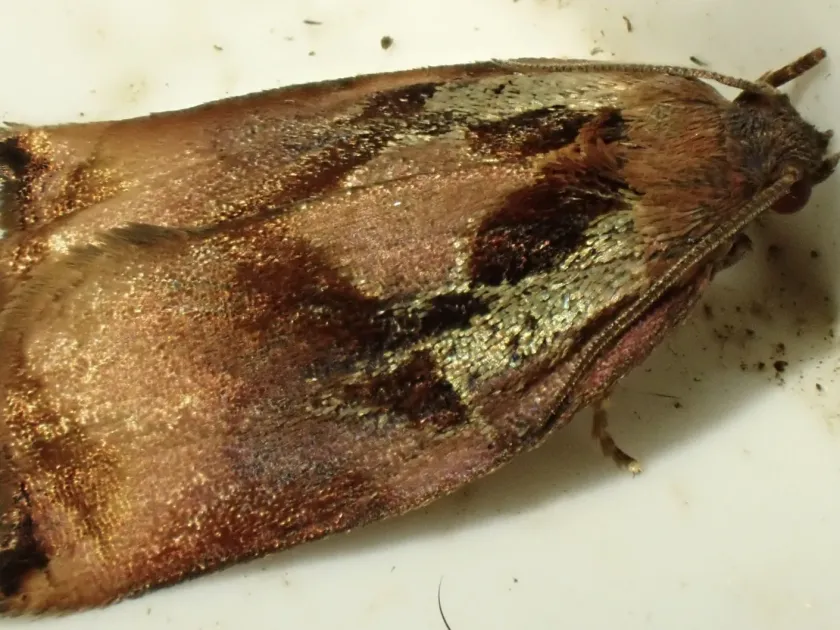
The variegated golden tortrix (Archips podana) belongs to the Tortricidae family. The adult moth has a wingspan of 18–25 mm, with brownish or reddish-brown forewings displaying a complex darker pattern.
The larvae, or caterpillars, grow up to 25 mm long. Their bodies range from olive to grass green, while their heads are usually dark brown or black, aiding their camouflage among foliage.
Pupation occurs within leaves that have been rolled and tied together with silk. This silken shelter provides the pupa with protection against weather and natural predators.
The species typically completes two generations annually in temperate regions. Larvae of the later instars overwinter in silk cocoons hidden within bark crevices.
Adult moths are nocturnal. During the day, they remain stationary on the underside of leaves or within the canopy, making them difficult to spot during routine orchard inspections.
What it damages
This pest is highly polyphagous, attacking a wide range of fruit crops including apples, pears, cherries, and plums, as well as several berry-producing bushes.
Beyond fruit trees, the variegated golden tortrix is known to infest ornamental plants like roses, maples, and lindens, increasing its impact in landscape gardening.
Older larvae consume large portions of leaf tissue, leaving only the veins behind, which severely impairs the tree's photosynthetic capacity during the growing season.
The most significant economic damage occurs when larvae feed on developing fruit. They excavate shallow cavities in the skin, leading to fruit deformation and premature dropping.
Damaged fruit often develops secondary rot infections due to the skin being compromised, rendering the produce unsuitable for storage or fresh market sale.
When it appears
The first generation of adults emerges in late May or June. Females deposit eggs in clusters on the upper surface of leaves, where they hatch in about two weeks.
The second generation appears in August. Larvae of this generation are particularly destructive as they feed during the critical ripening phase of most pome and stone fruits.
As autumn temperatures drop, the larvae cease feeding and migrate to protected sites on the tree trunk to construct cocoons for the winter diapause.
Monitoring the flight of adult moths using pheromone traps is essential for precise timing of integrated pest management interventions in commercial orchards.
Climate factors such as temperature and humidity significantly influence the developmental speed, potentially leading to population explosions in warm, damp seasons.
Signs of infestation
The most obvious symptom is leaves being rolled into tubes or clusters and secured with silk threads, which serve as protective feeding shelters for the larvae.
Frass (larval excrement) visible on the leaf surface or around the fruit stem indicates active feeding by the caterpillars nearby.
Surface scarring on fruit appears as shallow, corky patches. These markings become more prominent as the fruit grows and matures towards the harvest date.
Wilting of shoot tips occurs when larvae feed on the apical growth or sever the leaf petioles, disrupting the tree’s structural development.
Careful inspection of the canopy reveals "webbed" fruit where the larva has tied a leaf to the fruit surface to create a hidden feeding area.
Control measures
Cultural practices are paramount, including the removal of loose bark from tree trunks to eliminate overwintering sites and the sanitation of fallen orchard debris.
Pheromone traps are highly recommended to monitor population density and to synchronize insecticide applications with the peak activity of the pest.
Biological control using Bacillus thuringiensis (Bt) sprays can effectively suppress young larvae before they create heavy silken webs that protect them from contact.
Chemical control should target vulnerable larvae shortly after hatching. It is vital to use systemic or contact insecticides before the caterpillars enter the leaf rolls.
- Encouraging natural predators such as parasitic wasps.
- Pruning infested shoots during the summer growth phase.
- Applying insect growth regulators at the appropriate larval stage.
Taxonomy
- Latin name
- Archips podana
- Order
- Lepidoptera (butterflies)
- Family
- Tortricidae
- EPPO code
- CACOPO
Discussion
No discussions yet — be the first.