
Archips infumatana leafroller
Archips infumatana
Description
How to identify
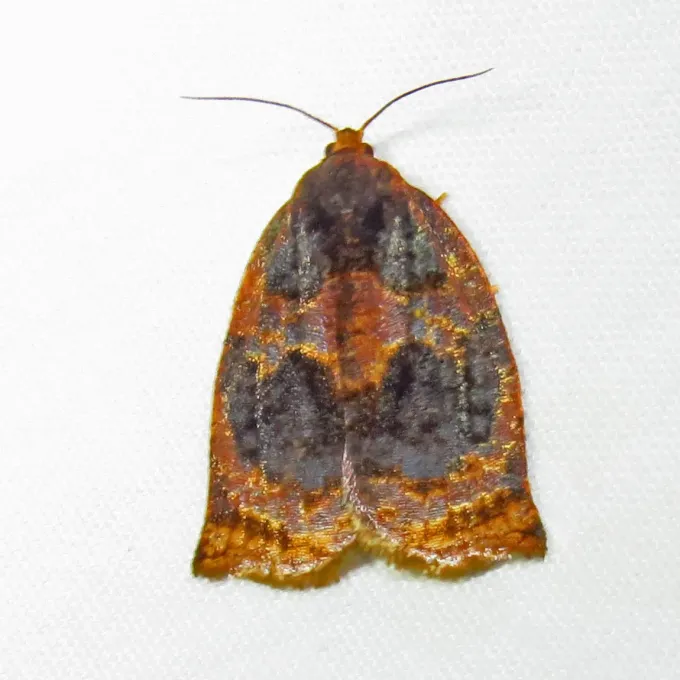
The Archips infumatana leafroller belongs to the order Lepidoptera and the family Tortricidae. Adult moths are relatively small with a wingspan ranging from 20 to 25 mm.
The forewings exhibit a pattern characterized by light to dark smoky-brown shades, often featuring distinct dark markings that provide excellent camouflage on bark.
The larvae are typically cylindrical with a brownish or black head, and their body color generally ranges from light green to olive, matching the foliage they feed on.
Pupation occurs within rolled-up leaves or in crevices of the tree bark, secured by dense silk spun by the larva during the final stages of its development.
Identification to the species level usually requires specialized entomological study, as Archips infumatana closely resembles other members of the Archips genus.
What it damages
This species is a generalist feeder that prefers plants within the Rosaceae family, causing significant economic damage to apple, pear, and stone fruit orchards.
Larvae primarily consume buds and young leaves, but they are also known to bore into young fruit, causing deep holes that render the produce unmarketable.
Damage to the foliage leads to reduced photosynthetic capacity, weakening the tree and causing physiological stress during the peak growing season.
Heavy infestations can result in premature leaf drop, stunted shoot development, and a substantial decrease in overall fruit production and quality.
Wounds left by the feeding larvae serve as entry points for various secondary pathogens, including fungi that cause fruit rots and bark cankers.
When it appears
Adult moths typically emerge in late spring, which aligns with the bud-break and flowering phases of host fruit trees.
Eggs are laid in clusters on leaf surfaces, and the subsequent larvae hatch within approximately two weeks, depending on environmental temperatures.
The period of larval activity coincides with the most vulnerable developmental stages of the host plant, particularly during flowering and fruit setting.
Depending on the local climate and temperature, Archips infumatana may complete multiple generations within a single season, escalating the infestation risk.
The species overwinters in the larval stage, usually hiding within protective silken hibernacula located in deep bark crevices or near fruit buds.
Signs of infestation
The most diagnostic sign of an infestation is the presence of leaves tightly rolled or folded and webbed together with silk threads.
Inspection often reveals ragged feeding patterns on leaves and localized skeletonization where the larvae have consumed the softer tissues.
On developing fruit, characteristic deep, circular pits or scars appear as the larvae graze on the surface or bore into the flesh.
Frass (larval excrement) is often found inside the leaf rolls or trapped in the webbing between leaves, indicating active feeding sites.
In severe cases, the tree canopy may appear disfigured, with numerous silk-webbed structures holding deformed or dead leaves together.
Control measures
Monitoring using pheromone traps is highly recommended to pinpoint the exact timing of adult moth flight and subsequent egg-laying periods.
Cultural practices include scraping loose bark from tree trunks and thinning the canopy to reduce shelter sites and improve spray penetration.
Biological control options, such as the application of Bacillus thuringiensis, provide an effective and environmentally friendly way to suppress larval populations.
Chemical control should be targeted during the early stages of larval hatching to minimize the impact of the pest before they enter the leaf rolls.
- Regular pruning of infested shoots and branches.
- Encouraging natural predators such as lacewings and parasitic wasps.
- Integrated Pest Management (IPM) rotation of insecticide classes.
Taxonomy
- Latin name
- Archips infumatana
- Order
- Lepidoptera (butterflies)
- Family
- Tortricidae
- EPPO code
- ARCHIN
Discussion
No discussions yet — be the first.