
Archips goyerana moth
Archips goyerana
Description
How to identify
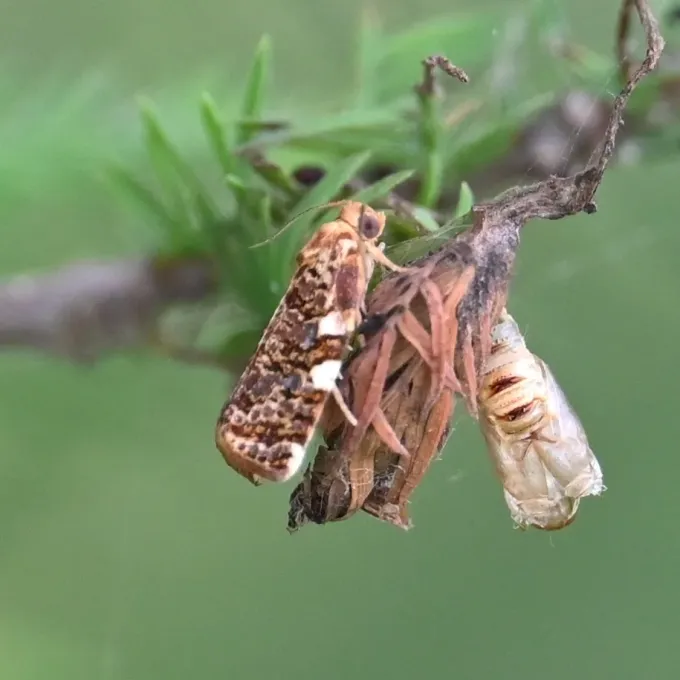
Archips goyerana is a moth species belonging to the Tortricidae family within the order Lepidoptera. Like other leafrollers, the adult moths have a characteristic bell-shaped or trapezoidal outline when at rest, with wings folded over the abdomen.
The forewings typically display a tan or brownish coloration with distinct darker bands and markings, which help them blend in with tree bark and foliage. However, visual identification of this specific species is challenging due to the close similarity between various members of the genus Archips.
The larvae are typical leafroller caterpillars, characterized by a smooth body with well-developed thoracic legs and a distinct head capsule. They exhibit a strong avoidance reflex, wriggling violently and dropping on silk threads when disturbed.
Definitive identification usually requires anatomical study of the genitalia of adult specimens. Field diagnosis is often supplemented by the use of pheromone traps, which are specific to the species and highly useful for monitoring populations.
Understanding the life stages of this moth is crucial for accurate pest management. The developmental period can vary significantly based on temperature and regional climatic factors.
What it damages
This species is known to infest a wide variety of deciduous trees and shrubs. It is considered an important pest for various fruit crops, particularly those within the Rosaceae family, causing both direct and indirect damage.
The larvae primarily feed on buds, young leaves, and developing blossoms, which can drastically reduce the plant's growth potential and fruit-set capability. Intense feeding activity significantly diminishes the total leaf area available for photosynthesis.
In high-density infestations, the larvae may feed on the surface of developing fruit, creating irregular pits and scars. This damage not only ruins the fruit's cosmetic appeal but also makes it highly susceptible to fungal infections and decay.
By damaging terminal shoots, the caterpillars disrupt the plant’s normal growth pattern. This often leads to stunted growth, reduced vigor, and the development of abnormal, bushy branch structures.
Young orchards and nursery seedlings are particularly vulnerable to this pest, as the loss of primary shoots can delay tree development and impact overall orchard productivity for several years.
When it appears
The life cycle of Archips goyerana is closely tied to the host tree's phenology. Winter is typically passed in the egg stage or as early-instar larvae tucked into bark crevices or near bud scales.
In spring, as temperatures rise and buds begin to swell, the larvae emerge from their overwintering sites. They immediately begin feeding on the fresh tissue, which provides the necessary nutrients for their rapid development.
Adult moths typically emerge in early to mid-summer. During this time, they engage in mating and egg-laying, selecting host plants to ensure the next generation has immediate access to food.
Depending on the latitude and local climate, the species may complete one or several generations per year. This potential for multiple generations requires careful monitoring throughout the entire growing season.
By autumn, the development slows down as the species enters diapause. This survival strategy ensures that the population remains viable through the winter, ready to repeat the cycle when spring conditions return.
Signs of infestation
The most distinctive sign of Archips goyerana infestation is the presence of rolled or folded leaves, often bound together with dense silk webbing. Inside these shelters, larvae are protected from predators and environmental stressors.
Visible webbing is a key diagnostic indicator. You will often see silk strands connecting adjacent leaves or anchoring leaves to fruit, effectively creating a protected chamber for the caterpillar to feed.
Larval feeding often results in skeletonized leaves, where only the vascular tissue remains. This damage pattern is easy to spot upon close inspection of the tree canopy during the active growth phase.
The accumulation of dark fecal pellets, or "frass," inside the rolled leaves is a definitive sign of an active infestation. Its presence confirms that the larva is currently feeding in the immediate vicinity.
Dying or wilting terminal shoots that appear severed at the base are common indicators that larvae have been burrowing into the soft stem tissue, disrupting the transport of nutrients.
Control measures
Integrated Pest Management (IPM) for Archips goyerana focuses on cultural practices such as pruning and destroying infested shoots to lower the overwintering population density.
Biological control options include the release of parasitic wasps, such as Trichogramma species, which parasitize the moth's eggs and effectively suppress population growth in a natural way.
Microbial insecticides based on Bacillus thuringiensis (Bt) offer a targeted approach to managing caterpillars. These products are most effective when applied during the early stages of larval development.
Chemical control should be used as a last resort, triggered by threshold levels established through pheromone trap monitoring. This approach minimizes unnecessary chemical exposure and delays the development of resistance.
- Monitor population levels regularly with pheromone-baited traps.
- Maintain proper tree health through balanced fertilization to support resilience.
- Rotate insecticides with different modes of action to maintain efficacy.
Taxonomy
- Latin name
- Archips goyerana
- Order
- Lepidoptera (butterflies)
- Family
- Tortricidae
- EPPO code
- ARCHGO
Discussion
No discussions yet — be the first.