
Georgian leafroller
Archips georgiana
Description
How to identify
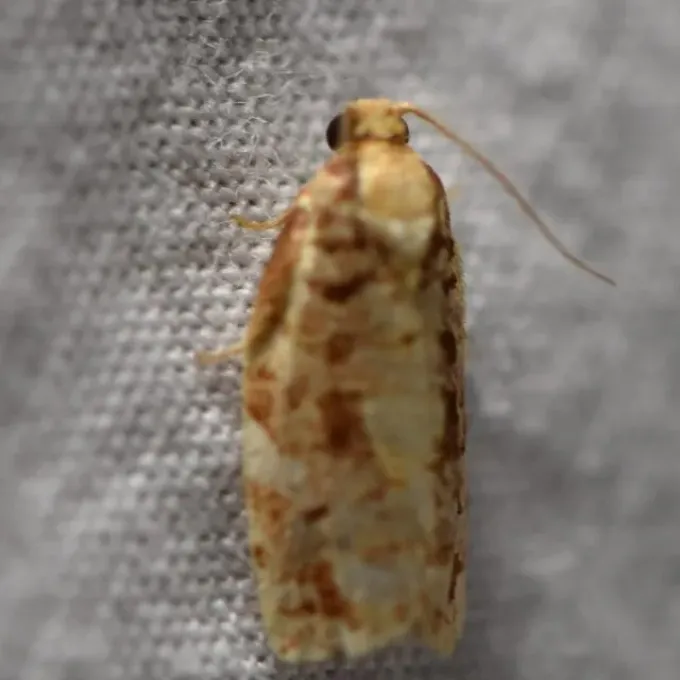
The Georgian leafroller (Archips georgiana) belongs to the Tortricidae family within the order Lepidoptera. This small moth is primarily crepuscular and nocturnal, which makes its visual detection during daylight hours difficult.
Adult individuals exhibit the typical wing structure for the genus Archips, which fold in a roof-like manner when at rest. Wing coloration varies from light brown to ochre hues, featuring a darker reticulated pattern.
Larvae of this species go through several developmental stages, gradually changing color from light green to darker shades, typically featuring a darker head capsule. The body is covered in sparse hairs, a common characteristic of most leafroller species.
The insect undergoes complete metamorphosis: egg, larva, pupa, and imago. Each stage is strictly tied to specific temperature conditions and the availability of a food base within its distribution range.
Identification of the species is often performed by examining the imago's genital apparatus or via DNA analysis, as many members of the Archips genus appear very similar externally.
What it damages
The main food sources for the Georgian leafroller larvae are woody and shrubby crops. The greatest damage is inflicted on fruit plantations, where the pest attacks leaves, buds, and fruitlets.
Larvae can damage both the leaf apparatus, pulling leaves together with silk into characteristic "cocoons" or "tubes," and bore into young shoots, causing deformation and subsequent necrosis.
During outbreak years, the leafroller can significantly reduce the photosynthetic activity of plants due to extensive leaf surface damage, leading to a weakened overall plant immunity.
Damage to generative organs — buds and fruitlets — directly impacts yield. Even partial injury to the pedicel or the tissues of a young fruit can lead to premature abscission.
In addition to fruit trees, the pest may be found on wild representatives of the Rosaceae family, providing a reservoir near agricultural fields.
Signs of infestation
The first visual sign of the pest's presence is the occurrence of curled or silk-glued leaves at the tips of shoots. Inside such shelters, one can always find a larva or its frass.
Damaged buds in spring may fail to open or exhibit uneven margins, indicating that their contents have been eaten by larvae during the early development period.
On the surface of young fruits, shallow ulcers or "netted" skin damage are often observed, which harden into corky tissue over time, reducing the marketability of the produce.
The presence of moths in the orchard can be confirmed using pheromone traps, which allow for monitoring the onset of flight and population peaks to make informed treatment decisions.
Branches infested with high larval numbers look stunted; their growth slows down, and leaves may develop a chlorotic tint due to disrupted nutrient and water transport.
Control measures
Effective protection begins with agrotechnical measures: removing and destroying damaged leaves and shoots where larvae are localized early in the season.
The application of biological insecticides based on Bacillus thuringiensis shows high efficacy against early-instar larvae and is safe for beneficial insect predators and parasitoids.
Chemical treatments are carried out during periods of mass larval hatching. It is recommended to rotate products from different chemical classes to prevent the development of resistance within the pest population.
Using sticky bands on tree trunks helps limit larval movement, while hanging pheromone dispensers facilitates the disruption of mating patterns by confusing males.
A crucial role is played by encouraging natural enemies: insectivorous birds, Trichogramma wasps, and other parasitic Hymenoptera that can suppress leafroller numbers to an economically acceptable level.
Taxonomy
- Latin name
- Archips georgiana
- Order
- Lepidoptera (butterflies)
- Family
- Tortricidae
- EPPO code
- ARCHGE
Discussion
No discussions yet — be the first.