
Dark-brown apple tortrix
Archips fuscocupreanus
Description
How to identify
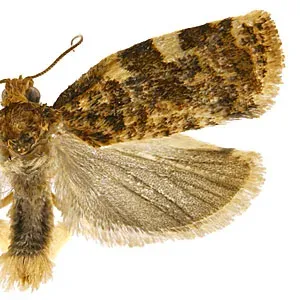
The dark-brown apple tortrix (Archips fuscocupreanus) belongs to the Tortricidae family of the order Lepidoptera. Adult moths typically have a wingspan ranging between 20 and 25 mm.
The forewings are dark brown or coppery-brown in color, often featuring a subtle reticulated pattern that provides effective camouflage against tree bark. The hindwings are generally lighter, with shades of gray or brownish-gray.
Larvae undergo several developmental stages, changing color from yellowish-green in early instars to an olive-green hue in later stages. The head capsule remains dark or brown throughout their development.
The species deposits eggs in the form of flat, overlapping clusters that resemble small, dense patches on the tree trunk and branches.
As a highly adaptable species, it thrives in moderate climates, often becoming a significant pest in commercial apple orchards and smaller fruit gardens.
What it damages
The primary host for this pest is the apple tree, though it can also infest pear, quince, and other fruit-bearing trees when population densities are high.
Early-stage larvae target developing buds, boring into them to consume the interior tissues, which frequently prevents the growth of new leaves and flowers.
During the blooming season, the larvae web flowers and buds together using silk threads, destroying the reproductive parts and causing premature flower drop.
After fruit set, larvae transition to young fruitlets, feeding on the surface or burrowing inside, creating deep cavities that render the fruit unsellable.
Extensive defoliation by larvae can significantly stress the trees, reduce photosynthetic activity, and lead to reduced vigor during the subsequent growing season.
When it appears
This species is univoltine, meaning it produces only one generation per year. The eggs overwinter on the bark of host trees, remaining dormant until spring.
Larval emergence coincides with the green-tip or tight-cluster stage of apple tree development, making spring scouting essential for effective pest management.
Adult moths typically fly during the summer months, specifically from late June to early August, depending on regional temperatures and seasonal heat accumulation.
After mating, females lay eggs that stay on the tree throughout the autumn and winter, establishing the foundation for next year's generation.
Optimal conditions for larval development include mild spring temperatures and adequate humidity, which support survival rates within the tree canopy.
Signs of infestation
One of the earliest signs of infestation is the presence of buds that fail to open or appear desiccated, often accompanied by silk webbing.
Leaves rolled into tight cylinders or "tents" are a major diagnostic feature, as the larvae hide inside these structures to feed protected from predators.
Accumulation of frass (larval excrement) near the points of damage is a strong indicator that the population is active and requires immediate attention.
Malformed or scarred young fruits, characterized by pits or shallow excavations on the skin, indicate that the larvae have reached the fruit-feeding stage.
- Rolled leaves tied with silk.
- Webbed flower clusters.
- Tunnels in young fruitlets.
- Presence of larval frass on leaves.
Control measures
Cultural control methods involve cleaning tree trunks of loose, old bark during the winter to destroy overwintering egg clusters and pruning infested branches.
Biological control options, such as Bacillus thuringiensis (Bt) sprays, are effective against young larvae and represent an environmentally friendly approach.
Chemical control is most effective when timed precisely to the larval emergence period, reducing the need for broad-spectrum insecticide applications.
Pheromone traps are essential for monitoring adult flights, allowing orchard managers to calculate the optimal timing for protective interventions.
Encouraging the presence of natural enemies, including predatory bugs and parasitic wasps, can help keep population levels below the economic threshold.
Taxonomy
- Latin name
- Archips fuscocupreanus
- Order
- Lepidoptera (butterflies)
- Family
- Tortricidae
- EPPO code
- ARCHFU
Discussion
No discussions yet — be the first.