
Oak leaf roller
Archips crataegana
Description
How to identify
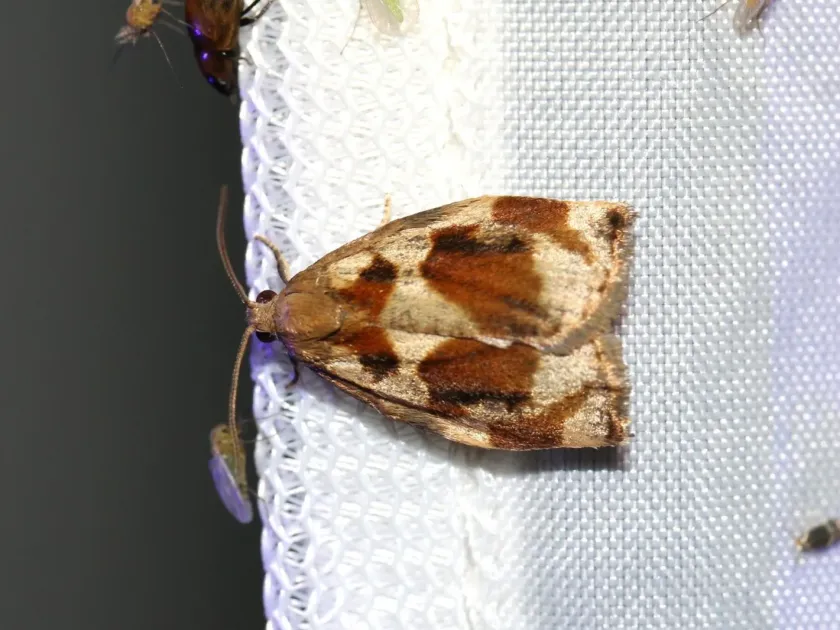
The Oak leaf roller (Archips crataegana) is a moth species belonging to the Tortricidae family. The adult moth features a wingspan of approximately 18–26 mm, with forewings showing a brown-grey or ochre pattern.
The larvae, or caterpillars, reach a length of 20–25 mm. They possess a black head capsule and an olive-green body covered with small, light-colored tubercles, each bearing a long hair.
Females deposit their eggs on tree branches in flat, hard-to-spot clusters. These clusters are often coated with a substance that matches the texture and color of the bark, providing excellent camouflage.
The species overwinters as an egg. This stage is highly resistant to cold, allowing the population to survive harsh winters and synchronize emergence with the spring budburst.
Pupation occurs within the larval habitat. The caterpillar uses silk threads to roll leaves into protective tubes or dense bundles, creating a safe enclosure for its transformation into a pupa.
What it damages
The Oak leaf roller is a polyphagous pest, meaning it feeds on a wide range of plants. While it prefers oaks, it frequently infests orchard trees such as apple, pear, plum, and cherry.
In addition to cultivated fruit trees, the pest thrives on various wild species, including elm and willow. These trees often serve as reservoirs for the pest, facilitating re-infestation of nearby orchards.
The primary damage is caused by larvae feeding on buds, developing flowers, and young foliage. In cases of high infestation, they may also consume the skin and flesh of small, developing fruit.
Damaged leaves are often skeletonized, leading to reduced photosynthetic capacity. This weakens the tree's vigor and can result in significant yield losses and reduced fruit quality.
Heavy infestations can lead to partial defoliation of the tree, which negatively impacts the tree's ability to store energy for the subsequent year's bloom and growth cycles.
When it appears
The biological cycle is strictly synchronized with the phenology of the host plants. Larvae hatch early in the spring, typically at the time of the budburst of host fruit trees.
The larval stage is the most active feeding period, lasting approximately 4 to 6 weeks. It usually occurs between mid-spring and early summer, covering the flowering stage of most fruit trees.
Pupation takes place in late May or June. This phase is relatively short, usually lasting about two to three weeks until the adult moth emerges.
Adult moths fly during the summer months, typically in June and July. During this time, they mate and lay eggs that will remain dormant until the following spring.
The species produces one generation per year. However, the high reproductive rate of females ensures that even a single generation can cause substantial damage if not managed properly.
Signs of infestation
The first sign of an infestation is the presence of damaged or "webbed" buds in early spring, which fail to open correctly due to larval feeding.
Leaves rolled into tight cylinders or irregular bundles tied with silk are diagnostic signs of the presence of the larvae within the canopy of the tree.
Feeding damage on young fruit appears as irregular surface excavations. As the fruit grows, these wounds often turn into scarred, corky patches, ruining the aesthetic and market value.
The presence of fine silken threads between leaves and branches, along with black frass (excrement) pellets, indicates active larval feeding within the immediate area.
Visual spotting of the moths during evening hours near light sources or resting on tree bark confirms the presence of the reproductive adults.
Control measures
Good orchard hygiene is the first step in control. This includes scraping old bark off the trunks where egg clusters may be hidden and removing pruned material from the orchard.
Biological control using bacteria like Bacillus thuringiensis can be very effective if applied correctly during the early larval stages before the leaves are tightly rolled.
Monitoring using pheromone traps is recommended to track the flight of adult moths, allowing for precise timing of necessary insecticide applications.
Maintaining a balanced ecosystem by encouraging natural predators, such as birds and parasitic wasps, can help keep the Oak leaf roller population below the economic threshold.
- Apply insecticides during the early larval stage (post-bloom).
- Use targeted bio-pesticides to protect beneficial insects.
- Manually remove and destroy rolled leaves in small-scale orchards.
- Ensure proper tree spacing and pruning for better spray coverage.
- Monitor for early damage signs as soon as buds start swelling.
Taxonomy
- Latin name
- Archips crataegana
- Order
- Lepidoptera (butterflies)
- Family
- Tortricidae
- EPPO code
- ARCHCR
Discussion
No discussions yet — be the first.