
Cherry fruitworm
Archips cerasivoranus
Description
How to identify
The cherry fruitworm (Archips cerasivoranus), also known as the ugly-nest caterpillar, is a moth species belonging to the family Tortricidae. Adult moths typically have a wingspan of 18–25 mm, with their forewings displaying a distinct yellow-brown pattern with darker netting, providing effective camouflage.
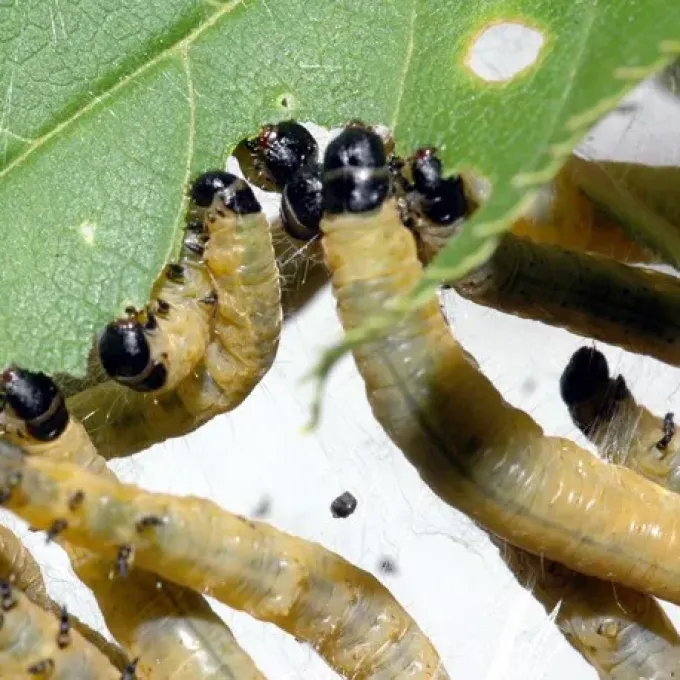
The larvae are approximately 20 mm long when fully grown. They possess a yellow-green to olive-colored body with a shiny black head and prothoracic shield. A sparse covering of light-colored hairs on the body is a key morphological feature for field identification of this species.
Eggs are deposited by females in dense clusters on the bark of young twigs. These egg masses are covered with a protective glue-like secretion, forming a durable, flat plate that blends seamlessly with the host plant's bark, making them extremely difficult to spot during winter.
Pupation occurs within the safety of the webbed nests constructed by the larvae. The pupae are dark brown, and before the adult moth emerges, they partially protrude from the cocoon to facilitate the eclosion process.
This species is univoltine, meaning it completes only one generation per year. While this limits its rapid population growth compared to multi-generational pests, the larvae's habit of feeding in dense, colonial groups still causes localized but intense damage.
What it damages
The cherry fruitworm primarily attacks members of the Rosaceae family, with cherry and chokecherry being the most common hosts. It may also occasionally infest other stone fruit species and apple trees if they are located near heavily infested host plants.
The damage is caused exclusively by the larvae. Immediately upon hatching in the spring, they begin to weave silk around the leaves, creating large, colonial webbed nests. They feed inside these structures, skeletonizing the leaves and causing them to turn brown and wither.
Significant damage occurs when entire branches or the tops of young saplings are stripped of foliage. This loss of photosynthetic capacity weakens the tree, makes it more susceptible to environmental stress, and can lead to the death of affected twigs.
The infestation of terminal shoots is particularly detrimental to tree development. By destroying the growth buds and young leaves, the larvae stunt the growth of the twigs and can lead to the loss of fruit yields if the reproductive buds are compromised.
While an individual nest may not kill a mature tree, cumulative damage from multiple colonies can significantly reduce the vitality of the orchard, leaving the trees vulnerable to secondary attacks by wood-boring insects or fungal pathogens.
When it appears
The insect overwinters in the egg stage on the bark of twigs. Embryonic development resumes with the onset of spring, and hatching typically coincides with the bud-break phenological stage of the host tree, ensuring the larvae have immediate access to succulent new growth.
The larval stage lasts approximately 40–50 days, during which they continuously expand their silk nests. Gardeners usually notice the characteristic webbing in late spring and early summer as the nests grow larger and become more conspicuous.
Pupation typically begins in early summer. The pupal stage lasts for about two to three weeks. Adult moths emerge in mid-to-late summer, usually starting in July, beginning their reproductive cycle of mating and egg-laying.
Adult moths are nocturnal and crepuscular, showing little activity during the day. They spend daylight hours hiding among the dense foliage of the host plants, which makes monitoring their presence through visual inspection challenging for orchard managers.
Egg-laying continues through the end of the summer. Once the female completes oviposition, the egg masses are secured to the host twigs, where they remain dormant throughout the autumn and winter months, awaiting the return of favorable temperatures.
Signs of infestation
The most prominent sign of infestation is the presence of large, unsightly webbed nests at the ends of twigs. These nests often contain trapped dead leaves, excrement, and silk threads, making them stand out against the healthy foliage of the tree.
- Skeletal leaves: Leaf tissues are partially consumed, leaving only the veins behind within the nest.
- Accumulated frass: Small, dark granular excrement pellets are visible inside the silk webbing.
- Stunted growth: Terminal shoots stop extending, and the area around the nest appears deformed.
- Premature leaf drop: Heavily infested branches may shed leaves in mid-summer, creating a patch of early autumn-like foliage.
- Egg masses: Smooth, brownish, plate-like deposits on the bark of twigs, visible during the dormant season.
Because the larvae are colonial, finding one nest often indicates that others are nearby. If the nest is disturbed, the larvae will exhibit rapid, wriggling movements and may drop from the tree on silk threads to escape predators.
The severity of the infestation is easily estimated by counting the number of active nests per tree. Monitoring is most effective during the spring months, as this allows for intervention before the larvae reach maturity and pupate.
In cases of high infestation, the total leaf area lost can be significant enough to reduce the storage of carbohydrates needed for winter survival and next year's bud development, impacting the overall tree vigor.
Control measures
Manual removal of the nests is the most effective mechanical control measure, especially for smaller trees. Pruning and destroying the webbed nests during the spring and late winter effectively reduces the overwintering population.
Chemical control should be timed to coincide with the hatching of the larvae in the spring. Contact or systemic insecticides are effective if applied before the larvae have fully enclosed themselves within dense, protective webs.
Biological control using Bacillus thuringiensis (Bt) is highly recommended for commercial and backyard orchards. This bacterium specifically targets the larvae, providing a safe alternative that protects beneficial insects and pollinators.
Integrated Pest Management (IPM) practices, including the use of pheromone traps, can help track adult moth activity. This data allows growers to apply treatments at the most vulnerable lifecycle stages, minimizing the need for broad-spectrum chemical use.
Encouraging natural predators and parasitoids, such as parasitic wasps, is an essential strategy for long-term population suppression. Maintaining a diverse orchard environment helps keep the population of the cherry fruitworm below the economic injury level.
Taxonomy
- Latin name
- Archips cerasivoranus
- Order
- Lepidoptera (butterflies)
- Family
- Tortricidae
- EPPO code
- ARCHCE
Discussion
No discussions yet — be the first.