
Asian fruit tortrix
Archips asiaticus
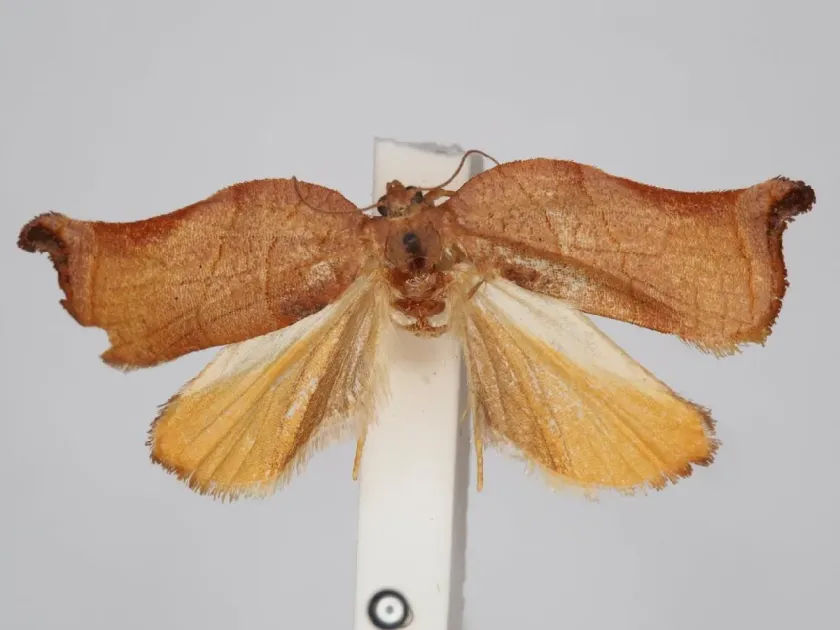
Description
How to identify
The Asian fruit tortrix (Archips asiaticus) is a member of the Tortricidae family within the order Lepidoptera. This moth species is a significant pest in fruit orchards across its range.
Adult moths feature a wingspan ranging from 20 to 25 mm. Their forewings typically exhibit a mottled pattern of light brown, ochre, and dark brown, providing excellent camouflage against tree bark.
Larvae, or caterpillars, go through several developmental stages. Initially pale, they eventually develop a greenish to olive body color with a dark, often black, head capsule.
Pupae are dark brown and usually hidden within rolled leaves or bark crevices, which are secured with silk to protect the developing insect from predators and environmental hazards.
The life cycle typically includes one or two generations per year, depending on the local climate. Overwintering occurs primarily at the egg stage, attached to the branches of host trees.
What it damages
This pest targets various Rosaceae species, most notably apple, pear, plum, and apricot trees. It can cause significant economic losses in commercial fruit production.
The larvae feed on young leaves, buds, and flowers, but the most severe damage occurs when they consume developing fruit, leading to poor yields and reduced quality.
Affected young shoots often display stunted growth, as the larvae frequently consume the tender apical meristem, disrupting the tree's natural developmental architecture.
Fruit damage usually appears as superficial grazing, which creates corky patches on the skin of the fruit, making it unattractive and susceptible to secondary fungal infections.
In cases of high infestation, the foliage loss caused by leaf-rolling and skeletonization significantly reduces the tree's photosynthetic capacity, affecting future harvests.
When it appears
Adult moths typically emerge in the spring, coinciding with the bud-break phase of host fruit trees. Their activity levels are highly dependent on early spring temperatures.
Egg-laying activity begins in May. Females deposit eggs in clusters on smooth branches, where they are camouflaged by a secretion that darkens over time.
Larval emergence occurs after approximately two weeks, with the young caterpillars immediately seeking out fresh buds and leaves to begin their feeding cycle.
The second generation of moths is usually active during mid-summer. This generation is often responsible for the direct damage to ripening fruits observed in orchards.
As autumn approaches, the life cycle completes, and the final generation of the season prepares for overwintering, ensuring the species survives until the following spring.
Signs of infestation
The most recognizable sign of infestation is the presence of leaves rolled up and fastened together with silk webbing, which serve as protective shelters for the larvae.
Damaged fruit surfaces with irregular, cork-like scars or holes are a definitive sign that Archips asiaticus larvae have been active on the tree during the fruit-set period.
The presence of larval frass (droppings) accumulated within the webbed leaf nests is an indicator of an active and feeding caterpillar population.
Wilting or dead terminals on young branches are often caused by the larvae feeding inside the shoot tips, which disrupts vascular flow and causes localized dieback.
Empty pupal cases found in bark crevices or attached to dried leaves signify that a generation has completed its development and the adults have already emerged.
Control measures
Successful management of the Asian fruit tortrix requires an integrated approach that focuses on minimizing pesticide use while maximizing natural control mechanisms.
- Pruning and removing infested branches during winter to destroy overwintering egg clusters and pupae hidden in the bark.
- Monitoring population levels using pheromone-baited traps to determine the exact timing for insecticide applications, avoiding unnecessary spraying.
- Applying biological control agents, such as Bacillus thuringiensis, during the early larval stages to manage populations safely.
- Encouraging natural predators, including parasitic wasps and spiders, which can significantly reduce the number of caterpillars in an orchard.
- Targeted chemical treatments during the pink bud stage to prevent initial larval establishment before they can move to fruits.
Taxonomy
- Latin name
- Archips asiaticus
- Order
- Lepidoptera (butterflies)
- Family
- Tortricidae
- EPPO code
- ARCHAS
Discussion
No discussions yet — be the first.