
Archips leafrollers
Archips
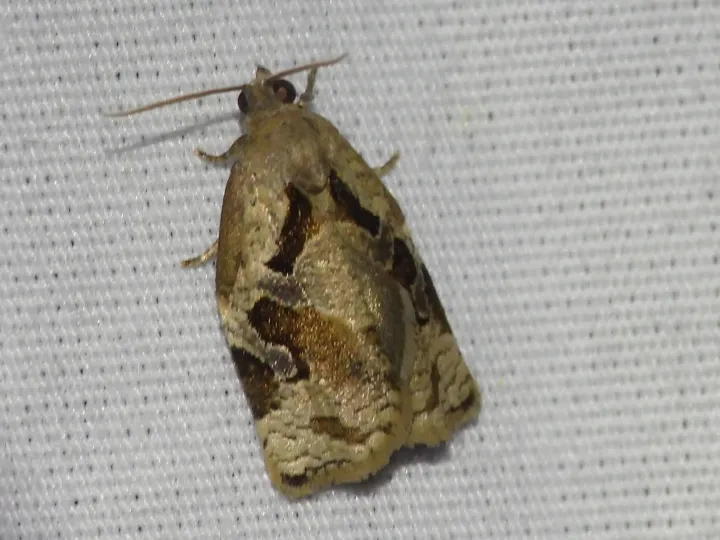
Description
How to identify
The genus Archips belongs to the Tortricidae family. These moths are widespread pests of deciduous trees and fruit orchards, known for their ability to roll leaves into protective structures.
Adult moths have a wingspan ranging from 18 to 30 mm. Their forewings typically exhibit intricate patterns of dark brown, tan, and reddish-orange markings, providing excellent camouflage against tree bark.
The larvae, or caterpillars, are the damaging stage. They are generally green to brownish with a dark head capsule, possessing a characteristic set of prolegs that allow them to move quickly when threatened.
Pupation occurs within the rolled leaves, where the larvae spin silken cocoons. The pupae are brown and exhibit small, hooked spines on their abdominal segments to secure themselves within the leaf rolls.
This genus includes several species, such as the fruit tree leafroller. They are highly adaptable and thrive in various temperate environments, making them persistent problems in agricultural settings.
What it damages
Archips species are polyphagous, meaning they feed on a wide variety of plants. Common hosts include apple, pear, cherry, plum, and various ornamental deciduous trees and shrubs.
In early spring, larvae emerge and feed on swelling buds. By hollowing out the buds, they destroy potential flowers and leaves, severely impacting the tree's development right at the start of the season.
As the season progresses, larvae roll leaves into tight, webbed tubes or clusters. This feeding behavior reduces the surface area available for photosynthesis, leading to overall tree stress and reduced vigor.
Fruit damage is a major economic concern. Larvae feed on the surface of young fruit, leaving deep, corky scars. This damage causes fruit deformation, stunted growth, and increased susceptibility to rot pathogens.
In young orchards or nurseries, leafrollers can damage terminal shoots, causing them to wilt or grow crookedly, which affects the structural development of the trees.
When it appears
Most species in this genus are univoltine, meaning they produce one generation per year. They overwinter as egg masses, which are glued to the bark of branches and covered with a protective secretion.
Larval emergence typically occurs in spring, coinciding with the green tip or tight cluster stage of host plant development. The synchronization with bud burst ensures that food is immediately available.
The larval stage lasts for several weeks, during which they grow rapidly and move across the foliage, creating new webbed shelters as they outgrow their old ones or exhaust local food sources.
Adult moths emerge during the summer months, usually from June to August. They are nocturnal and are attracted to light, which is often used in monitoring traps for research and pest management.
After mating, females lay new egg masses on branches to prepare for the winter, effectively resetting the life cycle for the following year.
Signs of infestation
The presence of silken webbing around buds or terminal clusters is the earliest sign of infestation. These webs often trap leaf debris and bud scales, making them highly visible.
Leaf curling is the most prominent symptom. When you see leaves tightly rolled, tied together with silk, or folded at the edges, it is almost certainly the work of a leafroller caterpillar.
If the leaves are disturbed, the caterpillars often wiggle backward or drop from the leaf on a silken thread to escape predators. This rapid, twitchy movement is a classic identifier.
Fresh or old feeding damage on the skin of developing fruit is a major indicator. These scars often start as small pits and can expand into large, distorted areas as the fruit grows.
Accumulated frass, which appears as small dark pellets, can often be found inside the webbed leaf nests, confirming the presence of an active larva.
Control measures
Sanitation is key; pruning and destroying infested leaf clusters during the spring and early summer can significantly reduce local populations before the next generation emerges.
Biological control using Bacillus thuringiensis (Bt) is effective against young larvae. This option is environmentally friendly and helps preserve beneficial insects in the orchard.
Chemical intervention should be timed carefully. Applications are most effective during the petal-fall stage or when larvae are still exposed and haven't yet secured themselves deep within rolled leaves.
Pheromone traps are excellent tools for monitoring moth activity. They help orchardists determine exactly when to apply controls, ensuring maximum efficiency and minimal chemical usage.
Encouraging natural predators, such as parasitic wasps or birds, can help keep leafroller populations in check, promoting a more balanced ecosystem within the orchard.
Taxonomy
- Latin name
- Archips
- Order
- Lepidoptera (butterflies)
- Family
- Tortricidae
- EPPO code
- ARCHSP
Discussion
No discussions yet — be the first.