
Apterothrips
Apterothrips
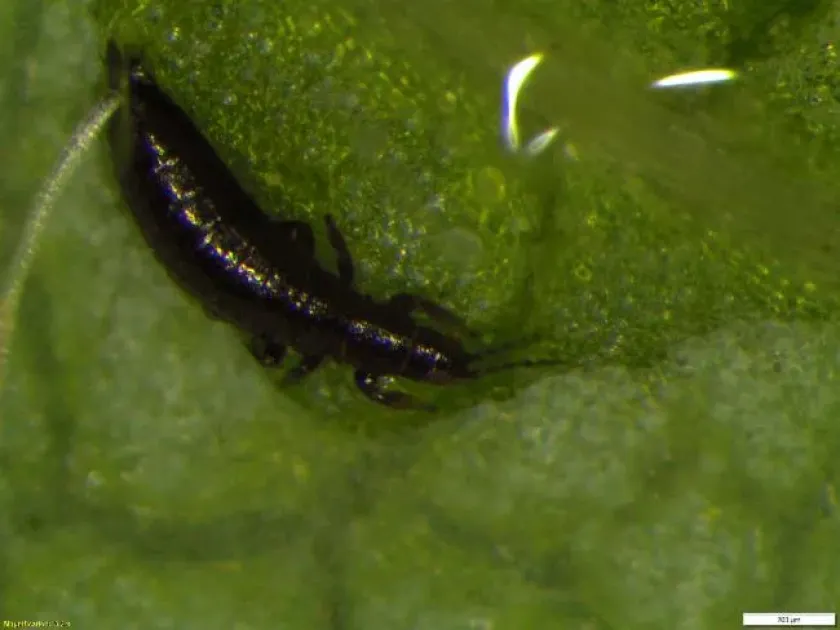
Description
How to identify
Apterothrips belongs to the order Thysanoptera and the family Thripidae. These tiny insects are characterized by a tendency toward wing reduction, which makes many species appear wingless or having shortened wings.
The adult body is typically elongated, reaching up to 1.5–2 mm in length. Their coloration ranges from yellowish to brownish, which aids in camouflage on the surfaces of leaves and stems of host plants.
The mouthparts of Apterothrips are of the piercing-sucking type. Larvae resemble adults visually but differ in their smaller size and the absence of sexual maturity.
The life cycle includes the stages of egg, larva, propupa, pupa, and adult (imago), with the development of most stages occurring directly on the host plant.
Reproduction can occur both sexually and parthenogenetically, which allows the population to increase rapidly under favorable environmental conditions.
What it damages
This pest affects a wide range of herbaceous plants, including ornamental crops, weeds, and some vegetable species. It is frequently found on plants within the Asteraceae family.
They feed mainly on young leaves and buds, sucking out cell sap from plant tissues. This process disrupts normal photosynthesis and metabolic activity in the plant.
Under greenhouse conditions, Apterothrips can cause significant damage to rare collections, causing deformation of growth points and curling of leaf blades.
During mass outbreaks, the pest spreads to all aerial parts of the plant, including flowers, which significantly reduces the marketability and ornamental value of the crop.
Additional damage arises from the fact that thrips can be vectors for viral diseases, which are transmitted during their feeding activities across different plants in the same area.
Signs of infestation
The first sign of an Apterothrips infestation is the appearance of silvery or whitish spots ("streaks") on the leaf blade, which eventually merge into larger damaged patches.
Leaves begin to turn yellow, curl, and drop prematurely. In areas where insects congregate, one may notice small black dots, which are the pest's excrement.
Buds of damaged plants often fail to open or open imperfectly, developing into distorted shapes due to the mechanical impact of the thrips' feeding apparatus.
Upon careful inspection of the underside of the leaf, especially along the veins, one can discover the insects themselves, which are highly mobile when disturbed.
Stunted growth and general plant depression are characteristic indirect signs that the pest population has reached a critical level and requires immediate control measures.
Control measures
The primary control method is agrotechnical, which includes the removal of weed reservoirs and the implementation of crop rotation to break the pest's life cycle.
In greenhouses, blue sticky traps are an effective tool for monitoring and reducing the population of adult thrips.
The application of insecticides from the organophosphate or neonicotinoid groups shows high efficacy, provided that application protocols are strictly followed.
Biological control methods include the release of natural enemies such as predatory mites (e.g., Amblyseius) or anthocorid bugs, which actively feed on thrips larvae and eggs.
Regular irrigation and maintaining optimal humidity in greenhouses hinder the development of Apterothrips, as many thrips species prefer hot and dry microclimatic conditions.
Taxonomy
- Latin name
- Apterothrips
- Order
- Thrips
- Family
- Thripidae
- EPPO code
- APTTSP
Discussion
No discussions yet — be the first.