
Yellow leafroller
Apoctena flavescens
Description
How to identify
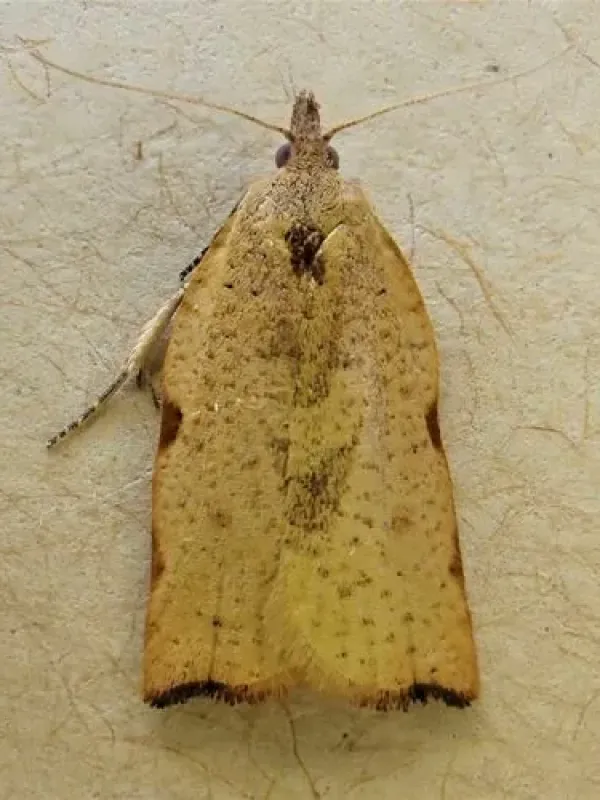
The Yellow leafroller (Apoctena flavescens) is a moth belonging to the Tortricidae family within the order Lepidoptera. As the name suggests, the adult moth is characterized by yellowish-ochre forewings.
Like other members of the Tortricinae subfamily, these moths are generally small in size. When resting, they typically hold their wings in a bell-shaped position, providing camouflage against bark and leaves.
The species undergoes a complete metamorphosis, progressing through egg, larval (caterpillar), pupal, and adult stages. Each stage is adapted to specific environmental conditions.
Morphological identification is often complex due to the resemblance to related leafroller species. Entomologists typically rely on genital dissection to confirm the species definitively.
Despite their modest size, populations can increase rapidly under favorable climatic conditions, posing a significant risk to horticultural and orchard crops.
What it damages
This pest is a polyphage, meaning it attacks a wide variety of host plants. The larval stage is responsible for the majority of the damage caused to cultivated vegetation.
Young caterpillars often feed on developing buds in the early spring. As they grow, they move on to consume leaves and developing fruit, causing both structural and physiological damage.
Larval feeding on fruit surface leads to scarring and blemishes, significantly reducing the marketability of the produce. In severe cases, fruits may drop prematurely.
Heavy infestations can lead to significant defoliation of host trees. This loss of photosynthetic area weakens the plant, negatively impacting yield for the current and future seasons.
Injured tissues often become entry points for secondary infections, such as fungi or bacteria. This complicates plant health management and requires additional control measures.
When it appears
Adult activity typically begins in the spring, synchronized with rising temperatures. Mating and egg-laying occur during the night, as these moths are nocturnal creatures.
Larval emergence coincides with the vegetative growth of host plants. The caterpillars are most active during the peak growing season, seeking fresh tissue for rapid development.
Winter is typically spent in a dormant state, either as early-instar larvae or pupae. They hide in bark crevices, leaf litter, or other sheltered parts of the host plant.
The number of generations per year depends on the local climate and temperature gradients. In warmer regions, the species can complete multiple generations within a single season.
Understanding the life cycle timing is critical for effective control. Monitoring degree-day accumulation helps agronomists predict when caterpillars will appear and when to intervene.
Signs of infestation
The most prominent sign of an infestation is the presence of leaves curled or tied together with silken webbing. These structures serve as protective nests for the larvae.
Visual inspection often reveals irregularly shaped holes in leaves, caused by larval feeding. When leaves are tied together, the damage is concentrated within these clusters.
Larval frass (excrement) is frequently found near these silken nests, serving as a clear indicator of active feeding sites. This helps in locating infestations early.
Damage to fruits is characterized by shallow or deep pits in the skin. These injuries may become necrotic over time, making the fruit susceptible to further decay.
- Silken webs tying leaves together.
- Deformed and curled leaf tissue.
- Scars or pitting on the surface of young fruit.
- Presence of pupal cases within folded leaf margins.
Control measures
Effective management of the Yellow leafroller requires an integrated approach. Cultural practices should be the first line of defense to maintain plant vigor and reduce pest pressure.
Pruning and sanitation are essential. Removing infested branches and clearing plant debris helps reduce the population of overwintering larvae and pupae.
Biological control options, including the use of entomopathogenic bacteria or natural predators, are highly effective when applied during the early stages of larval development.
Chemical control should be applied based on economic thresholds determined by monitoring. Using pheromone traps is an excellent method for tracking adult population dynamics.
Careful selection and rotation of insecticides are necessary to prevent the development of resistance. Always follow local agricultural regulations regarding application timing and safety.
Taxonomy
- Latin name
- Apoctena flavescens
- Order
- Lepidoptera (butterflies)
- Family
- Tortricidae
- EPPO code
- APCTFL
Discussion
No discussions yet — be the first.