
Viburnum leafroller
Aphelia viburnana
Description
How to identify
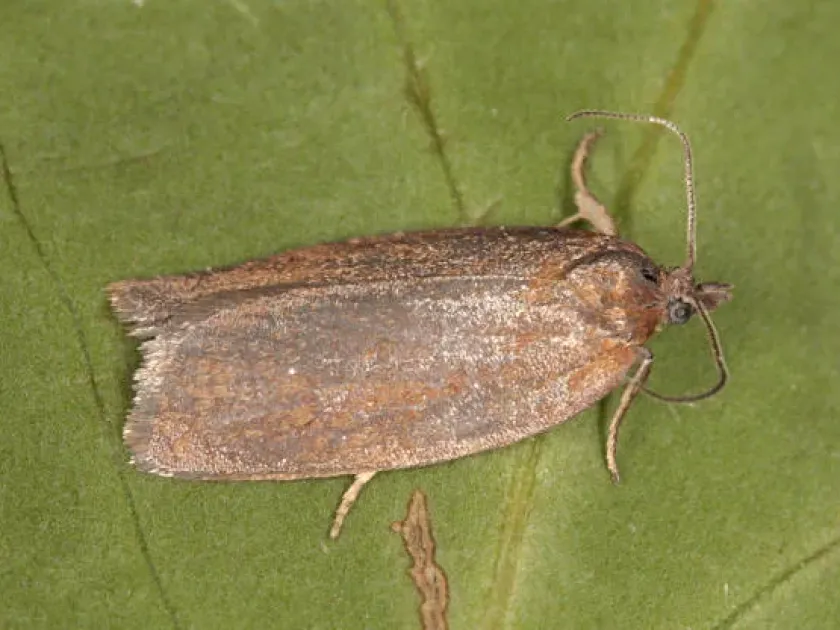
The Viburnum leafroller (Aphelia viburnana) belongs to the order Lepidoptera and the family Tortricidae. The adult moth has a wingspan of 18–22 mm, characterized by ochre-brown to yellowish-brown forewings featuring dark transverse lines.
The larvae, or caterpillars, reach up to 20 mm in length. They typically exhibit a grey or greenish-grey body with a dark head and thoracic shield, and they are known for their high mobility when disturbed, often dropping on silk threads.
The life cycle undergoes complete metamorphosis. In most regions, this species completes one generation per year, though warmer climates may support a partial second generation throughout the growing season.
Overwintering occurs at the larval stage in dense silk nests constructed within branch forks or under bark scales. As temperatures rise in spring, they resume feeding on emerging buds and young foliage.
Pupation takes place inside leaf rolls tightly fastened with silk. The adult flight period typically occurs between June and July, after which females deposit eggs on the leaves of host plants.
What it damages
The Viburnum leafroller is a polyphagous pest, affecting a variety of plants, primarily within the Caprifoliaceae family. Viburnum is its primary host, but it also attacks various orchard trees.
In orchards, this pest frequently targets apple, pear, plum, and cherry trees, consuming both vegetative buds and tender leaves, which impacts the overall vigor of the host plant.
Severe infestations can lead to significant crop losses by destroying floral buds and blossoms. This prevents fruit set and drastically reduces the yield of fruit-bearing trees and shrubs.
Ornamental shrubs are also at risk, with the leafroller causing aesthetic damage through leaf rolling and skeletonizing. Repeated attacks can weaken the plant, making it susceptible to secondary pathogens.
In nursery environments, larval feeding on apical shoots causes stunted or deformed growth, which complicates the formation of a healthy crown in young ornamental trees.
Signs of infestation
The most prominent sign of infestation is the presence of curled or rolled leaves fastened together with silk webbing. These structures serve as protection for the developing larvae.
Inside the rolled leaves, one can observe larval excrement, appearing as small, dark pellets. This serves as a reliable diagnostic feature of current larval activity.
Leaves exhibit irregular holes or serrated edges where the caterpillars have consumed the tissue, often leaving behind only the primary vein structure of the leaf.
During the flowering stage, one might notice withered or deformed blossoms covered in webbing. These flowers fail to produce fruit and eventually drop off prematurely.
In early spring, damage to buds is noticeable as they may fail to open or appear stunted and dry, often with thin silk threads indicating the presence of a larva.
Control measures
Cultural control measures involve pruning and destroying infested branches during winter or early spring. Removing weeds around the base of host plants also helps eliminate alternative habitats for the larvae.
Promoting a healthy garden ecosystem by encouraging natural predators, such as predatory beetles, birds, and parasitic wasps, can significantly keep the population under control.
Biological insecticides, specifically those containing Bacillus thuringiensis, are highly effective against young larvae and are considered safe for beneficial insects and pollinators.
Chemical treatments should be applied before the larvae form tight leaf rolls, as once they are protected inside, insecticides become significantly less effective.
Using pheromone traps is recommended for monitoring adult populations. This practice helps time interventions precisely, ensuring maximum efficacy and reducing the need for excessive chemical use.
Taxonomy
- Latin name
- Aphelia viburnana
- Order
- Lepidoptera (butterflies)
- Family
- Tortricidae
- EPPO code
- APELVI
Discussion
No discussions yet — be the first.