
Flax Tortrix
Aphelia paleana
Description
How to identify
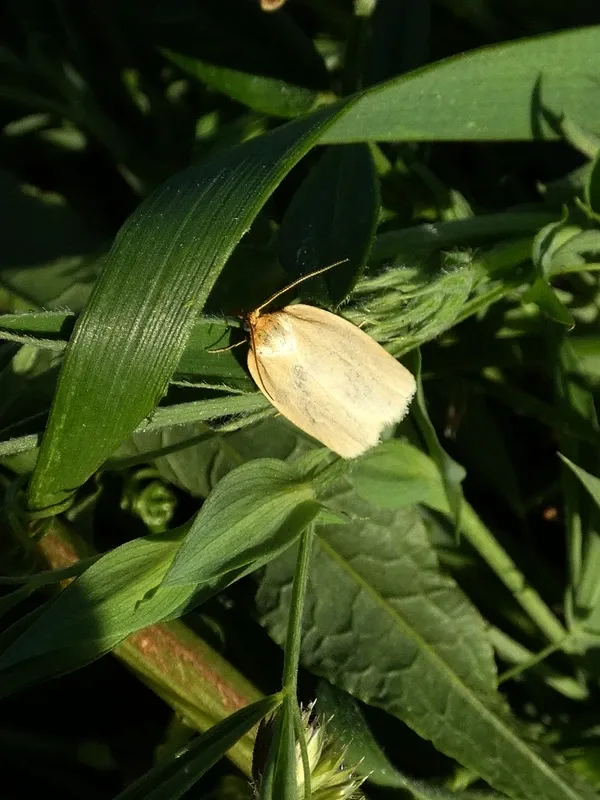
The Flax Tortrix Aphelia paleana belongs to the order Lepidoptera, family Tortricidae. The adult moth has a wingspan of 22–26 mm, with forewings that are straw-yellow to brownish, featuring distinct darker transverse bands.
The larvae (caterpillars) reach 18–22 mm in length. They typically exhibit a greyish-green or dirty-yellow body color with a dark brown or black head capsule. Pupation occurs within leaves rolled by the larvae, protected by a loose silken cocoon.
This pest is widely distributed across forest and forest-steppe zones, favoring areas with dense vegetation. The species demonstrates high ecological plasticity, allowing it to thrive on both cultivated crops and wild grasses.
The life cycle consists of one generation per year. Larvae of early instars overwinter in dense silken hibernacula or among plant debris, resuming activity in early spring as soon as consistent positive temperatures are reached.
Identifying this pest is challenging due to the larvae's cryptic behavior, as they spend most of their time hidden inside rolled leaves or webbed inflorescences, avoiding direct sunlight.
What it damages
The Flax Tortrix is a polyphagous pest, affecting a wide range of crops, primarily within the Poaceae family. Host plants include timothy-grass, bluegrass, fescue, as well as cereal crops such as wheat, barley, and rye.
Damage is caused by the larvae, which feed on young leaves, creating holes or skeletonizing the leaf blade. As they mature, larvae often migrate to the generative organs, damaging spikes and developing seeds.
The greatest economic impact occurs in seed grass fields and cereal crops during the heading and flowering stages. In cases of mass outbreaks, the pest can destroy a significant portion of reproductive organs, leading to severe yield losses.
Beyond direct destruction of foliage and inflorescences, damaged plants become more susceptible to fungal and bacterial infections due to the breach of the plant's epidermal layer. Affected spikes are often stunted or completely devoid of grain.
While less frequent on legumes like clover, the species can still cause noticeable damage under conditions of high population density in diverse agroecosystems.
When it appears
The flight period of the first generation occurs in June and July, coinciding with the peak vegetative growth of cereal crops. During this time, moths mate and lay eggs in small clusters on the leaf surfaces.
Embryonic development lasts approximately 10–14 days, followed by larval eclosion. The initial feeding phase takes place mid-summer, matching the peak growth cycle of host plants.
By autumn, after completing several instars, the larvae prepare for diapause. Depending on the climatic region, this process begins in late September or October when mean daily temperatures drop to threshold levels.
Spring reactivation occurs in April as larvae begin feeding on overwintered green tissues. This is a critical period for agronomists to scout fields and identify early infestation hotspots.
The total duration of the active feeding period ranges from 30 to 45 days, covering the most vulnerable growth stages of cereal crops that require careful protection.
Signs of infestation
The primary sign of infestation is leaves rolled into tubes or tied together with silk. These "cigar-like" deformations are easily visible during morning or evening field inspections.
The presence of larval frass (excrement) within silken webs is a definitive indicator of active feeding. These localized spots often appear as wilted or yellowing patches on the foliage.
When inflorescences are attacked, symptoms such as "white heads" or grain abortion appear. In areas where spikes are webbed together, grain development ceases, resulting in deformed and empty husks.
Intensive skeletonization of leaves leads to "windows" in the leaf blade that quickly turn brown. Heavy infestations make the crop appear thin and weakened.
- Rolled terminal leaves.
- Silken webbing on spikes.
- Skeletonized patches on leaf blades.
- Dark frass pellets in damaged areas.
Control measures
Crop rotation is fundamental to preventing the build-up of this pest in fields. Timely control of weeds along field margins is essential, as these areas serve as overwintering reservoirs for the larvae.
The application of insecticides is most effective during the period of mass larval eclosion. Contact-stomach poisons are recommended to suppress the population before significant damage occurs.
Biological control methods include the use of natural enemies, such as Trichogramma wasps, which parasitize the moth's eggs. Releasing these wasps during the egg-laying period can drastically reduce pest numbers without chemical intervention.
Agronomic practices like deep autumn plowing help destroy a portion of the overwintering population by disrupting their hibernacula and hindering their emergence in spring.
Monitoring population levels with pheromone traps allows for precise timing of chemical applications, minimizing pesticide use while ensuring effective control of the pest population.
Taxonomy
- Latin name
- Aphelia paleana
- Order
- Lepidoptera (butterflies)
- Family
- Tortricidae
- EPPO code
- TORTPA
Discussion
No discussions yet — be the first.