
Apanteles
Apanteles tabonus
Description
How to identify
Apanteles (Apanteles tabonus) belongs to the order Hymenoptera and the family Braconidae. These are tiny parasitoid wasps that act as essential regulators in agro-ecosystems.
Adult individuals are typically black, measuring about 3–4 mm in length, making them easily overlooked during routine field scouting.
Unlike many other insects, this species is classified as a beneficial parasitoid rather than a pest, playing a crucial role in natural pest suppression.
Morphologically, they possess delicate antennae and transparent wings, allowing them to navigate effectively while searching for hosts among crop foliage.
They are systematic members of the Braconidae family, known for their high efficiency in controlling various lepidopteran caterpillars.
What it damages
It is important to clarify that Apanteles tabonus does not damage agricultural crops, as it does not feed on plant tissues.
On the contrary, this wasp is an ally to farmers, as it parasitizes caterpillars that cause significant damage to vegetable and grain crops.
The presence of this species helps suppress populations of harmful pests, thereby reducing the need for intensive chemical interventions.
There are no negative impacts of this insect on plant development, as they feed primarily on nectar in their adult stage.
Therefore, they should be encouraged in agricultural landscapes to leverage their ability to reduce pest numbers naturally.
When it appears
The activity of adult Apanteles tabonus begins in late spring, following the rise in ambient temperatures suitable for their flight.
Population density peaks in mid-summer, which correlates with the development of caterpillar hosts that serve as targets for their larvae.
They can complete multiple generations throughout the growing season, providing persistent biological control against lepidopteran outbreaks.
As autumn temperatures decline, the adults enter a state of diapause, overwintering in soil or crop debris until the following spring.
Optimal environmental conditions, including moderate humidity and lack of extreme weather events, ensure the survival of the population through winter.
Signs of infestation
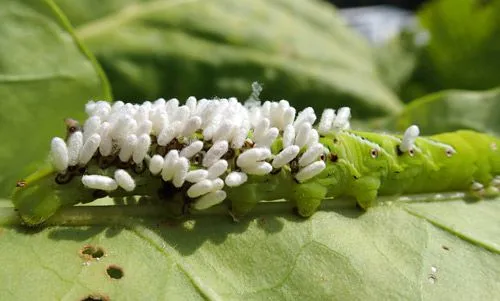
The most distinct sign of Apanteles activity is the presence of dead or lethargic caterpillars covered in small, white, or yellowish cocoons.
These cocoons are the pupal stage of the wasp, which emerges from the host after the larval development is completed inside the caterpillar.
When these clusters are observed, it confirms that natural biological control is successfully limiting pest population expansion.
Parasitized caterpillars stop feeding immediately, preventing further damage to the crops they were inhabiting before the wasp intervened.
Scouting the underside of leaves for these cocoon clusters is a recommended practice to assess the level of biological control in the field.
Control measures
As Apanteles tabonus is a highly beneficial insect, agricultural management should focus on its conservation rather than control.
The primary strategy is to minimize the use of broad-spectrum insecticides that negatively affect natural enemy populations in the field.
Integrating nectar-rich plants around field borders provides a vital food source for adult wasps, increasing their longevity and reproductive success.
Practicing Integrated Pest Management (IPM) allows for the use of selective pesticides that target pests while sparing beneficial parasitoids.
- Prioritize biological control over chemical suppression.
- Adopt selective pest management techniques.
- Maintain floral refuges to support local parasitoid populations.
Taxonomy
- Latin name
- Apanteles tabonus
- Order
- Hymenoptera
- Family
- Braconidae
- EPPO code
- APANTA
Discussion
No discussions yet — be the first.