
Sorghum apanteles
Apanteles sorghiella
Description
How to identify
Sorghum apanteles (lat. Apanteles sorghiella) is a small insect belonging to the order Hymenoptera and the family Braconidae. It is a well-known parasitoid wasp that plays a vital role in natural pest suppression.
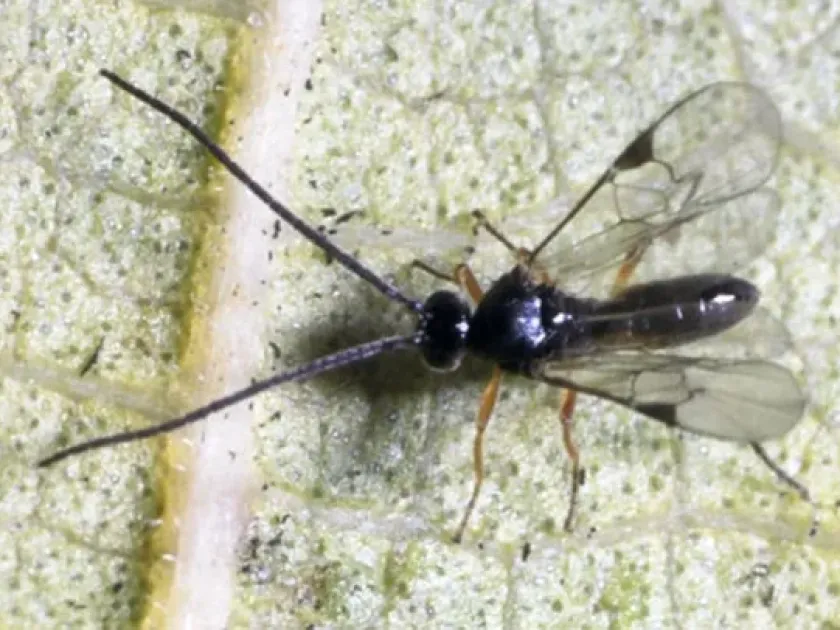
Adults are tiny wasps, typically dark-colored with transparent wings and specific wing venation characteristic of the Braconid family. Accurate identification usually requires a microscope.
The larvae develop as endoparasitoids, meaning they complete their growth inside the host caterpillar. Once developed, the larva exits the host to pupate on the surface.
The cocoons are usually white or pale yellow and are often found in clusters near the remains of the host caterpillar. This clustering behavior is a key field sign for detection.
Because many Apanteles species look similar, identifying Apanteles sorghiella requires specialized knowledge of the local entomofauna of sorghum fields.
What it damages
Sorghum apanteles is not a plant pest. Instead, it is an essential beneficial insect that regulates populations of primary pests attacking sorghum crops, such as various caterpillars and moths.
By parasitizing larvae that feed on sorghum foliage and stalks, this wasp effectively reduces the overall level of herbivory, contributing to better crop health and yields.
The "harm" it causes is strictly limited to the pests it targets. It is a crucial component of natural pest control systems in sorghum-growing regions across the world.
Agricultural practices that prioritize broad-spectrum insecticides often accidentally eliminate these beneficial wasps, leading to secondary pest outbreaks that are harder to manage.
Thus, this species should be considered an asset to farm management, helping to maintain ecological balance and reduce dependency on synthetic chemical inputs.
When it appears
The life cycle of the Sorghum apanteles is perfectly synchronized with the phenology of its host caterpillars. Their activity peaks during the growing season when sorghum is vulnerable to infestation.
There can be multiple generations per year, depending on local climate conditions and the availability of suitable hosts. Warm temperatures generally accelerate their development.
The adults are most active during the egg-laying phases of the pest moths. This synchronization ensures that the wasp larvae have access to a fresh supply of hosts.
Overwintering usually occurs in the pupal or larval stage inside host remains or leaf litter. Therefore, management of harvest residues is essential for the survival of the population.
Environmental factors like relative humidity and temperature play a significant role in the successful emergence and mating of adults during the start of the season.
Signs of infestation
The presence of Apanteles sorghiella is best indicated by small clusters of cocoons found attached to the leaves or stalks of sorghum plants.
Observing sedentary or weakened caterpillars is another common sign. These caterpillars have usually been parasitized and are no longer actively feeding on the crop.
Empty pupal skins or exit holes on the bodies of deceased caterpillars serve as clear evidence that the wasp has successfully emerged from its host.
A noticeable decrease in caterpillar damage compared to neighboring fields, coupled with the presence of cocoons, confirms that the wasp is successfully suppressing the pest population.
Scouting for these indicators allows agronomists to confirm the effectiveness of biological control without the need for unnecessary pesticide applications.
Control measures
Protection of this species is essential, as it provides free natural pest control. Management practices should focus on conservation rather than elimination.
- Minimize the use of non-selective, broad-spectrum insecticides that harm beneficial wasps.
- Choose biorational pesticides or selective chemicals that target only specific pests.
- Maintain field borders with flowering plants to provide nectar for adult wasps.
- Adopt conservation tillage practices to protect overwintering pupae in crop residues.
- Monitor pest levels closely to ensure that insecticide use only occurs when the economic threshold is exceeded.
By creating a safe environment for Sorghum apanteles, farmers can significantly improve the sustainability of their sorghum production and reduce long-term operational costs.
Taxonomy
- Latin name
- Apanteles sorghiella
- Order
- Hymenoptera
- Family
- Braconidae
- EPPO code
- APANSR
Discussion
No discussions yet — be the first.