
Apanteles
Apanteles ippeus
Description
How to identify
The Apanteles ippeus belongs to the order Hymenoptera, family Braconidae. It is a tiny parasitic wasp, typically measuring 3–5 millimeters in length.
Adult individuals have a black body with a slight metallic luster. Their wings are transparent with a distinct vein pattern, which is typical for members of this family.
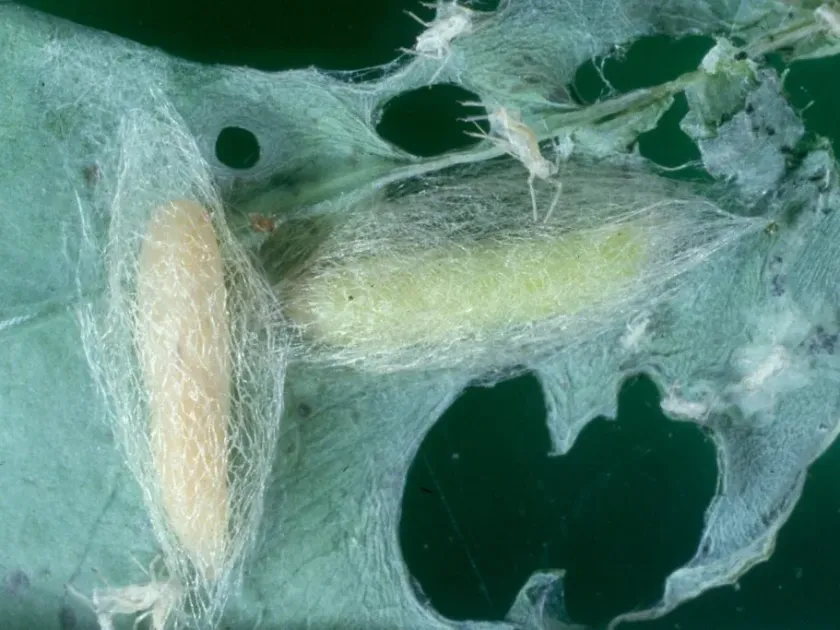
The larvae are white or cream-colored and develop internally within their host. Once development is complete, they emerge to spin characteristic white, silky cocoons.
It is crucial to clarify that this insect is a beneficial parasitoid, not a plant pest. Growers often mistake it for a pest because they find cocoons on damaged leaves.
Identification in the field is difficult due to their microscopic size, so laboratory analysis using a microscope is often required for precise species confirmation.
What it damages
Biologically, Apanteles ippeus does not cause any damage to agricultural crops, as neither adults nor larvae feed on plant tissues.
The insect acts as a specialized parasitoid. Its life cycle relies on the caterpillars of certain lepidopteran species that cause significant crop losses.
Adult wasps feed on nectar from flowers, which makes them effective pollinators and valuable components of the local ecosystem.
The presence of Apanteles in a field is a sign of natural pest regulation, rather than an indication of a crop threat.
Any damage observed near these insects is actually caused by the host caterpillars, which the Apanteles wasps are actively neutralizing through parasitism.
When it appears
The life cycle of Apanteles is closely synchronized with the phenology of its host caterpillars. Adult activity is primarily observed during the spring and summer seasons.
Multiple generations can develop throughout the season, providing continuous control of pest populations during the critical growth phases of crops.
During the winter, the insects remain in diapause, usually as pupae within cocoons hidden in crop residues or the top layer of soil.
The emergence of adult wasps coincides with the flight period of target lepidopteran pests, ensuring that hosts are available for egg-laying.
Temperature significantly impacts development: warmer weather accelerates metabolic processes and shortens the metamorphosis cycle, leading to faster reproduction.
Signs of infestation
The primary sign of Apanteles presence is the appearance of clusters of tiny white cocoons on damaged leaves or next to deceased caterpillars.
If you observe a caterpillar that has stopped feeding and looks lethargic, with cocoons attached to its body, this indicates successful parasitization by the wasp.
The absence of further leaf damage where these wasps are found confirms their efficacy in suppressing pest populations.
When scouting, inspect the undersides of leaves, where adult wasps often search for hosts to lay their eggs.
It is important not to confuse these cocoons with pest egg clutches, as unnecessary insecticide application would kill these beneficial insects.
Control measures
No control measures are needed against Apanteles, as it serves as a natural ally for farmers in protecting crops from pests.
The agronomist’s primary goal is to preserve and support the population of these parasitoids by minimizing the use of broad-spectrum insecticides.
Using selective biological products allows for the control of pests while ensuring the survival of beneficial insects in the field.
- Maintain nectar-rich flower strips to support adult wasps.
- Avoid blanket chemical spraying of fields.
- Create natural habitats such as hedgerows to protect parasitoid populations.
Integrating the use of Apanteles into your farming strategy helps reduce chemical pesticide reliance and promotes sustainable agriculture.
Taxonomy
- Latin name
- Apanteles ippeus
- Order
- Hymenoptera
- Family
- Braconidae
- EPPO code
- APANIP
Discussion
No discussions yet — be the first.