
Apanteles
Apanteles decorus
Description
How to identify
Apanteles decorus belongs to the Hymenoptera order and the Braconidae family. These insects are small wasps that play a significant role as natural regulators of pest populations in agricultural ecosystems.
Adult specimens are very small, typically measuring between 3 to 5 millimeters in length. Their dark bodies and specialized wing venation are key physical characteristics that distinguish them within their family.
Their biological function is closely tied to the lifecycle of Lepidoptera larvae. Adults are nectar-feeders, which is essential for their energy requirements to locate hosts and fly across large distances.
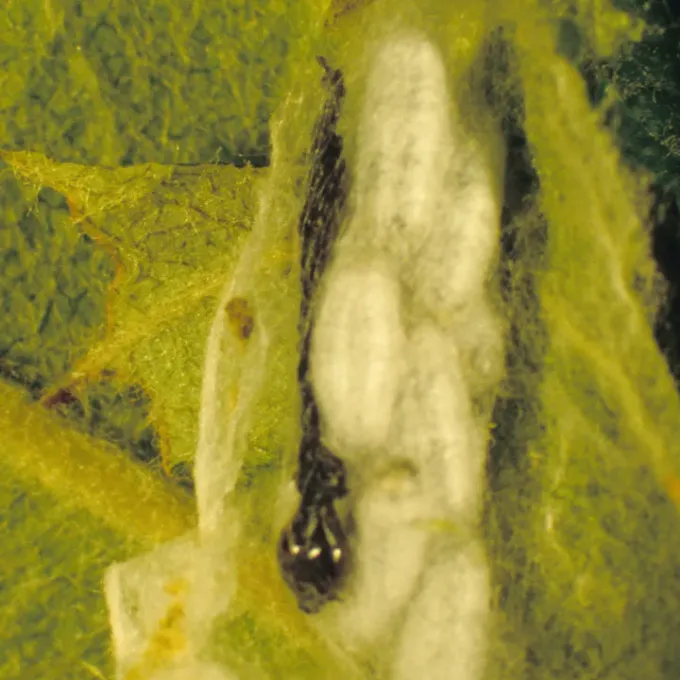
Identification in the field is often easier through the observation of their cocoons. Larvae spin these cocoons on the surface of plants after emerging from their host, making them visible to trained scouts.
Understanding their morphology is crucial for any integrated pest management strategy, as these insects act as natural allies against various foliage-feeding larvae.
What it damages
While Apanteles species are primarily known as beneficial entomophages, their absence in an agroecosystem leads to severe economic damage caused by host insects. They primarily target larvae of various owlet moths (Noctuidae).
The "damage" attributed to this species is essentially an indirect effect caused by the loss of natural control. When these wasps are eradicated by chemicals, pest populations surge, causing significant defoliation of crops.
Agricultural crops susceptible to major damage include sunflowers, sugar beets, and various cereal grains. In these fields, the primary host pests can cause devastating losses if not managed by biological agents.
The damage is expressed through direct feeding of caterpillars on leaf tissue, stems, and reproductive organs of plants, leading to reduced yield and poor overall plant health.
Agronomists must view these wasps as a critical component of crop resilience. Maintaining their presence is essential to suppress pest outbreaks that would otherwise require intensive chemical intervention.
When it appears
The activity period of Apanteles decorus closely follows the larval stages of their Lepidopteran hosts. They begin their activity as soon as spring temperatures allow for successful flight and host searching.
Peak population levels typically occur mid-summer, coinciding with the second or third generation of host caterpillars. This is when the interaction between the wasp and the pest is most intensive.
The life cycle involves an egg stage deposited inside the host, larval development within the host, followed by pupation in external cocoons. This process is temperature-dependent and highly efficient.
Over a full growing season, the species can complete multiple generations. This multivoltine cycle ensures that the wasps can sustain pressure on pest populations throughout the critical vegetative period of crops.
Monitoring for these wasps is recommended during the scouting of primary pests, as their presence indicates a functional biological control system within the agricultural parcel.
Control measures
The most effective control measure is the preservation of biodiversity at the field edges. Providing nectar sources, such as wildflower strips, helps sustain wasp populations and improves their searching efficiency.
Strategic pesticide application is necessary. Broad-spectrum insecticides should be replaced with selective biological products to protect these beneficial wasps from accidental eradication.
Implementing integrated pest management (IPM) practices, including crop rotation and reduced tillage, helps stabilize the environment, allowing natural enemies to thrive without constant disruption.
Monitoring the ratio of parasitized to non-parasitized larvae allows agronomists to make informed decisions about whether intervention is truly needed or if the natural agents are sufficient.
- Maintain wildflower buffer zones around crops.
- Use selective bio-pesticides instead of broad-spectrum chemicals.
- Regular field scouting to assess parasitism rates.
Taxonomy
- Latin name
- Apanteles decorus
- Order
- Hymenoptera
- Family
- Braconidae
- EPPO code
- APANDC
Discussion
No discussions yet — be the first.