
Apanteles cordoi
Apanteles cordoi
Description
How to identify
Apanteles cordoi belongs to the family Braconidae, a group of parasitic wasps that play a crucial role in agricultural ecosystems.
Adult wasps are small, typically measuring 2–4 mm in length, and are generally dark-colored, making them difficult to spot without professional training.
These insects are specialized endoparasitoids, meaning their larvae develop inside the bodies of their hosts, usually lepidopteran larvae.
Morphological identification is complex and often requires detailed examination of the wasp's structure under a microscope by an expert entomologist.
They are highly specialized in locating host larvae by detecting chemical signals emitted by plants under insect herbivory.
What it damages
Apanteles cordoi is not a plant pest; rather, it is a highly beneficial insect that serves as a natural regulator of caterpillar populations.
By parasitizing larvae, the wasp effectively reduces the damage that these pests would otherwise cause to crops and gardens.
The damage sometimes observed on crops is strictly caused by the pest larvae themselves, not by the parasitoid wasp.
Removing this beneficial species through excessive chemical intervention can lead to an increase in pest outbreaks, resulting in greater crop loss.
Therefore, farmers should consider these wasps as natural allies in Integrated Pest Management (IPM) strategies.
When it appears
The activity of Apanteles cordoi coincides with the presence of host larvae during the spring, summer, and early autumn months.
Their life cycle is closely synchronized with the development of specific agricultural pests, ensuring that hosts are available for the next generation.
Wintering typically occurs in the pupal stage, often inside cocoons attached to plant debris or within the remains of the host insect.
Environmental factors like temperature and humidity directly influence the speed of their development and the success of each generation.
Peak emergence of adult wasps is usually observed when their host larvae are most abundant in the field or orchard.
Signs of infestation
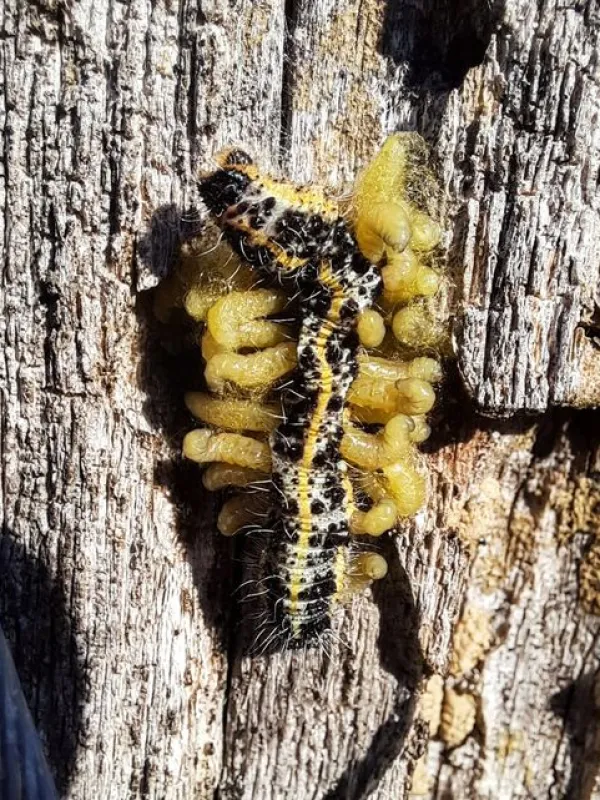
The most visible sign of Apanteles cordoi activity is the presence of small, white or yellowish silken cocoons on the back of host larvae.
When you find sluggish or dying caterpillars covered in these small cocoons, it is a clear indicator that the parasitoid is successfully suppressing the pest population.
A reduction in the overall damage to crop leaves is a long-term indicator of the beneficial activity of these braconid wasps.
Emergence holes in the host’s skin indicate that the wasp larvae have completed their development and are ready to pupate.
Adult wasps can often be observed feeding on nectar from flowers or floral strips planted around the crop fields.
Control measures
No control measures are needed for Apanteles cordoi, as it is an essential beneficial insect for any sustainable farming operation.
Avoid the use of broad-spectrum insecticides, as these chemicals kill beneficial wasps and disrupt natural pest control mechanisms.
Implementing a refuge system or planting nectar-rich flowers helps provide adult wasps with food, increasing their lifespan and efficiency.
Conservation of crop residues in certain areas can help provide safe overwintering sites for the next year's generation.
Focusing on selective, target-specific pest control allows Apanteles cordoi to thrive and continue its valuable role in protecting crops.
Taxonomy
- Latin name
- Apanteles cordoi
- Order
- Hymenoptera
- Family
- Braconidae
- EPPO code
- APANCD
Discussion
No discussions yet — be the first.