
Apanteles cajae
Apanteles cajae
Description
How to identify
Apanteles cajae is a species of parasitic wasp belonging to the family Braconidae, within the order Hymenoptera. This insect acts as a highly specialized endoparasitoid.
Adult wasps are very small, typically measuring 3–5 mm in length, and have a black body. They are characterized by a slender abdomen and specific wing venation patterns typical of the Microgastrinae subfamily.
The larvae develop internally within the host, specifically the caterpillars of tiger moths (such as Arctia caja), making the initial stage of infection invisible to the naked eye.
Identification of this species is usually performed by entomologists examining the female's ovipositor or the silk cocoons produced by the larvae upon exiting the host.
As a natural parasitoid, it plays an essential role in regulating populations of Lepidoptera in various ecosystems, including agricultural fields and gardens.
What it damages
Apanteles cajae is not considered a pest; on the contrary, it is an extremely beneficial insect that provides natural biological control against harmful caterpillars.
The host, the garden tiger moth caterpillar, is a notorious polyphagous pest that feeds on a wide range of agricultural and ornamental plants, causing significant foliage damage.
By parasitizing these caterpillars, the wasp larvae prevent the host from reaching adulthood, effectively neutralizing the threat to crops before significant damage occurs.
The presence of this parasitoid is a positive indicator of a healthy, functioning agroecosystem that naturally suppresses pest populations.
Utilizing such beneficial species is a key component of Integrated Pest Management (IPM) strategies, aiming to reduce chemical reliance and maintain ecological balance.
When it appears
The activity of adult Apanteles cajae coincides with the larval stage of its host, typically occurring throughout the spring and summer months, from May to August.
Female wasps actively search for young caterpillar instars to lay their eggs, often locating them via chemical cues emitted by damaged plant foliage.
The life cycle of the parasitoid is highly synchronized with its host, ensuring that larvae are available during the most critical periods of pest development.
Depending on local climate conditions, several generations of these wasps may occur within a single growing season, allowing for continuous suppression of the moth population.
As winter approaches, activity decreases, and the parasitoids overwinter either within the host or as pupae, awaiting the next emergence cycle in the spring.
Signs of infestation
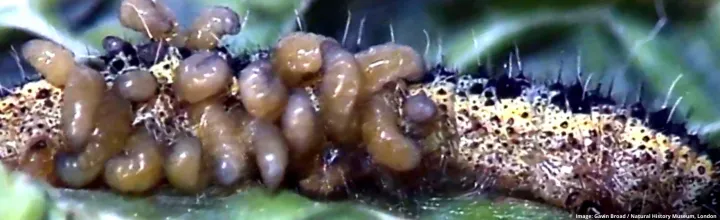
The most visible evidence of Apanteles cajae activity is the appearance of small, yellowish or white silk cocoons covering the body of the host caterpillar.
Infested caterpillars become lethargic, cease feeding, and eventually die shortly after the wasp larvae exit the host to pupate on the surface.
The appearance of the pest may be altered, often showing signs of deformation or discoloration, which serves as a diagnostic feature for the parasitism.
Agronomists often observe the dried remains of caterpillars surrounded by a cluster of wasp cocoons, confirming that the biological control agent is actively present.
These signs clearly indicate that the natural suppression of the pest is in progress, suggesting that further insecticidal treatment may be unnecessary.
Control measures
No control measures are needed for Apanteles cajae; rather, the focus should be on conserving and protecting this beneficial parasitoid population.
The primary strategy is to minimize the application of broad-spectrum insecticides, which are often toxic to natural enemies like parasitic wasps.
Implementing ecological practices, such as providing nectar-rich plant strips, helps maintain adult wasp populations by providing necessary food sources.
Choosing selective pesticides that target specific pests without harming the parasitoid community is crucial for sustainable plant protection.
- Protect natural habitats for parasitoids
- Avoid broad-spectrum chemical sprays
- Plant diverse flora to attract beneficial insects
Taxonomy
- Latin name
- Apanteles cajae
- Order
- Hymenoptera
- Family
- Braconidae
- EPPO code
- APANCJ
Discussion
No discussions yet — be the first.