
Apanteles
Apanteles briareus
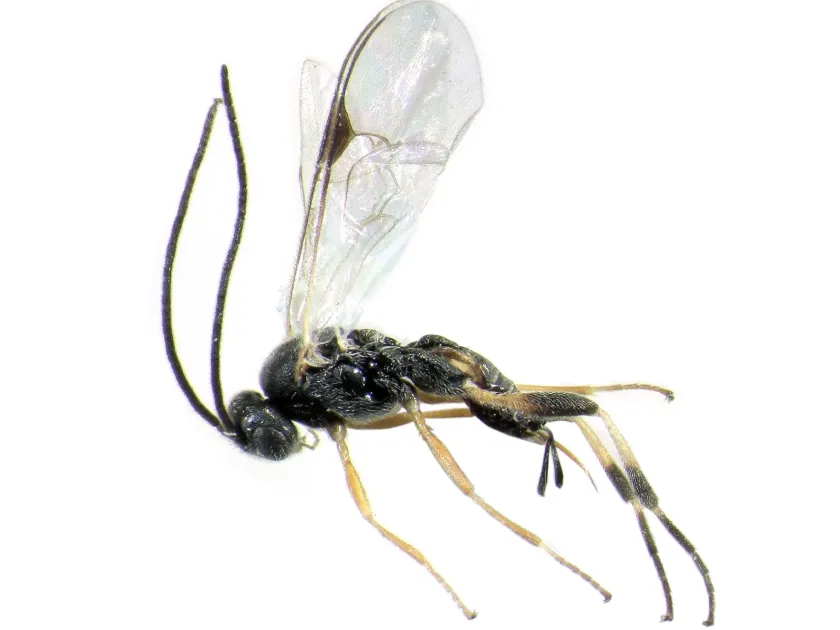
Description
How to identify
Apanteles (Apanteles briareus) belongs to the Braconidae family of parasitic wasps. They are widely recognized as highly effective natural enemies of many lepidopteran pests, making them a crucial component of integrated pest management in modern agriculture.
The adults are small, measuring typically 3 to 5 mm in length, with dark, slender bodies and clear wings with distinct venation patterns. They are highly active flyers, specifically adapted to locating host larvae amidst dense foliage.
The life cycle involves the female wasp laying eggs inside the body of a host caterpillar. The larvae develop internally, eventually emerging to spin small, white or yellow silken cocoons, often grouped together on or near the remains of the host.
Correct identification requires laboratory analysis of wing vein structure and antennal segments, as the genus includes many species that are morphologically similar but occupy different ecological niches.
Understanding the presence of these wasps helps farmers identify natural suppression levels of pest populations without resorting to immediate chemical intervention.
What it damages
Apanteles species are not considered pests; rather, they are beneficial organisms that contribute significantly to crop health. They do not feed on plant tissues and therefore do not cause direct mechanical or nutritional damage to crops.
Any perceived "damage" associated with their cocoons is a misunderstanding of their role. The cocoons are a sign that the beneficial wasp has successfully completed its development by neutralizing a pest that would have otherwise damaged the crop.
Their presence is evidence of a balanced ecosystem. Crops where these wasps are abundant are generally better protected against outbreaks of cutworms, loopers, and other foliage-consuming pests.
Their economic value lies in their ability to provide free, effective pest suppression. By parasitizing host larvae, they reduce the density of primary agricultural threats, saving costs associated with insecticide application.
There is no economic threshold for damage caused by these insects, as they are essential allies in maintaining plant vitality and improving overall agricultural productivity.
Control measures
Control measures for Apanteles are actually conservation measures. Since they are beneficial, the goal is to protect and foster their populations rather than eliminate them from the farm environment.
The most important action is to minimize the use of broad-spectrum insecticides, which often kill non-target beneficial species. Transitioning to integrated pest management (IPM) practices is essential for their survival.
Farmers can promote Apanteles populations by establishing floral strips or refugia that provide nectar sources for adult wasps. This supplementation ensures they stay in the field and remain active against target pests.
Effective monitoring involves using sticky traps or field inspections to count cocoons or active wasps. This data allows for more informed decision-making, ensuring chemical interventions are used only when absolutely necessary.
Adopting sustainable agricultural practices ensures that natural regulation mechanisms remain functional, reducing the chemical burden on the soil and crops while maintaining high-quality harvest yields.
Taxonomy
- Latin name
- Apanteles briareus
- Order
- Hymenoptera
- Family
- Braconidae
- EPPO code
- APANBR
Discussion
No discussions yet — be the first.