
Apanteles americanus
Apanteles americanus
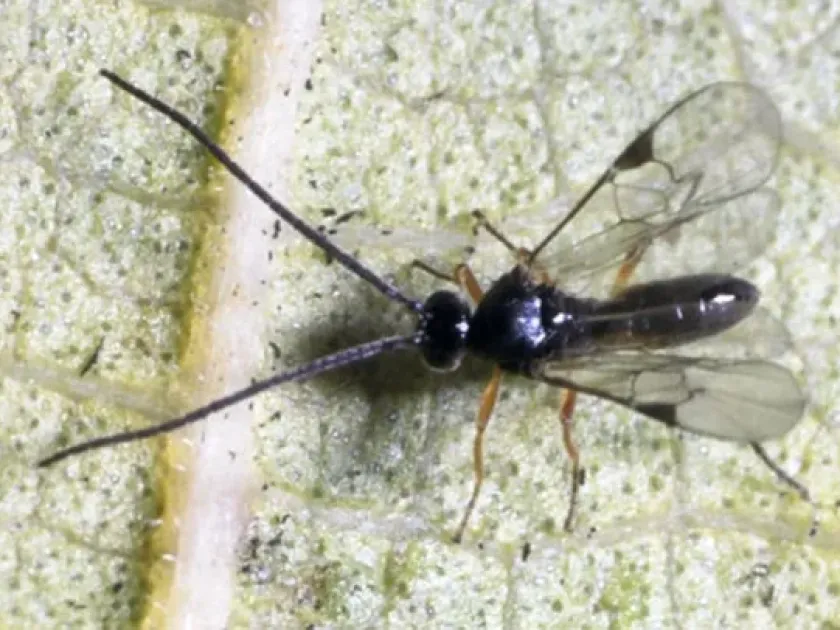
Description
How to identify
Apanteles americanus is a species of parasitic wasp belonging to the order Hymenoptera and the family Braconidae. These insects are essential natural regulators of caterpillar populations in various agricultural systems.
Adults are small wasps, typically measuring 2 to 5 millimeters in length. Their bodies are generally dark-colored with translucent wings, making them difficult to spot without professional entomological monitoring tools.
The life cycle involves internal parasitism of lepidopteran larvae. The larvae feed within the host caterpillar, and upon maturity, they emerge to spin communal cocoons, which are often found in clusters on the host or nearby leaf surfaces.
Identification of the species is complex and usually requires microscopic analysis of wing venation and abdominal structure to distinguish it from other related braconid species found in the same habitats.
Their population dynamics are heavily dependent on the availability of host insects. In environments where broad-spectrum pesticides are used, the population of these beneficial wasps can collapse, leading to secondary pest outbreaks.
What it damages
Apanteles americanus does not cause direct damage to crops. Instead, it acts as a beneficial parasitoid that feeds on the larvae of various lepidopteran pests, effectively reducing their density in the field.
The primary hosts include various moths and caterpillars that are known to cause severe damage to field crops such as tomatoes, corn, and leafy vegetables. By parasitizing these hosts, the wasp contributes to natural pest suppression.
The perceived damage is actually caused by the host caterpillars before they are successfully parasitized. However, the presence of the wasp significantly decreases the amount of leaf tissue lost to feeding caterpillars over time.
Crops heavily infested by the host caterpillars often benefit from the presence of Apanteles americanus as a natural check. The wasp acts as a living shield, reducing the need for intensive chemical applications.
Agronomic strategies should focus on protecting these wasps rather than viewing them as a threat. The true pest in this relationship is the caterpillar, not the parasitoid that helps control it.
When it appears
Activity typically begins in late spring and continues through the autumn months, depending on the climatic conditions and the availability of host caterpillars for reproduction.
Development is temperature-dependent, with optimal activity occurring between 20°C and 28°C. Development slows down significantly during cooler periods, ensuring the insect survives throughout the growing season.
Multiple generations can occur in a single season. The synchrony between the wasp's life cycle and the host's population growth is critical for achieving successful natural control of the pest population.
Adults are most active during the early morning hours when humidity is higher, which aids in their survival and ability to locate host caterpillars for oviposition.
The species overwinters as pupae within cocoons or inside diapause-entering larvae, providing a stable foundation for the population to re-emerge when conditions become favorable the following spring.
Signs of infestation
The most prominent sign of Apanteles americanus activity is the discovery of deceased or paralyzed caterpillars surrounded by small, yellowish or white, fuzzy cocoons.
Host plants may exhibit signs of feeding damage, such as missing leaf tissue, but as the parasitoid population grows, the frequency of these feeding scars usually decreases as the host population is reduced.
Careful inspection of the undersides of leaves may reveal tiny entry holes on the skin of caterpillars, which are the results of female wasps inserting eggs into the host.
Empty cocoon clusters on the leaf surface are a positive indicator that the parasitoid has completed its life cycle and is successfully suppressing the local pest population.
A lack of active caterpillars despite the presence of fresh cocoons indicates that the wasp is effectively managing the pest pressure in the field.
Control measures
The primary management goal is to conserve the natural population of this wasp. This is achieved by minimizing the use of toxic pesticides that can negatively impact the parasitoid's survival.
- Avoid the use of broad-spectrum insecticides during peak wasp activity.
- Incorporate floral strips into field margins to provide nectar for adult wasps.
- Utilize integrated pest management (IPM) practices to monitor both hosts and parasitoids.
- Choose selective bio-insecticides when chemical intervention is necessary.
By shifting to an integrated approach, growers can maintain high levels of Apanteles americanus, which provides consistent and cost-effective natural pest control throughout the growing season.
Regular monitoring helps in making informed decisions about whether intervention is truly needed or if the natural parasitoid population is already sufficient to handle the pest pressure.
Ensuring that the environment remains hospitable for these beneficial insects is a cornerstone of sustainable agriculture and long-term crop protection success.
Taxonomy
- Latin name
- Apanteles americanus
- Order
- Hymenoptera
- Family
- Braconidae
- EPPO code
- APANAM
Discussion
No discussions yet — be the first.