
Anychus
Anychus
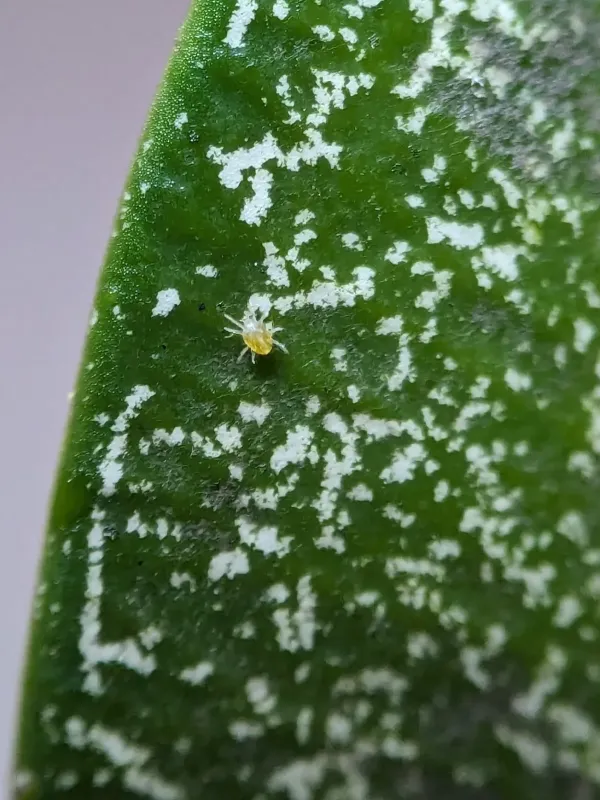
Description
How to identify
Anychus (genus Anychus) belongs to the spider mite family (Tetranychidae), which is part of the order Trombidiformes. These are microscopic arthropods that often remain unnoticed until mass reproduction occurs.
The body of an adult mite is oval in shape and has a characteristic coloration that varies depending on the species, life stage, and the type of host plant it feeds on.
The life cycle includes the egg, larva, protonymph, deutonymph, and adult stages. Females are usually larger than males and more fecund, which contributes to the rapid population growth under favorable conditions.
Mites move slowly, yet they are easily dispersed by wind, water, or agricultural machinery over long distances, which complicates the localization of infestation hotspots.
For accurate species identification, the use of a binocular microscope or a high-magnification lens is often required, as the morphological features on the mite's body are extremely small.
What it damages
Anychus is a polyphagous pest capable of damaging a wide range of agricultural, ornamental, and forest crops by feeding on the cellular sap of leaves.
Vegetable crops grown in open fields and greenhouses, as well as various fruit trees and shrubs in gardens, are the most susceptible to mite attacks.
The damage caused to plant tissues disrupts normal photosynthesis, which directly leads to a decrease in overall productivity and the quality of market produce.
Severe infestations can cause premature leaf drop, which significantly weakens the plant's immunity and makes it more vulnerable to secondary fungal and bacterial infections.
In cases of mass infestation on seedlings or young trees, complete loss of the crop is possible, causing significant economic damage to agricultural enterprises.
When it appears
Active development of the pest begins with the onset of warm and dry weather, which is the most favorable for its biological processes.
The optimal temperature range for the intensive reproduction of Anychus mites is between 25 and 30 degrees Celsius under low humidity conditions.
In greenhouse environments, the pest can maintain high activity and reproductive capacity almost year-round if a food source is available.
Overwintering of adults or diapausing eggs usually occurs in tree bark crevices, under plant debris, or in the upper layers of the soil.
In spring, as the average daily temperature rises, overwintered individuals move to young shoots of weeds before migrating to cultivated plantings.
Signs of infestation
The first sign of mite presence is the appearance of characteristic small light dots on the upper side of the leaf, which are the sites of tissue punctures.
Over time, the damaged areas merge, forming large chlorotic patches, after which the leaf gradually yellows, dries out, and falls prematurely.
On the underside of the leaf, one can often notice thin webbing, which serves as a protective framework for mite colonies and their eggs during their life cycle.
When inspecting plants with the naked eye, one can detect microscopic moving specks, as well as the presence of a characteristic film consisting of larval exuviae.
- Yellowing of the leaf blade.
- Curling and deformation of leaves.
- Presence of webbing on the underside of leaves.
- Stunting of overall plant growth and development.
- Premature dropping of flowers and fruit sets.
Control measures
The cornerstone of Anychus management is the agronomic method: deep autumn plowing and the timely removal of weeds along field borders.
Maintaining optimal soil and air humidity plays a crucial role, as increased moisture levels significantly slow down the development of the mite population.
When the economic threshold of damage is reached, specialized acaricides with selective action against spider mites should be applied.
It is recommended to rotate chemical products to prevent the development of resistance in the pest population against active ingredients.
Within the framework of biological control, entomophages such as phytoseiid mites are actively used to effectively manage mite numbers in greenhouses and orchards.
Taxonomy
- Latin name
- Anychus
- Order
- Mites
- Family
- Tetranychidae
- EPPO code
- ANYCSP
Discussion
No discussions yet — be the first.