
Pine bud weevil
Anthonomus varians
Description
How to identify
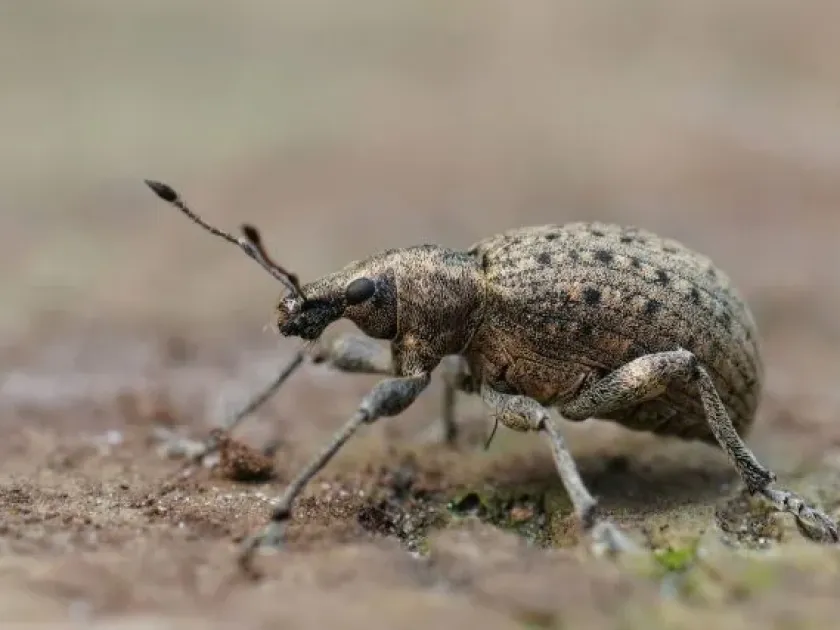
The pine bud weevil (Anthonomus varians) is a small beetle belonging to the order Coleoptera and the Curculionidae family. Adults are typically 3–4 mm long and possess a distinct elongated rostrum.
Their coloration ranges from dark brown to black, often featuring reddish nuances. The surface of their elytra is covered in dense hairs, creating a mottled pattern that provides excellent camouflage against tree bark.
The larvae are legless, C-shaped grubs, white or yellowish with a characteristic brown head capsule. They develop exclusively within the buds of host plants, remaining concealed throughout their growth.
Pupation also occurs inside the damaged buds. The species typically has a univoltine life cycle, meaning one generation per year, with adults overwintering in ground litter or bark crevices.
This species is widely distributed across Eurasian coniferous forests, specifically targeting young pine stands where environmental conditions favor larval development.
What it damages
The primary host for Anthonomus varians is the Scots pine (Pinus sylvestris). Both adults and larvae utilize the tree for food throughout the growing season.
Adults feed on needles and buds, creating small feeding punctures. While adults cause some defoliation, the most severe damage is caused by the larvae feeding inside the buds.
Larval feeding destroys the apical meristem and the embryonic needle primordia, effectively preventing the development of the shoot for the current year.
Repeated attacks on the terminal buds cause stunted growth, crown deformation, and sometimes the development of a bushy appearance due to the loss of apical dominance.
In nurseries and young plantations, such damage significantly impacts the growth rate and structural integrity of the trees, leading to economic losses.
When it appears
Overwintered adults emerge in early spring as soon as temperatures rise, usually when the pine buds begin to swell and sap flow increases.
Adults engage in a period of maturation feeding before mating and oviposition. Females deposit their eggs directly into the developing buds.
The larval stage coincides with the rapid growth of the pine shoots in spring and early summer, allowing the larvae to consume the soft interior tissues of the bud.
Pupation occurs by mid-summer, and the new generation of adults emerges in late summer. These adults continue to feed on needles before finding overwintering sites.
The timing of the life cycle is strictly regulated by the phenological stages of the host tree, making the bud development phase critical for the pest.
Signs of infestation
The earliest signs of infestation are small puncture marks on the surface of young buds, often accompanied by resin droplets oozing from the holes.
Spring yellowing or drying of the terminal buds is a classic symptom. These buds often snap off easily, revealing the larval tunnels and frass inside.
Internal examination of a damaged bud typically reveals granular, brown excrement produced by the larvae, along with the larva itself or a pupal chamber.
Visual deformity of the shoot, such as curling or terminal dieback, serves as a retrospective indicator of previous season activity.
Thinning of the foliage on young branches during the adult feeding period can indicate a localized population outbreak.
Control measures
Chemical control involving systemic or contact insecticides is most effective when applied during the early spring emergence period before eggs are laid.
Silvicultural methods include ensuring healthy growing conditions for young stands to increase their vigor and resilience against pest attacks.
Sanitation measures, such as the pruning and destruction of infested buds during the larval stage, can effectively reduce local population densities.
Encouraging biodiversity in pine stands by protecting natural predators and parasitoids provides a long-term strategy for biological control.
- Application of insecticides during bud swell.
- Physical removal and destruction of infested shoots.
- Monitoring populations using visual tree inspections.
- Promoting habitats for insectivorous birds and beneficial wasps.
Taxonomy
- Latin name
- Anthonomus varians
- Order
- Coleoptera (beetles)
- Family
- Curculionidae
- EPPO code
- ANTHVA
Discussion
No discussions yet — be the first.