
Pear bud weevil
Anthonomus bituberculatus
Description
How to identify
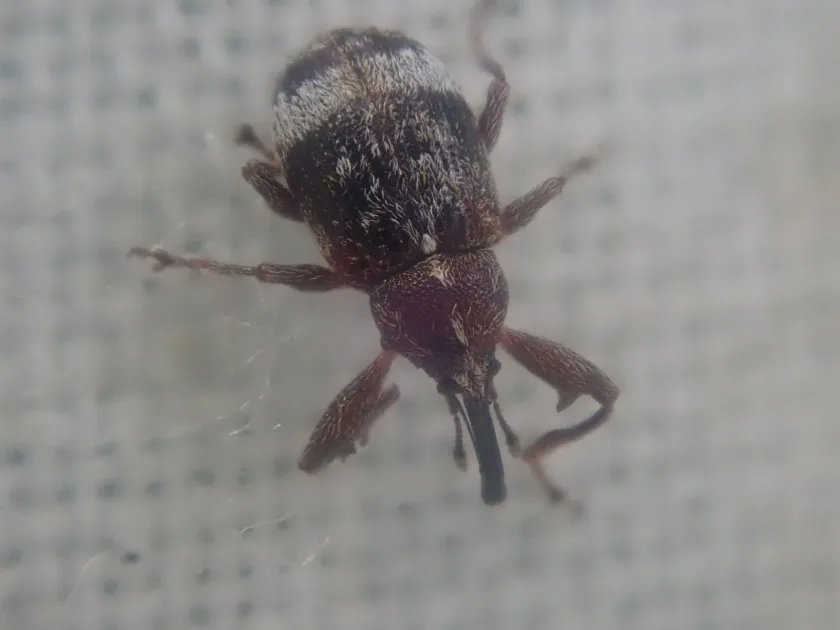
The pear bud weevil (Anthonomus bituberculatus) belongs to the order Coleoptera and the family Curculionidae. This species is characterized by a specific morphology that distinguishes it from other closely related weevil species.
The adult insect has an elongated snout and a body covered with fine scales, which often provide excellent camouflage on the bark or leaves of host plants. The common name comes from two distinct tubercles on the elytra, which are a key identification feature.
The life cycle follows complete metamorphosis, passing through egg, larva, pupa, and adult stages. Larvae are typically legless, white to yellowish in color, and specialized for feeding inside plant tissues.
Adult weevils are active during the growing season and possess wings, allowing them to move between trees in search of food and suitable sites for oviposition. They often remain still or drop to the ground when disturbed.
For identification in orchards, agronomists rely on visual inspection of flower buds in the early spring, as well as using beating trays to dislodge insects from branches for counting and identification.
What it damages
This pest primarily attacks fruit trees of the Rosaceae family, with a significant preference for pears and apples. Adult weevils feed on swelling buds, boring deep holes that cause the buds to wither and die before they can bloom.
Larval feeding causes the most severe damage as they develop inside flower buds or young fruitlets. This feeding process prevents the buds from opening, causing them to dry out and fall prematurely, which directly impacts the harvest.
Mechanical damage caused by feeding creates entry points for various pathogens, including fungi and bacteria, which can lead to further decay and decline in the overall health of the fruit tree.
The severity of the damage depends on the population density of the weevil. In orchards with poor management, infestations can lead to substantial yield losses, potentially rendering the harvest non-viable.
Besides immediate crop loss, the feeding damage to young shoots can negatively affect the vegetative growth of trees, which is particularly detrimental to young orchards and nursery production.
When it appears
Emergence from overwintering sites typically begins in early spring, triggered by rising temperatures and the onset of sap flow in trees. Overwintering occurs in bark crevices, leaf litter, or the upper soil layer.
Peak activity corresponds with the bud-swelling and leaf-burst stages of the host plants. During this time, adults are actively feeding and mating, and females begin laying eggs inside the buds or young fruit tissues.
The larval stage is relatively brief, coinciding with the flowering and fruit-setting period. Pupation typically occurs within the damaged buds or just below them, where the larvae have completed their development.
A new generation of adults emerges in the summer, though their activity levels may be lower than those of the overwintering generation. As temperatures drop in autumn, they move to their hibernation sites.
Successful management requires precise timing of monitoring and intervention, specifically during the critical phenological stages from early spring leaf burst until the petal-fall stage of the fruit trees.
Control measures
Cultural control measures are foundational and include cleaning tree trunks of loose, old bark and removing fallen leaves from the orchard floor to eliminate prime overwintering sites for the weevils.
Chemical control involves the application of registered insecticides during the pre-bloom stage. It is crucial to select products that minimize impact on beneficial insects and pollinators while controlling the target pest.
The use of sticky bands or trunk barriers provides an effective non-chemical way to restrict the movement of adult weevils from the soil to the tree canopy, especially in small-scale or organic orchards.
Biological control options, such as the use of entomopathogenic fungi or nematodes, can be effective under appropriate environmental conditions, helping to reduce the overall pest population in a sustainable manner.
- Regular monitoring using pheromone or visual traps.
- Application of insecticides based on economic thresholds.
- Sanitary pruning to remove infested buds.
- Promoting the presence of natural predators in the orchard ecosystem.
Taxonomy
- Latin name
- Anthonomus bituberculatus
- Order
- Coleoptera (beetles)
- Family
- Curculionidae
- EPPO code
- ANTHTU
Discussion
No discussions yet — be the first.