
Strawberry blossom weevil
Anthonomus bisignifer
Description
How to identify
The strawberry blossom weevil (Anthonomus bisignifer) is a small beetle belonging to the Curculionidae family. These insects are characterized by a long, slender snout, which they use for feeding and depositing eggs into plant tissues.
Adult beetles typically measure 3–4 mm in length. Their bodies are covered in fine, dense hairs, usually in shades of gray or brown, providing excellent camouflage against soil and plant debris during the early spring season.
The larvae are legless, curved grubs with a distinct brown head. Because they reside entirely inside the flower buds throughout their development, they are shielded from environmental stressors and most contact-based pesticides.
Adults overwinter in the soil or under leaf litter. Once spring temperatures reach approximately 12°C, the beetles emerge from hibernation to begin feeding on young leaves and preparing for their reproductive cycle.
The species shows a high degree of host specificity, primarily targeting plants within the Rosaceae family. Understanding this biological preference is key to identifying potential risk areas on a farm or garden plot.
What it damages
The strawberry blossom weevil is a significant pest of cultivated strawberries and raspberries. Both the adult beetles and the larvae cause damage, though the latter is responsible for the most severe yield losses.
Adults consume plant tissue, creating tiny, pin-prick holes in leaves and developing buds. While this weakens the plant, the most critical damage occurs when the female lays eggs inside the buds and severs the pedicel.
This behavior leads to the wilting and eventual dropping of the flower buds. In severe infestations, a grower can lose more than 50% of the total strawberry yield if effective control measures are not implemented.
Since the pest targets the reproductive structures of the plant, the impact on production is immediate and irreversible for the affected buds. This results in significant economic hardship for commercial berry producers.
Furthermore, the presence of damaged, decaying buds within the canopy can encourage the development of secondary fungal diseases, further compromising the health of the remaining berries.
When it appears
The activity of the strawberry blossom weevil begins in early spring, typically between April and May, depending on the climatic zone. This coincides precisely with the bud development stage of strawberries.
The cycle of egg-laying continues throughout the entire budding period. This staggered timing ensures that the pest population remains active on the crop for several weeks, demanding sustained monitoring by the grower.
Larval development inside the bud lasts between two to four weeks. After the larval stage is complete, pupation occurs within the withered bud, followed by the emergence of the new adult generation.
New adults emerge in the summer and engage in supplemental feeding. They consume the foliage and remaining fruit, storing energy reserves necessary to survive the upcoming winter months.
By late summer or early autumn, the beetles enter a state of diapause. They seek protected environments, such as deep soil crevices or dense mulch, to remain dormant until the next spring cycle begins.
Signs of infestation
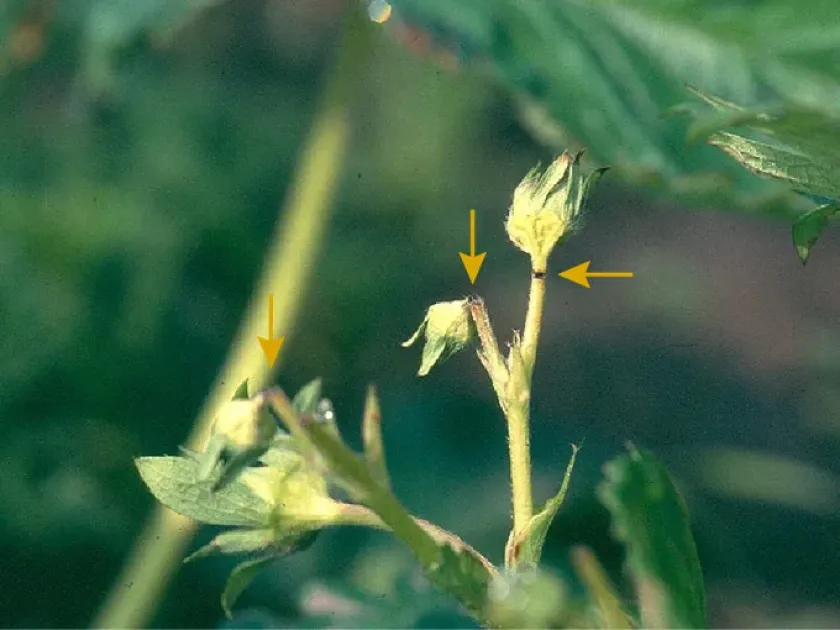
The most diagnostic sign of a weevil infestation is the presence of drooping or withered flower buds dangling from partially severed stalks. This is the direct result of the female's egg-laying behavior.
Close inspection of the buds will reveal small, clean puncture holes made by the beetle's snout. If a damaged bud is opened, the white larva or pupa is usually visible inside.
Small, irregular holes in the young leaves are another indicator of adult feeding activity. These signs often appear well before the flower buds are fully exposed, signaling the need for intervention.
In addition to visual signs, growers may observe a sharp decline in the number of fruits forming, despite healthy-looking plants. This mismatch between vegetative growth and fruit set often points to weevil damage.
- Wilting or "hanging" flower buds.
- Severed flower stalks.
- Small, pin-prick holes on foliage.
- Evidence of feeding in unopened buds.
- Early season reduction in fruit set.
Control measures
Cultural control is the first line of defense. Keeping the area free of debris and weeds, especially those related to the Rosaceae family, helps reduce the available overwintering sites for the beetles.
Manual removal is effective for small-scale gardens. Shaking the plants over a tray or cloth during the cool morning hours, when beetles are sluggish, can significantly reduce the local population.
Biological control agents, including entomopathogenic fungi or specialized bacterial products, can be applied early in the season to manage the population before it reaches the egg-laying phase.
Chemical intervention should be restricted to the pre-flowering stage. Using contact or systemic insecticides prior to the opening of the first blossoms is crucial to protect the crop while preserving pollinators.
Sustainable pest management requires rotating chemicals to prevent resistance and integrating monitoring techniques, such as pheromone traps or systematic field scouting, to make informed treatment decisions.
Taxonomy
- Latin name
- Anthonomus bisignifer
- Order
- Coleoptera (beetles)
- Family
- Curculionidae
- EPPO code
- ANTHBI
Discussion
No discussions yet — be the first.