
Almond weevil
Anthonomus amygdali
Description
How to identify
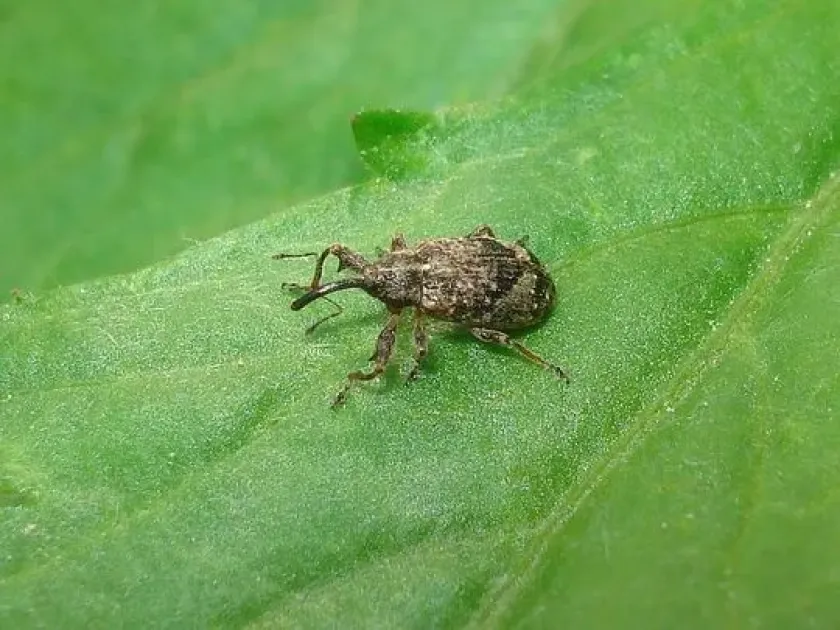
The almond weevil (Anthonomus amygdali) is a small beetle belonging to the Curculionidae family. Adult beetles typically reach sizes of 3 to 4 millimeters in length.
Their bodies are oval-shaped and covered with dense, grayish-brown scales that provide excellent camouflage against the bark of almond trees.
A prominent feature of this pest is its elongated rostrum (snout), which is typical for weevils and is used for feeding and preparing sites for egg-laying.
The larvae are legless, C-shaped grubs with a pale, white body and a distinct brown head capsule, specialized for internal development within plant tissues.
These insects are highly elusive, often remaining motionless or dropping to the ground when disturbed, which makes detection challenging during the daytime.
What it damages
The almond tree (Prunus dulcis) is the primary host for this species, though it can occasionally infest other stone fruits like peaches or plums if almond trees are absent.
The most significant damage is caused by the larvae, which burrow into the flower buds and consume the floral parts from the inside out.
Infested buds fail to bloom properly, often turning brown and shriveling on the branch, resulting in a direct reduction of the annual nut yield.
Adults also contribute to damage by feeding on young leaves, buds, and shoots, causing small puncture wounds that may lead to secondary fungal infections.
Severe infestations can lead to a significant decline in tree health and overall orchard productivity due to the loss of reproductive potential.
When it appears
The life cycle of the almond weevil is closely synchronized with the phenological development of the almond tree, specifically the bud-breaking phase.
Adults emerge from their hibernation sites early in the spring as soon as temperatures rise, seeking out young buds to feed and mate.
After mating, females drill small holes into the developing buds and insert their eggs inside, ensuring the larvae have immediate access to nutrients upon hatching.
The larval stage lasts for several weeks, during which they grow and consume the interior of the bud, eventually forming a pupal chamber within the remains.
The new generation of adults usually emerges toward the end of the flowering period, after which they may feed briefly before seeking sheltered locations for the summer.
Signs of infestation
Early symptoms include tiny, superficial feeding punctures on the scales of the swelling buds, which may exude small droplets of plant sap.
As the larvae mature, the damaged buds fail to open and instead become necrotic, turning brown or black, which is a classic indicator of weevil presence.
Dissecting the withered buds usually reveals the presence of a white larva or a pupa, surrounded by frass (larval waste) inside the hollowed-out bud.
Reduced fruit set in the spring is often the first economic sign noticed by growers, frequently appearing as premature drop of tiny, undeveloped fruitlets.
- Buds shriveling and turning brown before opening.
- Small, circular holes found on young leaves.
- Premature fruit drop of immature nuts.
- Detection of adults on branches during evening inspections.
Control measures
Sanitation practices such as clearing away debris and fallen leaves around the base of the trees are essential to reduce overwintering sites for the beetles.
Shaking the trees onto a collection sheet early in the morning when the insects are less active is a viable method for small orchards to reduce population density.
Chemical control is most effective when applied at the "green tip" stage of the tree, targeting adults before they lay eggs within the buds.
Systemic insecticides are often preferred as they provide residual protection for the developing buds, preventing larvae from becoming established.
Integrated Pest Management (IPM) programs encourage the preservation of natural predators and parasitoids that help maintain weevil populations below the economic threshold.
Taxonomy
- Latin name
- Anthonomus amygdali
- Order
- Coleoptera (beetles)
- Family
- Curculionidae
- EPPO code
- ANTHAM
Discussion
No discussions yet — be the first.