
Say's ambrosia beetle
Anisandrus sayi
Description
How to identify
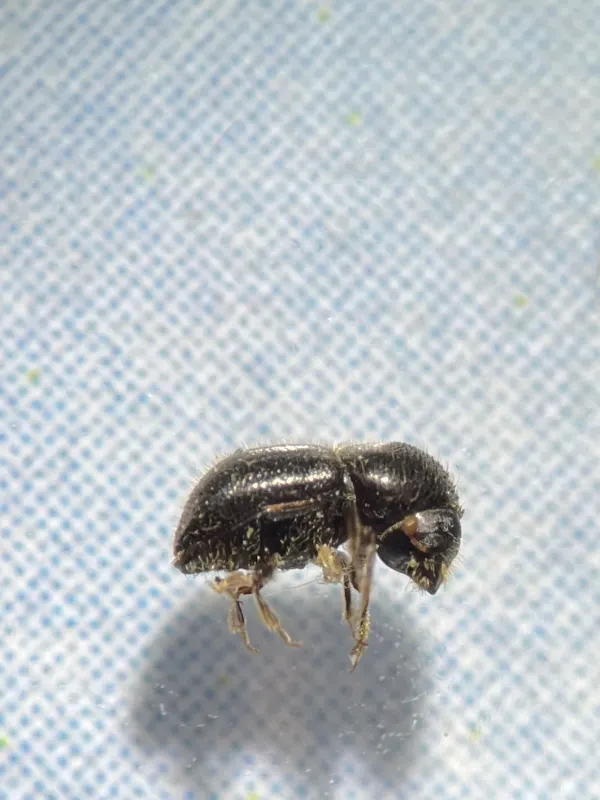
Say's ambrosia beetle (Anisandrus sayi) is a small beetle belonging to the subfamily Scolytinae (bark and ambrosia beetles), within the family Curculionidae. Adult beetles have a cylindrical body measuring approximately 2.5–3.5 mm, typically dark brown or black in color.
The defining characteristic of this species is its obligate symbiotic relationship with ambrosia fungi, which the beetles carry in specialized internal structures called mycangia. These fungi serve as the primary food source for both larvae and adults.
Males and females exhibit significant sexual dimorphism, common in the tribe Xyleborini. Females are larger than males and are specialized for boring tunnels into the wood of host trees.
These beetles lead a concealed lifestyle, preferring moist and weakened wood. Their activity is concentrated in the sapwood, where they construct complex, branching gallery systems for brood rearing.
Correct identification often requires close inspection with a hand lens or microscope, as the species can be easily confused with other wood-boring insects.
What it damages
This pest primarily attacks deciduous trees, including oak, beech, maple, walnut, and sometimes fruit trees. Trees experiencing stress from drought, diseases, or physical damage are the most susceptible.
Damage occurs when females bore into the trunk to establish maternal galleries. Inside these tunnels, females lay eggs, and the developing larvae feed on the fungus cultivated by their parents.
The destruction of the tree's vascular system disrupts the transport of water and nutrients, which ultimately leads to branch dieback or the death of the entire tree.
Mass outbreaks of this beetle in forests or orchards can lead to rapid degradation of tree stands over the course of several seasons.
The presence of the beetles and the associated fungal infections further weaken the tree's immune response, accelerating the decline and eventual mortality.
When it appears
Peak activity for Say's ambrosia beetle typically occurs in the spring, when overwintering adults emerge to seek out new host trees for colonization.
During the warm season, the beetle can complete multiple generations, provided that climatic conditions favor a rapid life cycle development.
The most intensive colonization of trees is observed during periods of prolonged drought, when the trees' natural defense mechanisms, such as sap flow, are compromised.
As autumn approaches, adult activity gradually declines, and the beetles prepare for overwintering inside the galleries within the wood or in the leaf litter at the base of the tree.
Temperature plays a crucial role in population dynamics: mild winters allow a higher number of adults to survive, leading to population spikes in the following spring.
Signs of infestation
The first and most obvious sign of an infestation is the presence of small entry holes in the bark, often surrounded by accumulations of fine sawdust or "frass".
Tree sap may leak from these holes, leaving dark streaks on the bark, which is particularly visible on trees with smooth bark surfaces.
The tree canopy may show premature yellowing or wilting of leaves, symptoms often confused with drought stress or nutrient deficiencies.
When a small section of bark is removed near an entry point, characteristic radial or longitudinal tunnels can be observed, with walls stained dark due to the fungal growth.
- Accumulation of fine sawdust at the base of the trunk.
- Dieback of individual scaffold branches.
- Numerous small, circular entry holes in the bark.
- Loss of leaf turgor and premature leaf drop.
Control measures
The primary management strategy involves maintaining high horticultural standards: adequate irrigation, fertilization, and protecting trees from environmental stress factors.
Regular sanitary pruning of infested branches and the removal of dead trees are essential to prevent them from becoming breeding hubs for the beetle population.
If an infestation is detected at an early stage, systemic insecticides may be applied via trunk injections or thorough bark sprays to manage the population.
The use of pheromone traps allows for monitoring beetle population trends, enabling timely interventions before mass colonization occurs.
Biological control agents, such as entomopathogenic fungi or bacteria, can be integrated into broader plant protection programs to suppress beetle activity naturally.
Taxonomy
- Latin name
- Anisandrus sayi
- Order
- Coleoptera (beetles)
- Family
- Curculionidae
- EPPO code
- ANIDSA
Discussion
No discussions yet — be the first.