
Shot-hole borer
Anisandrus dispar
Description
How to identify
The shot-hole borer (Anisandrus dispar) is a member of the Curculionidae family, specifically the Scolytinae subfamily. It is a small wood-boring beetle known for its significant sexual dimorphism.
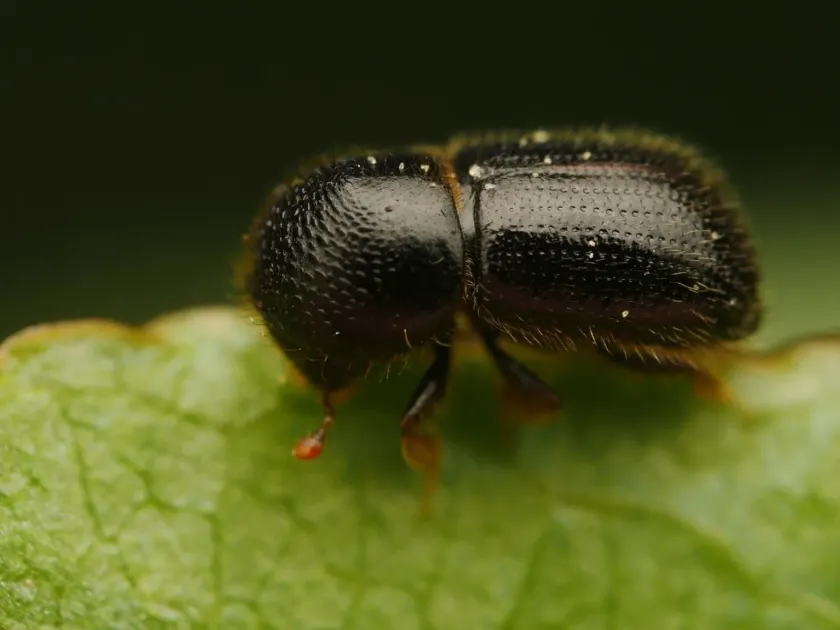
Females are approximately 3–3.5 mm long, black, and cylindrical in shape, making them highly efficient at drilling galleries into host tree wood.
Males are much smaller, reaching only about 2 mm, and are brownish and flightless. They typically spend their entire life cycle inside the galleries created by the females.
As an ambrosia beetle, this species does not consume wood fibers. Instead, it maintains a symbiotic relationship with fungi that grow on the walls of its galleries, providing essential nutrients for the larvae.
The larvae are white, legless, and grub-like. Unlike other bark beetles, they live in communal galleries, where they graze on the fungal mats grown by the adult female.
What it damages
The pest has a wide host range, attacking various fruit trees such as apple, pear, plum, cherry, and peach. It also infests many deciduous forest trees found near orchards.
Trees that are already weakened by environmental stresses, such as drought, frost, or poor soil nutrition, are significantly more susceptible to infestation than healthy trees.
The damage is primarily caused by the tunneling activity, which disrupts the tree’s xylem and phloem, preventing the flow of water and nutrients throughout the branches.
The introduction of ambrosia fungi into the tunnels can lead to systemic wood rot, causing the tree to lose structural integrity and eventually die if the infestation is severe.
In young trees, even a small number of entry holes can girdle the stem or main branches, causing sudden wilting and permanent damage to the plant's development.
When it appears
The adult females emerge from their overwintering sites in early spring, typically when temperatures rise above 12–15 degrees Celsius, coinciding with bud break.
During the spring, females seek out suitable hosts, bore into the bark, and begin excavating galleries. They introduce fungal spores into these chambers to begin the cultivation process.
The life cycle from egg to adult takes approximately two to three months, depending on regional temperatures. A partial second generation can occur during hot, extended summers.
Larval development is most active during the early to mid-summer period. During this time, the larvae feed exclusively on the ambrosia fungus inside the wood galleries.
By late summer, new adults emerge or remain within the galleries to overwinter. Females are the primary survivors, waiting for the following spring to restart the cycle.
Signs of infestation
Small, circular entrance holes, roughly 1.5–2 mm in diameter, on the surface of the trunk or branches are the first indicators of a shot-hole borer presence.
Frass (fine sawdust) accumulating around the base of the tree or directly below the entrance holes is a definitive sign of active tunneling by the beetles.
Yellowing, wilting, and premature leaf drop on specific limbs indicate a compromised vascular system caused by internal gallery construction and fungal infection.
In some cases, tree sap or gum may exude from the entry points, which serves as a defensive response against the intruders trying to establish galleries.
When cutting into suspicious branches, one can observe dark or black-stained tunnels inside the wood, resulting from the presence of the symbiotic fungal growth.
Control measures
The most effective strategy is proactive orchard management. Maintaining tree vigor through proper irrigation, fertilization, and site maintenance minimizes susceptibility.
Sanitation is critical; all infested branches and dead wood should be pruned and immediately destroyed, preferably by burning, to eliminate the pest's overwintering habitat.
While chemical control is difficult once the beetles are inside, systemic insecticides applied during the peak spring emergence can help reduce new infestations.
Monitoring using pheromone traps is highly recommended to detect the arrival of the beetles early, allowing for more precise timing of any necessary defensive sprays.
Protective coatings, such as white tree paint or kaolin clay sprays, may help deter females from landing and initiating boring activities on the bark surface.
Taxonomy
- Latin name
- Anisandrus dispar
- Order
- Coleoptera (beetles)
- Family
- Curculionidae
- EPPO code
- XYLBDI
Discussion
No discussions yet — be the first.